I strongly recommend that you watch (or listen) to this Triangulation interview with technologist Bill Atkinson. Leo Laporte does a great job interviewing Bill covering topics ranging from HyperCard, coding and authentic learning to Atkinson’s use of LSD.
Atkinson has long been a personal hero. I admit that I still miss HyperCard and credit this software for getting me into coding and authoring opportunities for students of all ages. Atkinson’s comments on the end of HyperCard and what he recommends as a replacement may be of interest to educators promoting student authoring. Brilliant insights based on his life experiences which remarkably predate the position of my present educational leaders. His way of describing these ideas seems more useful than most I encounter. These ideas were what initiated my own thinking about authoring to learn.
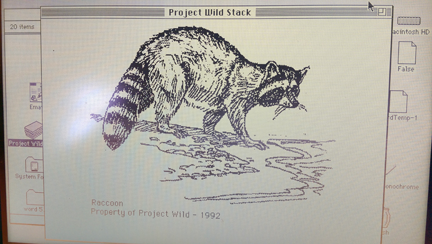
Sample from my NDWild clipart project (distributed as a Hypercard stack).
I want to get the new version of our Amazon Kindle book out so we can compete with the book reps promoting similar books with college faculty members. We write a textbook but it appears Amazon tends to sell our book to individuals. This presents an issue for us – writing a trade book is different from writing for a group-based instructional setting. When you write a textbook that tends to be purchased by individuals looking for a trade book, there is a mismatch that can’t be good.
I can’t compete with the book reps who go door to door except by offering a comparable resource at a fraction of the cost to the end user. I make this statement based on sales when we generated a product sold through a book company versus sales and the pattern of purchases when selling through Amazon. Pretty much the same book (even without the resources we now add online). So having the new book available during adoption time is about all I can think to adjust. I am always looking for suggestions.
At this point, I am being held up waiting for the new ISTE standards for students. I know the new standards are coming and I have reviewed a draft. However, I do not want to write something when what I describe may not be the final product. My guess is that ISTE will release the upgrade during the ISTE conference in several months. I am still trying to decide if it is worth waiting or indicating in the Kindle book that a release is coming soon,
I will add this issue to the various other issues I have with standards.
My issues with standards:
Standards themselves are pretty much a Rorschach test; the goals are vague enough that far too many things “could” be promoted as examples. Note that curriculum developers are sometimes expected to tag the activities they propose with the standard or standards that are addressed by the activities they have created. This tagging does establish an awareness of the standards which is probably a good thing, but the appropriateness of the standard to activity connection is seldom evaluated.
To be fair, standards are typically supported (if you are willing to explore a bit) by “examples” proposed by those generating the standards. The challenge here is one of translation. Educators in a variety of disciplines with specific goals in mind seldom find a perfect fit for their personal situations.
Standards seem to be trendy. They seem to support the priorities of the present crop of true believers who are motivated to participate on the committee writing the standards. The process of generating and releasing standards takes a considerable amount of time so it is a real commitment to see the process through. For example, the present NET*S has taken 7+ years to rework. I would ask for an addition to the product being generated. What is the body of research evidence supporting the various priorities/positions that are advanced? For those of us who care, this is a way to understand and sometimes challenge what has been proposed.
I often wonder if it would be more influential to promote the standards or to promote the evaluations that will be expected? I ask this as a matter of practicality and not as an endorsement of either extreme. If student performance is to be evaluated in any way that is external to evaluation experiences generated by the teacher, it is obvious that these evaluations influence what precedes them. Translate this as teaching to the test if I am being too vague. It seems we have moved past evaluating the “value added” performance of educators in most settings, but no administrator or instructor wants to view a low average performance from students. The issue here is often called “alignment” – does what is evaluated match what is proposed by the standards. I also expect that content area standards and performance evaluations are likely to more closely aligned than are more general standards (i.e., NET*S).
Will we be describing the NET*S standards in our writing? Of course we will. This really does not mean we are wishy-washy (is that the expression) or flip-floppers (I think this is still a political expression). What we are trying to do is develop a quality textbook. One of the keys in argumentation is being careful to understand issues as they are understood by those who advocate them. This is part of critical thinking and as a textbook author, it is essential to recognize that is not always about my critical thinking. It is mostly about the critical thinking I can generate in those who read my work. Presenting a simplified version of a complex topic does not promote the necessary depth of thought. My readers are exposed to standards whether I think they have practical value or not.
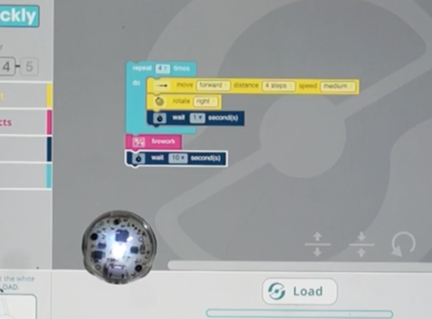
I have been working on our chapter on computational thinking. I have been exploring the ways the Ozobot can be programmed. The robot can be controlled with color codes embedded on a line the robot follows and using the Blockly coding system.
I created a video if you would like to see how coding with Blockly works.
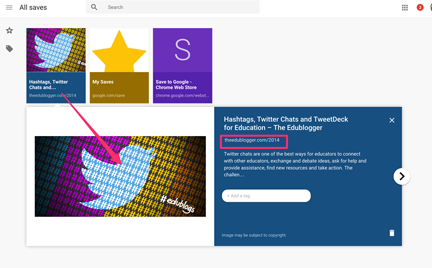
Clicking this icon will add a representation of the page being viewed to Google Save (see below).
Entries can be tagged for more efficient search. Selecting the saved representation of a site produces a larger display with additional information. Selecting the site URL takes you to that site.
Saving images a little differently. Images are available from https://images.google.com. Searching this site brings up images associated with the search term and selecting one image produces the following display. This display now includes a button that will save the image to Google Save (beware copyright issues in using the images).
I do not consider the present version of Google Save to be equal to the features of my present tools, but the service is free and would seem helpful when collecting resources for a project. Improvements would be required for me to consider the service as a way to collect resources long term.
What is the future of education? I am convinced that the future might best be described as individualization. Individualization is a way to understand other recent popular tactics. For example, interest in ‘genius hour”, “20% projects”, or some other way of carving out some school time for learner selected passion projects is a form of individualization. This tactic has generated a lot of recent interest in the K-12 community, but I would suggest has long been a staple in higher education – senior projects, honors programs, special topics and readings courses. I took advantage of all of these opportunities in my own undergraduate training and I have engaged with some students facilitating such projects as a faculty member. Frankly, I have been mystified by the general lack of interest among most college students in taking advantage of these opportunities. It is evidently just easier to follow the standard curriculum and meet graduation requirements by taking elective courses than exercising the flexibility students are allowed. I think students are missing out.
What other forms of individualization are being promoted? Differentiation is a popular concept. Like individualization I think differentiation could imply multiple ways of meeting several types of student needs. I prefer the term individualization because I have a longer history using this term and I often become annoyed when it seems a discovery pretty much amounts to using a new term for an older idea that has faded from familiarity. I mention “differentiation” to support my argument that meeting individual needs is a sensed need in education.
There is a long standing interest in learning styles or the notion that learners learn in different ways. This is a messy idea that is for the most part been rejected by researchers. However, it is an idea that is hard to operationalize and difficult to kill. I accept that each of us may prefer different learning experiences, but this is not the same as a position that different learning experiences are really best for categories of learners identified by some common attribute. If we could, would we allow different groups of learners to meet similar goals in different ways? In the grand scheme of things, I do not see this as a high priority or cost-effective, but I try to remain open to counter-arguments.
I have yet to identify the form of individualization I think should be more seriously considered in K-12. It is the change I think could make the biggest difference and yet is ignored because educators and/or educational institutions are reluctant to make basic changes that would be required. I think the most important type of individualization we could address is learning speed which also might be thought of as the pace of instruction. A common pace of instruction for all guarantees that some learners will be bored by a lack of challenge and others hopelessly lost because new content is presented before they are prepared. Personal tutors and technology allow approaches for providing this form of individualization. Only the wealthy can afford the tutors.
I have come to the conclusion that most see technology in ways that amount to nibbling around the edges. The ideas are interesting and worthy of implementation, but ignore the most important need. Allow some time to pursue personal interests. Encourage those so inclined to code or build robots. Engage students in some collaborative problem-solving tasks that involve critical thinking and are set within an authentic context encouraging a sense of meaningful contribution. Do these things. However, also recognize that we expect schools to develop in as many learners as possible certain core skills and core knowledge and that these expectations are to be accomplished with limited resources. Technology offers ways to allow students to take on these challenges as individuals by differentiating pacing and by identifying the specific difficulties each learner is facing. Technology-based systems that do these things are not replacements for teachers, they are ways to apply teacher time and talents to the specific needs of individual learners.
Cindy and I have a professional relationship that allows us to develop K-12 classroom ideas for technology integration. We approach our goals through a collaboration that allows each of us to take different approaches. This works well as long as the approaches are complimentary. Back in the day when “cooperative learning” was an “in thing”, this was called a jigsaw model. I have provided a link in case this trend had its day before your time. Cindy learns by doing and I learn by thinking (sometimes out loud). This means I do most of the writing.
Here is a recent exploration into the potential of “mini programmable robots”. We picked up an Ozobot at a recent conference and have spent just enough time with it since to understand some of the basics. An Ozobot is small – about the size of golf ball. It can be programmed in several different ways. One approach feeds instructions to the mobile bot through color codes imposed on the line that it is following. Different color patches on the line tell it to speed up, slow down, etc. Now the demos for this are suited to the size of the Ozobot – i.e., small. It might be asked to follow a pattern on the surface of an iPad.
What if instead of duplicating the typical small scale projects the company offers as examples you decide to apply a few basic principles to a project of your own design. What if instead of the surface of an iPad or a sheet of paper, you decide to build a lego city in your basement and allow the Ozobot to explore the city.
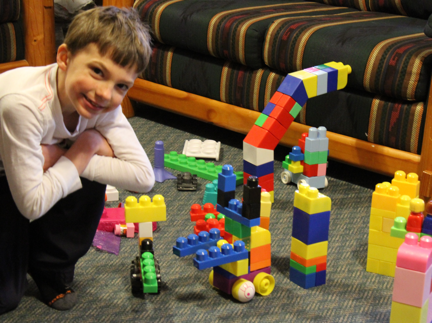
Cindy had a collaborator in this project. Some of our grandchildren were visiting and Preston likes “science” and legos. It turns out the kids think on a different scale than rational adults. None of this start small and then build up kind of thing.
I must say I would have started with the robot and figured it out first, but Preston wanted to build the city first.
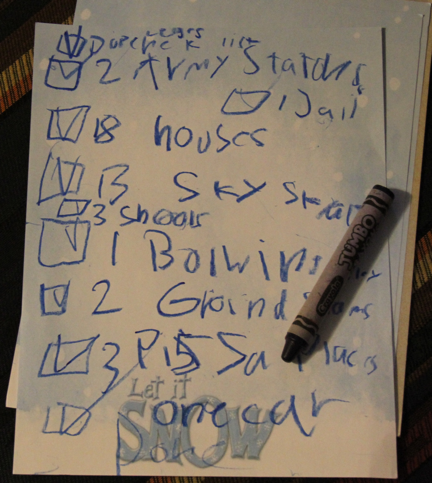
There was a plan (if you can read it). The plan specifies the structures to be included in the lego city.
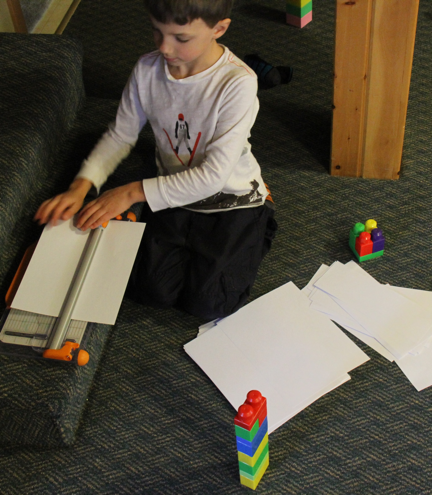
Now, it was time to construct the road (track). The idea was to cut sheets of paper in half and then tape them together.
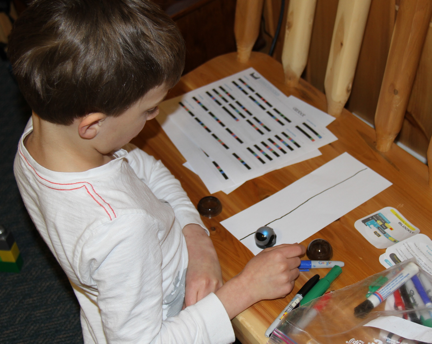
Here is the closest thing to a test of concept. You can see the sheet to the left that explains the different color codes. We did learn that the width of the line is important. If the line is too narrow, the bot just stops.
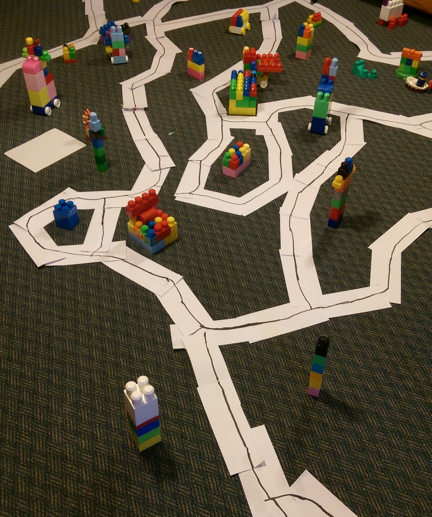
Here you see the robot on part of the road. One unanticipated problem concerned the method for joining the paper strips. When taping the pieces together, one sheet must overlap the other. It turns out it takes very little to stop the small robot. If it runs into the end of the next strip it stalls. This is not an issue as long as the direction of travel moves from the overlapping piece of track to the underlapping (is this a word) piece of track. Now if the track moves in a circle you soon figure this out and all would be well. However, if you decide to have the robot come to a turn in the road (and take the path less traveled) the problem of having all of the road moving in a predictable direction became an issue. The finished product contained several “bugs”, but like some software I have used it worked most of the time.
My mom had this expression she applied to me when I was allowed to dish up my own food when kids were allowed to make such decisions at a pot luck or some other event. She would say – “see, your eyes are bigger than your stomach”. I wish this was still the case. Anyway, this project was far larger than it should have been for a learner of Preston’s age. We spent hours and hours over two days taping slips of paper together and then retaping sections when we understood that adjoining pieces of paper had to be connected in a certain way or when little sister walked through the lego village dragging her feet and messing up the road. Once constructed, there was probably far less interest in exploring and debugging than probably would have been the case should the adults involved have excercised more control over the scope of the project.
One of the issues I think is important when it comes to project based learning is the efficiency of the project. When should an educator “scaffold” a project to increase efficiency? How much independence should learners be given and what are the benefits and costs of frustration and failure? These seem to be current educational issues and I could see these issues play out as I spent several hours cutting 3 inch sections of tape for the workers to use in the construction process.
Lately, this blog has been less active than usual. I don’t want folks to give up on my posts because of this inactivity so I thought I would explain myself. I am writing as much or maybe even more than usual, but I am spending most of this time updating our Kindle textbook. Academics typically make their selections for the new academic year (Fall, 2016) late in the Spring. This means if you want your most current work to be considered, the new content must be available by then. Doing the background work and then the writing to meet this deadline has kept my pretty busy. I can wait until the summer to make adjustments to our book related online content.
Doing the background work and then the writing to meet this deadline has kept my pretty busy. I can wait until the summer to make adjustments to the online content that extends our book in keeping with the goal of using the online resources to provide the most current content possible. For example, the new ISTE standards for students should be finalized about the time of the ISTE conference and these standards should receive considerable attention in an edtech text.
One of my goals in writing a textbook is to try to bring attention to themes we see in the field. The organization of a textbook around major themes is a benefit we believe is missing in unrelated resources that can be used to organize ideas for readers. A topic that has existed in our previous work, but has not been emphasized might be described as the opportunities in using technology to individualize student learning experiences. While we prefer the term “individualize”, others might use “personalize” or perhaps some similar term. I like individualize because I can define what this means to me (no matter how others use it).
Our content is based on a cognitive perspective. Individualization is inherent in cognitive models of learning. No matter what the experiences external to each learner, common experiences or not, the external experiences are processed uniquely by each learning as a function of existing knowledge and experiences and differences in aptitude and motivation. The work of learning cannot by done by anyone else.
Our work already has a heavy focus in problem-solving and problem-based activities. Multiple problems can be offered to learners (individualization) or students can be allowed to take on problems of their own choosing (individualized or 20% time projects). Technology offers so many ways to identify, research, and propose solutions to such problems.
The newest area in which we feel technology has offered significant opportunities for individualization is computer-based instruction. Some might argue we are recognizing a use of technology that has been around even before the age of the personal computer (e.g., Plato). Of course, but the key to our claim is the phrase “significant opportunities”. CAI/CBI was never available to many learners and existed in only a rudimentary form for those who did have access. This has changed with online curriculum (e.g., Kahn Academy).Access to online curriculum seems to generate a strange reaction in so many educators. There seems to be a negative gut reaction that is difficult to understand. Mention of computer and instruction within the same phrase might encourage concerns that technology is replacing teachers or have some vague connection with political-based education issues. It all seems to depend on how you see the possibilities. Teacher as facilitator is consistent with online curricula and so is individual models of student progress.
Access to online curriculum seems to generate a strange reaction in so many educators. There seems to be a negative gut reaction that is difficult to understand. Mention of computer and instruction within the same phrase might encourage concerns that technology is replacing teachers or generate some vague connection with political-based education issues. It all seems to depend on how you see the possibilities. Teacher as facilitator is consistent with online curricula and so are individual models of student progress.
We approach individualizing instruction from a mastery perspective. The Kahn Academy, for example, offers a way to engage students in a mastery approach to learning. My interest in mastery learning as a way to meet individual needs has been a fascination throughout my career. One of my first publications back in the late 1970s and my last publication in 2014 both concerned a mastery approach to individualizing learning. The first, of course, did not involve personal computers.
I guess it is time to get back to work. Blog posts will be generated when possible and I will make an occasional effort to upgrade anyone interested on our progress in finishing our next edition.



You must be logged in to post a comment.