Screentime and neuroscience

I have spend my life attempting to understand and improve human learning through the lens of a cognitive psychologist. Originally trained in biology, I understood that the hypothetical constructs used by those with a cognitive perspective had to somehow translate into the biological perspective of the neuroscientist, but when I investigated what the biological field offered I have found little of practical value. The findings of neuroscience were interesting, but offered me little beyond my existing cognitive perspective when it came to practical matters.

The concept of plasticity offered a difference of some potential. It posits that experience can result in fundamental changes in the human brain at the biological level and as I understand this proposal these changes are relatively permanent. By permanent, I mean it takes some time to modify such changes. I do think this concept has been abused. For example, the proposal in the popular “mindset” book suggests that students be encouraged to move from a fixed to a growth mindset because you can change your brain through continued effort. While my “intro to psych” understanding of plasticity would argue this is theoretically true, the actual investment of effort would be beyond the likely level of commitment of any believer. However, there are situations in which this level of commitment exists. The exposure of most of us including children to technology would meet this level of exposure.

A 2010 Kaiser Foundation study showed that elementary aged children use on average 7.5 hours per day of entertainment technology, 75 percent of these children have TV’s in their bedrooms, and 50 percent of North American homes have the TV on all day.

This is a tremendous amount of time and few of us would change an existing routine at this level.

So, if there is something about this exposure to technology that provides a unique brain experience, it would be an issue of interest and possibly concern.
What might this unique brain experience be? I have heard it described as continuous partial attention. The idea that while engaged in a primary task, we continually divert our attention to a different task. If the brain adjusts to make this attentional flexibility more powerful, as a consequence, the capability for focused attention would be diminished. We would find ourselves more distractable. Tasks requiring sustained attention would become more difficult to perform well.

My description here has been simplified and focuses specifically on attention because I believe this would be the cognitive variable most impacted by extended periods of time encouraging attentional switching. I am trying to setup an  introduction of the proposal in two books by Maryann Wolf – Proust and the Squid and Reader come home: The reading brain in a digital age. Neuroscience and brain plasticity are at the core of the author’s focus on learning to read, the long-term benefits of reading, and the impact of large amounts of screen time on reading.

Among the claims of her books:

Reading is not a cognitive skill our brains are preprogrammed to do. We reprogram our brains in order to read. Learning to read takes advantage of brain plasticity to change the way the brain works at multiple levels. A consequence of this change is not only that we learn to read, but we also become capable of more powerful thinking skills as a consequence of this reprogramming. Reading would be one of those tasks to which we devote a considerable amount of time.

Wolf proposes that heavy use of technology devices may work counter to some forms of brain development encouraged and sustained by reading. This different brain organization encourages a “skimming” approach to reading, difficulty in sustained attention, and possibly a decline in other thinking capabilities that come from and require deep and prolonged focus. Among the skills listed is empathy – the capacity to reflect on how others me see a situation from a perspective that differs from our own.

Concern for activities that compete with focused reading have been noted for as long as I can remember. This concern did not depend on a biological perspective. Don’t have the television on while you study was an admonishment I heard in my day as a student. Certainly, cognitive psychologists have long known the issues of limited capacity short term memory and attention and have understood the impact on the performance of a primary task. The altered brain position of the neuroscientist suggests it is more than that. The limited capacity perspective would suggest the remedy is to remove the secondary task; e.g., don’t talk on the phone while driving. This is not the same as proposing your driving skill has been changed whether or not you have happen to be on the phone. A relativity permanent change in function is what is suggested if the brain does alter the way it functions.

Is reading from paper and reading from the screen of an iPad different? I see this question at two levels – the immediate impact and the brain alteration argument. In both cases, I also try to understand why there would be a difference. I don’t see how the surface on which words appear could matter. I understand that what one can do with the paper and the iPad while reading are different. I have a similar reaction to the question of whether students should be allowed to take notes on a laptop during a lecture or should be required to write in their notebooks. While some may argue the surface on which one works matters, the option of using one surface in multiple ways and not the other seems far more obvious. If you get bored during a lecture, you can use your laptop to check Facebook. You can’t do this with your notebook. Similar options exist while reading on the iPad, but not a book. Just for the record, this would not be the same with a Kindle which pretty much limits you to reading and marking up the content (notes, highlighting) as optional activities.

Wolf suggests we have a different set while reading on a device and I think she is correct. She contends we are used to using devices to switch between tasks. We look something up. We check our email. We see if anyone has posted something to our Facebook timeline. The device whether it has to be or not is associated with frequently changing among tasks. I suppose this is true. The issue I have might be described as does this result in bad habits we carry over into new settings or does this result in an altered brain that nearly forces us into a different way of behaving. Are different habits of acting the same as different capabilities?

I don’t think the research at this point can answer the questions I have. I am willing to acknowledge that bad habits have been introduced. I admit that I do other things when reading on my iPad than when reading a book. Ironically, I read both of Dr. Wolf’s books on my devices (a Kindle and an iPad). I admit I looked up some things while reading. I also took notes and highlighted in a way I can now search from my devices or a different device than I used originally. I am not convinced my supplemental activities were destructive in the short or long term. I suppose my device-based reading activities are different than most, but I would suggest this is a professional habit rather than a difference in how my brain works.

Loading

Collecting geolocation data with the iPhone camera

I have wanted to do this video for a while. The present version of iOS changed how the collection of location data by the iPhone camera is turned on and off. I think that there are many educational uses for being able to position information in space and taking photos is one way to collect the data necessary to do this. Some are concerned about sharing their location along with photos so it is important to know how to turn this capability on and off. I have the process figured again so I thought I would share the process.

Loading

Geolocating your travel blog posts

This post may have a limited audience, but it explains a capability I thought added a great deal to my travel blog. My travel blog has the focus you might expect – I write posts based on the trips my wife and I take.

A travel blog by definition describes experiences at many specific places. The location is part of the context for each post. I use Blogger for this particular blog and after several years of writing posts about traveling, I finally noticed that Google allows the author to associate a location with each post. I am guessing few Blogger bloggers use this feature, but I thought it might be worth exploring.

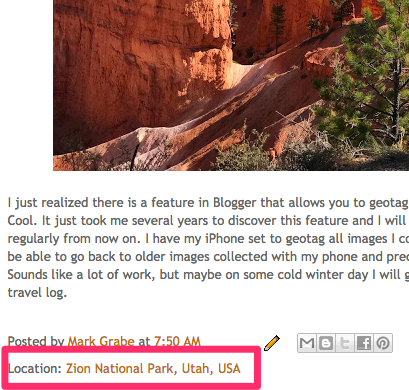
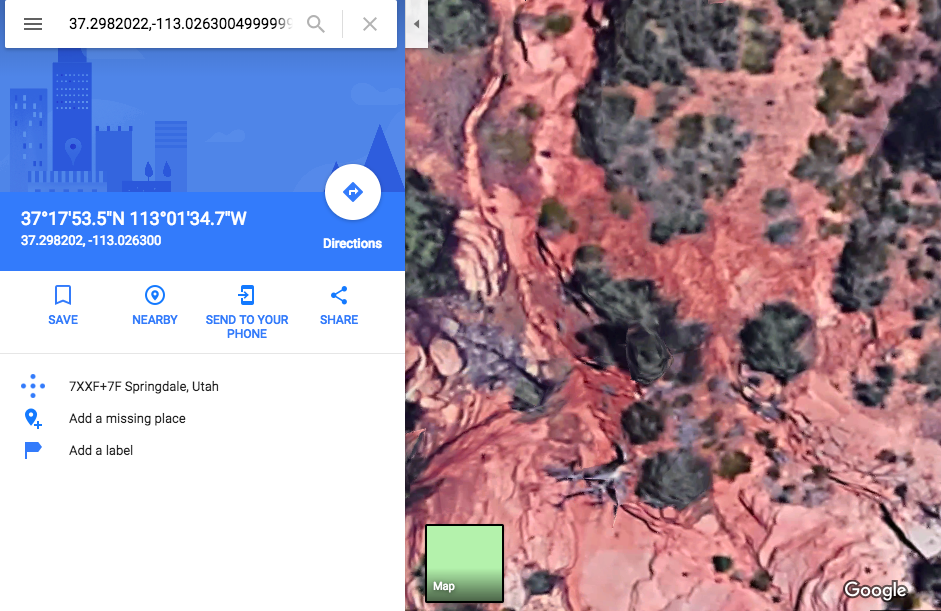
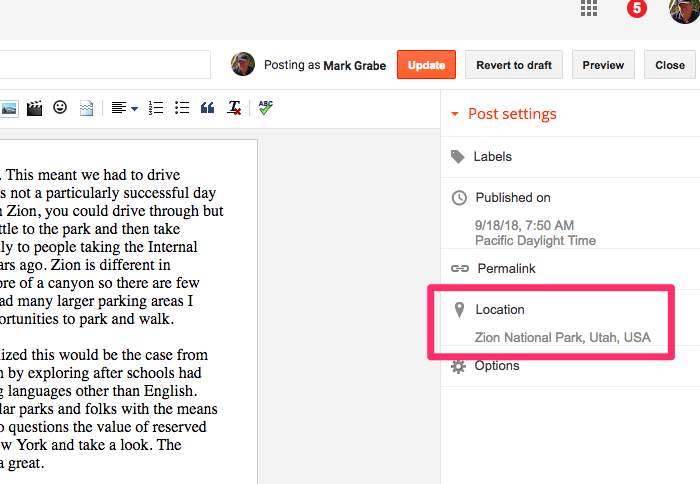
The text box to enter the desired location appears when you select the “Location” icon appearing in the right-hand column of the Blogger authoring page. What you enter here can be general (the name of a town) or more specific (a complete address). Because I try to include photos in most of my posts, if I use a photo captured with my phone, I use the location data stored by the phone in the EXIF data included in the photo file.

The location you enter will appear at the bottom of the post. This location is also a link that offers access to the location you specify as it appears on Google maps.


Loading

Brave New World

I enjoy exploring new services and products that have the courage to challenge well established existing companies. Brave is a new cross-platform browser available as an alternative to whatever you are using now. A classic tech business model seems to be doing what your competitors don’t and for alternatives to Google Chrome (Apple Safari, Firefox) this seems to be blocking ads and protecting against the collection of personal information. Brave is in this camp. This makes Brave very fast and it offers convenient controls for avoiding ads and cookies.

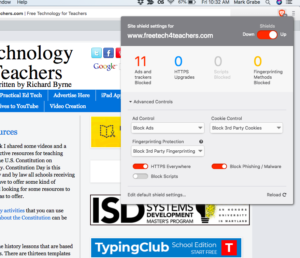
The image above shows the security controls and yes there are ads (I always use the Free Tech for Teachers site when I want to check for banner ads, but these are not the type of ad that is based on your browsing history).

I have mixed feelings about ads as a content producer. Users seldom click on the Google ads that accompany my posts so I make very little money from my offerings. This is not a concern to me, but I am interest in what this could mean to others committed to generating reasonable compensation for producing their content.

Brave has a plan for this situation. Brave intends to allow users to offer micropayment to the sites they visit. I have encountered this one time before. The idea is that as a user you commit a certain amount per month and this money is then offered to those you visit (and designate). I am interested in doing this as a consumer, but I am waiting to I am home and have access to my desktop machine because it appears that the synchronization of multiple platforms is yet quite primitive and the cross-platform payment option is not yet available. Payment and collection requires bit currency systems and I assume this will be an impediment until things are easier.

Reports I have read on the Brave business model have me confused. This ComputerWorld description seems to imply that Brave will partly fund itself by substituting its own vetted ads for existing ads. I read the Brave material as offering this as an option and not a requirement.

I promise a followup to this post as I have time to explore the funding model. For the time being, I think that Brave is worth exploring just for the speed advantage it offers. Note that many of the plugins you count on when using Chrome will not be available, but these enhancements will likely be coming if the company takes off.

Loading

The culture of innovation

Most educators interested in technology are too young to have been influenced by the era of innovation that made possible both the positive and negative uses of technology we experience today. Unless you were involved in the middle 1980s to the mid-1990s you missed out. This was a time of idealism and personal involvement that is mostly lacking today. Most folks are now willing to rely on existing platforms or the simplicity of coding without actual making. If you haven’t run your own server, you don’t understand. If you haven’t experienced the excitement of connecting your computer to a bulletin board for the excitement of connecting with individuals very different from yourself, you wouldn’t understand.

As an educational investment, coding without making misses the point. There are far more efficient and existing ways to practice problem-solving and a thoughtful methodological approach. Becoming part of a participatory technological enabled culture offers the opportunities of computational thinking and other opportunities that are far more important. Learn enough to install a service on a server that sits on your own desk and you have acquired more than the supposed benefits of computational thinking. You have created the opportunity to offer your ideas to the world and to engage with others. You have become a contributing part of a complex culture and made an investment in this culture.

I have had the opportunity to benefit from these experiences because at the time the investment in learning to code and learning the basics of operating a server were the price of admission. This is no longer the case. You need to know very little about technology itself to use Facebook or Twitter. I really don’t know if the problems now associated with how these services are used have anything to do with missing out on the original culture of the personal computer and the Internet. I blame the loss of that culture and the present problems on the take over of technology by commercial interests and what these interests have resorted to in order to make the money they make. In so many ways, it has become a race to the bottom. We want free, but we are unwilling to understand who free allows the investment and profit margin of the tech companies that dominate public technology use today.

Anyway, there are still ways to experience the educational benefits of the original PC and Internet culture. You and your students can still rent your own server space and install services that allow you to explore, communicate, and contribute. What I have in mind others have called the indieweb and there are some attempting to show the relevance of the indieweb for education.

Getting started 

My own efforts – I had the advantage of working at a university when I started my exploration in this area. This meant that I had access to a static IP for running a server. A static IP means that that the Interest address associated with your connection to the Internet The dotted quad or numerical representation of your web address xxx.xxx.xxx.xxx does not change each time you connect. A consistent online location is necessary for others to find you. I do admit that as the importance of the Internet became obvious the security types at the university regarded my activity with increasing skepticism. I had the advantage at the time of having accumulated a lot of experience and building a research program on software I wrote that could not be easily installed on university servers. All that aside, renting server space is now easy and fairly inexpensive. This is what I do now and this is the host for the content you are reading here.

Some examples of services I run on this server.

Blogs that make use of WordPress. This software can be installed using a script and embellished for different types of application (e.g., a blog versus an online book).

A wiki using the MediaWiki software (pretty much the same software as you would be accessing when you make use of Wikipedia). I used the software in a grad class I taught to have ed tech students create tutorials that were offered to educators. 

A bookmarking tool – Shaarli 

An RSS reader – FreshRSS 

A Drupal install that I used for a while with my students, but that I decided to deactivate when I taught less frequently in retirement and got tired of migrating to updated and more secure versions of Drupal.

HTML web content created with commercial web development software (DreamWeaver)

Are these services/content as sophisticated as one might find using services such as Facebook, Twitter, etc.? Of course not, but I understand how they work and I operate them myself. They offer the content I have created. This is a very different experience than adding my creative work to Facebook, Diigo, Instagram, or Twitter. I think it has been worth the effort in deepening my understanding and in being part of a different culture than most technology users experience. Just to be clear, I have never taken a computer science course. I taught myself to program and the other tech skills I needed. I am a psychologist, not a computer scientist or trained programmer. Doing it yourself offers a diversity of experiences that go far beyond writing code. How does the Internet work? What is a DNS? How do bad actors mess with your site? What does it take to attract others to your work? I believe that at least some of the experiences I have had are there at a low cost and offer students the opportunity to develop a depth of understanding that few now experience. If you want to be an innovator, consider indieweb experiences for your students. Encourage them to create something that is truly theirs.


Loading

It all started with coloring books

I thought I would explain how Cindy and I came to write several textbooks for the higher education market. In my experience with publishing companies, our experience was unique and makes a story worth telling. 

Most college profs who end up writing a textbook get their start in a specific way. The larger textbook companies have field reps who pitch textbooks to profs. We get free books and supporting tools and content (e.g., videos for class, question banks, ideas for class) to encourage the commitment of the students in our classes to an adoption. The money in the adoption is mostly in the first use. After that, used books take over and the companies make little money. This is why reps work hard to encourage new adoptions.

One of the other things these reps do is scout for new talent. Asking “have you considered writing a book” is a great way to play to the ego of the folks they are trying to get to commit to their existing books and getting profs to write a sample chapter or two and propose an outline and ideas for a new approach do result in a few new opportunities. Most who end up writing a book have also done some previous work for these companies. They may have been reviewing chapters from another book and offering related ideas or authoring the supplemental materials that accompany an existing book. Faculty members work really cheap, but we also know this is the way companies scout for talent. As an author of a book being edited, you can see this is the reviews written to offer you suggestions. Reviewers work hard to impress companies with their writing skill and knowledge.

Our book opportunities did not involve these traditional mechanisms. Our opportunities originated with coloring books. Cindy was working with teachers to find productive ways to engage students with technology when teaching traditional content and skills. Strange as it may seem today, her ideas and mine were not traditional. At the time, she was working with a program called Kid Pix and I happened to be heavily involved in creating study tools for college students using a Mac program called HyperCard. One of the tools available for the Mac was called ResEdit. This tool allowed the resources embedded in a Kid Pix file to be isolated, copied and pasted. When kids used Kid Pics they could use several Kid Pics tools to create drawings, import and modify images, and to add sound and eventually save the combination out as a single file. ResEdit allowed the image and sound to be copied from this file and added to a HyperCard stack. What we did with this capability was to create self-playing slide shows. There are so many ways to do this now, but our approach was original at the time. A typical strategy was to have individual students or student pairs create a Kid Pix file on a specific instance of a more general topic and then combine these individual creations into a slideshow on the topic. Apple showed our projects for years before companies figured out how to mimic this technique in an easier way (e.g., Kid Pix Companion).

Our interest in this technique led us to search for topics and materials that would be conducive to such an approach. Cindy and I were attending a conference in Chicago and were browsing a large bookstore during this trip. We came across a section that offered many thematic coloring books. You have probably encountered these coloring books without giving them much thought – e.g., Presidents of the United States, mammals, butterflies. You may know the expression – “discovery favors the prepared mind”. We immediately recognized a source for the projects we had in mind. I had a related idea. I wanted to digitize these coloring books and write a short “how to do it” manual a company could use to sell the combination as a product. I looked inside a coloring book from the giant collection in front of me and found that the coloring book was copyrighted by Houghton Mifflin.

I wrote up a proposal for Houghton Mifflin explaining the idea and describing some of our existing projects and techniques and sent it off. In a few weeks, the rejection letter came explaining that the division responsible for the coloring books did not do that kind of thing. End of dream? It turned out it was not the end. Weeks later we are notified by Houghton Mifflin and told that the education editor had heard about our proposal and would like to fly to Grand Forks, North Dakota, to visit us and see what we are doing. It is hard to explain just how unusual this situation was. This simply just does not happen.

Loretta Wolozin flew to Grand Forks from Houghton Mifflin headquarters in Boston and we showed her how we and the teachers we worked with did what we did. We owe much of what we eventually achieved to the early projects created by Pam Carlson and her second-grade students. The butterfly project resulting from what these students learned about butterflies, the life cycle of butterflies, and the butterflies of the United States by rearing monarchs and exploring books about butterflies were expressed as colored images of butterflies plus range maps, a song about butterflies, and other content available to all as a HyperCard slide show. It made an impressive demonstration.

Loretta offered us a contract to write a textbook for preservice educators wanting to learn what their students might do with technology. The offer required that we could expand the scope of the core ideas in our original coloring book proposal. Cindy and I came up with a concept we called “Technology Integration” to describe the most unique concept in our approach. I got the idea from a book by David Jonassen called “Mind Tools” which was about using technology productivity tools (word processing, databases, spreadsheets) as a way to explore the concepts and skills taught across the curriculum. The idea was to get beyond teaching the tools as computer literacy to using the tools in authentic ways to learn. We added our project approach, broadened the list of productivity tools available, offered a cognitive model of learning to explain the value of these activities, and explained related issues (cooperative learning, issues in the responsible use of technology). A book explaining how technology could be integrated in all classrooms was born.

Eventually, other opportunities followed. We had some success writing grants related to our ideas. We wrote a book extending integration themes to Internet activities (first as a separate book and later as content integrated into the original book). I develop content on technology integration to be included in textbooks for other college classes written by other authors.

Houghton Mifflin never did take advantage of our original suggestion, BUT I found another organization that would. My original career goal was to become a high school biology teacher. This was before I became interested in educational psychology. I did get an undergrad degree in biology and went through the teacher education program to become a biology teacher. My writing often contains references to this content and issues in teaching this content. My interests in technology and biology resulted in my collaboration with the Game and Fish Department in North Dakota. This state government department is called the Department of Natural Resources (DNR) in most states. These organizations are mainly interested in hunting and fishing, but also usually promote interest and education in natural resources including the development of resources provided to schools. I found a niche related to this mission.

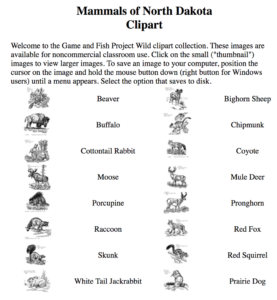
One of the ideas I promoted was the digitized coloring book project. Game and Fish had a simple coloring book mixing some North Dakota wildlife into a very coloring book. They were willing to commit to the development and distribution of a more complete and thematic collection of images of mammals, reptiles, birds, etc. This content was originally distributed as hypercard stacks, but eventually moved online as a component of other resources we offered through a server I managed for the department. 

I still have these images on my server. They look primitive now and are less useful than the images available to teachers through services such as the Noun Project. My images are bitmapped and cannot be manipulated into different sizes as easily as images in a PNG or SVG file format (https://thenounproject.com/). However, the Game and Fish “coloring book” images still exist and are available (http://learningaloud.com/clipart/).

Yes, this is the kind of story an old guy tells. However, it is kind of story that also leaves you searching for the next great adventure.

Loading

Hackers, hippies, and idealists

I am reading a book that offers a solution to the frustration I have with two technology trends. The first is to treat older folks (I will be 70 in a couple of months) as ignorant to digital technology. The second is the negative consequences of the hyper-commercialization of online technology (e.g., net neutrality, selling user personal data as compensation for access to online services).

The book is Adam Fisher’s Valley of Genius. The book is a history of Silicon Valley and the creation of digital technology as told by those were the innovators and enablers. Fisher “wrote” this book in a very unusual style. He first interviewed a couple of hundred people. He printed the text generated by entering the words generated in these interviews. He identified themes which mainly represented the comments on key events or innovations. He then manually cut apart the printed pages of text to isolate the comments associated with these events. Finally, he pasted together the comments to tell the stories of these events. It does sound strange.

So this was not the isolated remembrances of 200 valley notables. It was the integrated remembrances as if the entire group engaged in a group storytelling session.

It took more than four years of work. I understand the process, but I cannot imagine having the patience or the broad view to make this work.

If you are interested in technology and really want to understand the backstory, I strongly suggest this book. If it sounds too weird or you are not up to reading 500 or so pages, I would recommend two interviews with Fisher conducted by Leo Laporte (session 1, session 2). The closest thing I can recommend to this book is a much earlier book by John Markoff – What the dormouse said.

What these sources capture is the culture of early technology innovation and how that culture is so different from the present culture surrounding technology.  Fisher suggests we have moved from “a bicycle for the mind” to “rats in a social media maze”. I agree. This is what those who have lately to technology mostly fail to see this transition. They fail to see the negative consequences of unfettered capitalism as it has taken the innovation for all out of the culture.

Fisher proposes that perhaps by identifying the arc of the story of digital technology we might move forward in a more productive way.

I hope so.


Loading