Podcasts and audiobooks vs Kindles and Books

Let me start with this. I am personally a big consumer of content in many forms. I read. I watch. I listen. I spend money on content of multiple types I own and I get other content from a couple of different libraries. My intent here is not to discourage use of any of these resources or sources. What I struggle with are arguments that all formats are equally suited to all purposes. I am most interested in educational applications and decisions made by educators when it comes to assigning content. I am also not suggesting that it is not useful to have experiences learning from multiple formats.

Here is the type of message I think can be confusing. This news article is titled “Why we are ditching our kindles in favor of audiobooks“. While this may be true, this is not a claim about learning and perhaps more a comment on convenience. Here is an example of a more direct examination of the issue I am intending to address – Are audiobooks as good for you as reading?” This Time article both mentions the type of article that claims listening is just as good and articles that claim reading is to be preferred for learning. BTW – the article also gets into the screen vs paper reading issue which a different issue.

The Time article mentions a straightforward study by Willingham & Woody, 2010. The research considered the retention resulting from listening to a podcast vs. reading a transcript. I include this reference because the students reading the material learned much more as measured on a followup exam.

Willingham & Woody note that the students knew that listening resulted in less retention. I think those of us who use both formats on a regular basis do as well. We like listening for the convenience. We like listening because it allows us to do other things at the same time (driving, walking on a treadmill). We like listening because it is easier. Yes, we make students listen to lectures. However, we expect them to take notes and would rather they did nothing else at the same time. Is this what you and I do when we listen to an audiobook or a podcast. I doubt it. If I were going to just sit there listening and taking notes, I would prefer to read and highlight because I could be moving much faster.

Willingham notes that reading allows rereading which we do far more often than we realize. He is not describing the type of review that one might duplicate with an audiobook by scrubbing back a page or so and listening again, he is talking about the very efficient use of regressive eye movements we engage in when we read. Even if listeners relisten, what they are doing is not the equivalent of momentary pausing and internal sentence lookbacks that occur as we read.

The golfing expression – drive for show, putt for dough comes to mind. Reading and listening are kind of like that. Listen for fun, read to learn – if the efficiency and effectiveness of learning matters.

Daniel, David B. “They Hear, but Do Not Listen: Retention for Podcasted Material in a Classroom Context.” Teaching of Psychology 37.3 (2010):199. Web.

Loading

wt:social

There have been multiple attempts to offer an alternative to Facebook and I have tried and continue to use several (Diaspora, MeWe). The network effect (people stay where there are other people) makes it very difficult to gain traction. Now, Jimmy Wales, Wikipedia founder, is going to give it a try. The new service is called wt:social.

wt:social will differ from Facebook (and Twitter) mostly in how it is funded and how it is funded has consequences for how it works. Facebook and Twitter are funded by targeted ads and make use of user data to sell these ads. Wales intends to fund wt:social using the same kind of contribution model he used with Wikipedia.

Because wt:social has been relatively possible, Wales has had to institute a wait list approach for those not wanting to make an immediate contribution. I admit to being one of these individuals. I contribute to several social media sites, but the $100 a year subscription model was too much for me at this point. I would have contributed a lesser amount and I might eventually contribute the $100, but I want to see if the site can attract a substantial amount of activity before it would be worth this amount to me.

wt:social is built on an a previous news effort that never really gained much traction. It does retain some features of the effort and allows participants to create and “subwikis” that can be followed as an addition to following the posts from specific friends. I created a wiki – K12 Edtech – to see how this might work. Individuals interested in this topic who join wt:social are encouraged to add this “group” and to contribute. I intend to see the wiki with links top content I have written elsewhere and maybe some original content so there is initially something there to see. If nothing develops in a month or so, I will probably just delete the topic. Give it a look if interested.

If you are interested in wt:social and want to spend some time to see how it develops, my wait time was about a week.

If you are unhappy with Facebook or Twitter this may offer an alternative and a big name in the tech community may be able to pull off creating an option. How satisfied you are will depend on whether the new offering can attract users and what you found objectionable with other existing services. The elimination of the business model based on harvesting personal information to drive ads could be your objection. If you want to leave Facebook because of what you read there, it is hard to predict if things will improve with a different service. wt:social does allow control over acquaintances and wiki sources so your feed may end up more to your liking.

Loading

Kialo-Edu

I have written previously about my own experiences hosting an online argument/debate using Kialo.com. https://learningaloud.com/blog/2018/05/22/kialo-structured-argumentation].

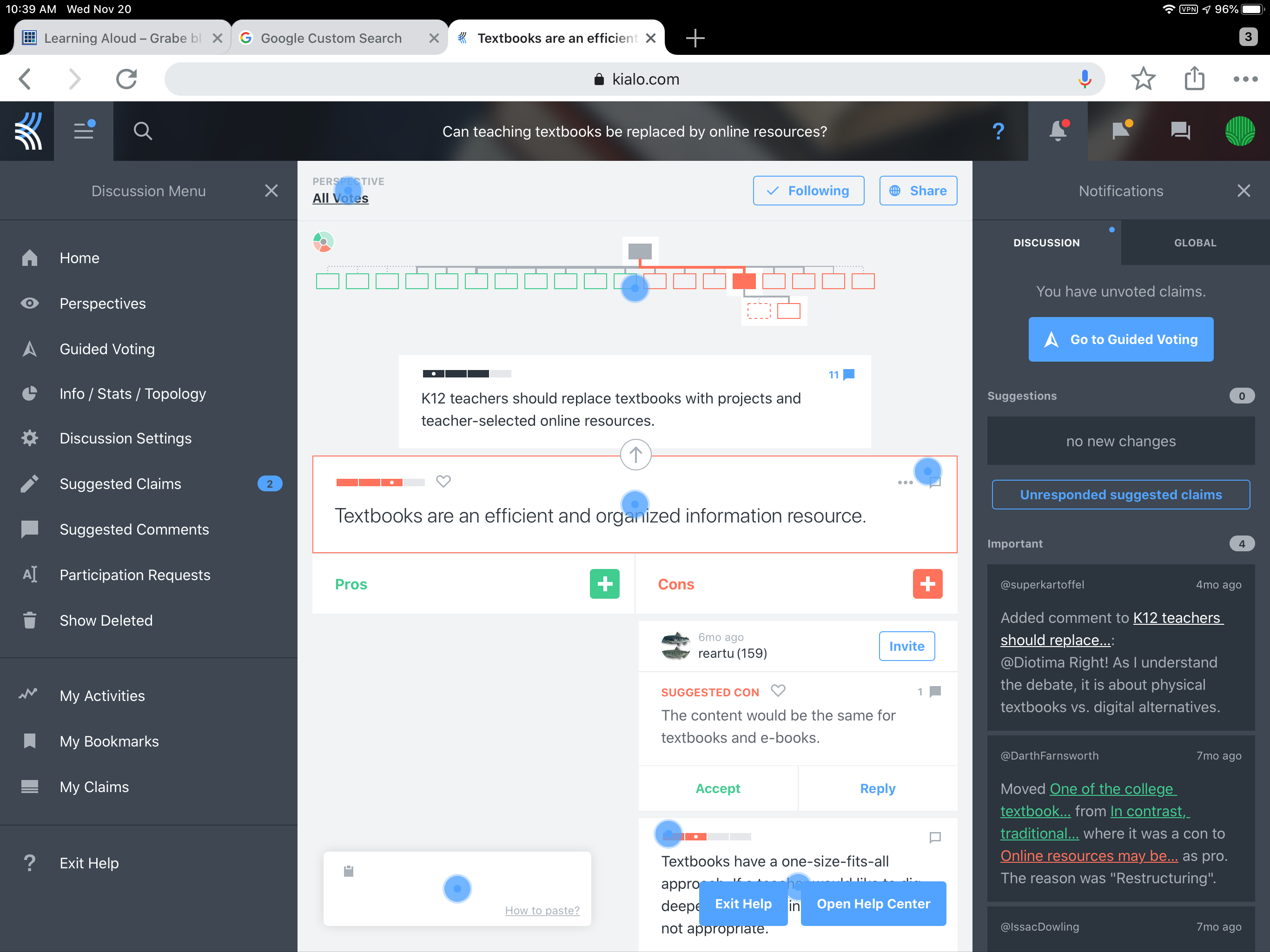
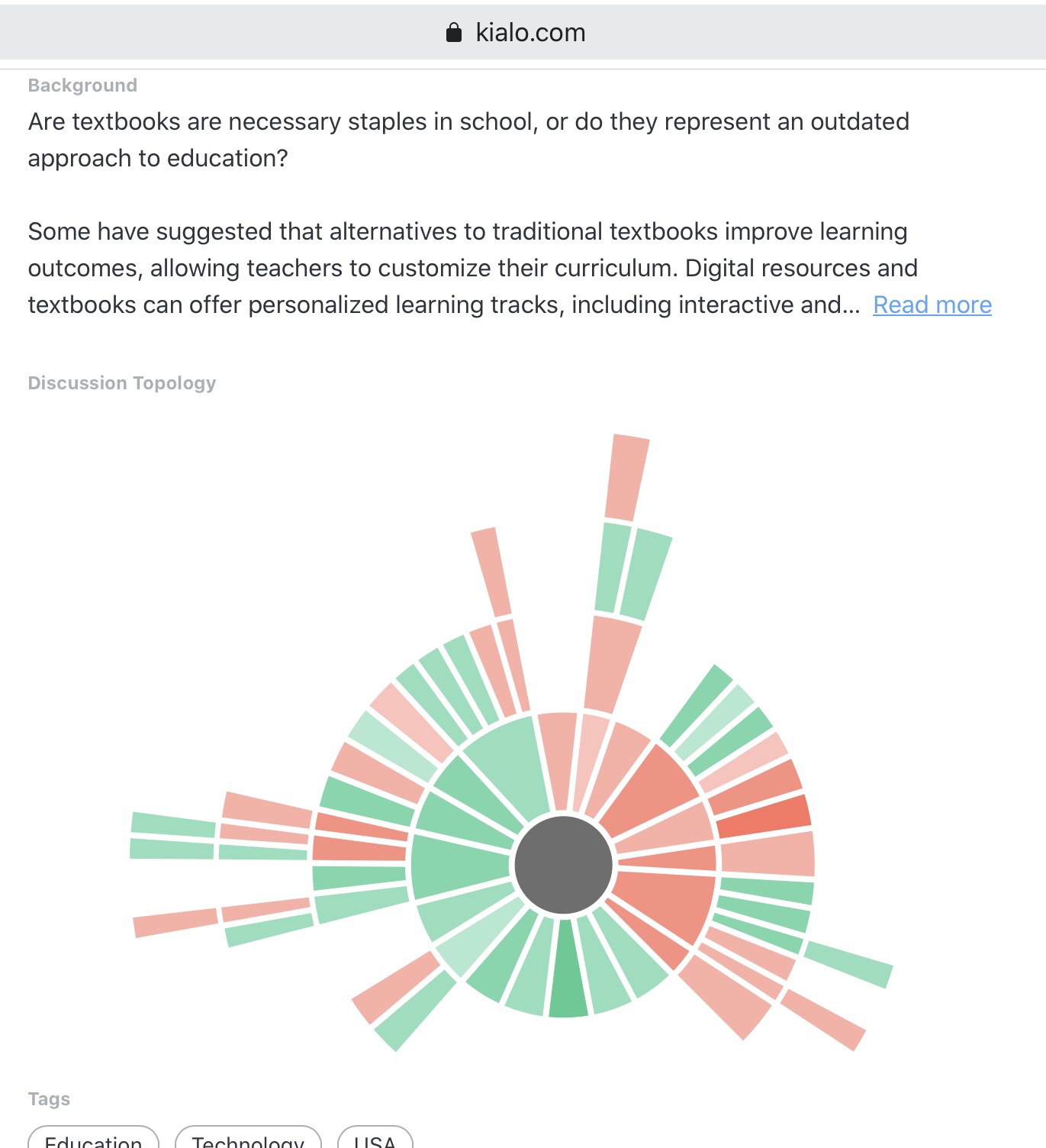
Kialo organizes the pro and con positions on a stated issue. Others are invited to add to the sample pro and con statements the host uses to initiate the discussion and to respond with pro and con statements to the statements made by others. The developing argument is visually structured as hierarchically organized statements and eventually participants are encouraged to vote on the persuasiveness of component components of the discussion.

A couple of visuals from my own effort may help communicate what this looks like. The first shows the interface for contributing and examining the discussion. The second a visualization of a mature discussion.

Kialo has now spun off a version of its original effort no focused on classroom use [Kialo-Edu.com – https://www.kialo-edu.com. Kialo was always used in classrooms, but this new version allows some separation. 

If this is at all interesting, I would encourage your attention to my original description of how the online tool works. Kialo offers content describing the intent of its new service for classrooms [https://www.kialo-edu.com/about] and offers additional background including tutorials, examples, and suggestions for application [https://support.kialo-edu.com/hc/en-us/articles/360035225932-Try-Out-Kialo-in-Five-Simple-Steps-High-School-Classrooms].

Loading

Brave is now available for iOS – this is big

I have been a supporter of the Brave browser and ecosystem since I first tried it months ago. Simply put, the Brave ecosystem is intended to protect user privacy and still allow a way for content creators and online service providers to generate revenue to support their effort and infrastructures. The Brave browser allows users to take several different actions:

  • Block ads, cookies, and scripts
  • View Brave screened and delivered ads and be compensated for being open to this content
  • Compensate content creators and service providers

Which of these capabilities is implemented is under user control. I do think it appropriate that if users block ads they should consider the reality that they are also accepting the work of others without compensation or at a minimum rejecting the assumption producers made when engaging in the creative process. So, I promote Brave as way to receive compensation AND compensate creators without abandoning privacy.

When I started with Brave, there was no opportunity for users of the browser to receive compensation by viewing selected ads. I put in $50 as a way to explore the full system as it developed. The availability of revenue for viewing Brave controlled ads was not available at that time. I did take advantage of the compensation opportunity when it became available, but must say that even at the amount of time I spent online I was still paying most of my commitment out of pocket. Not a big deal, but I do understand how the very frugal might see this as a problem.

One of the issues I had with Brave was that I could use Brave on all of the various devices I use, but the revenue generating opportunity was only available on my computers (not my phone or tablets). For many users, the phone and tablet may be their only devices or represent the vast proportion of the time they spend online. I think this was even true for me.

Today, Brave has announced that it now makes available the opportunity of iOS users to receive compensation for their attention. The multiple options I describe above are easy to set up.

I describe my experiences with Brave in multiple posts you can locate by using the search box on this site.

I think Brave will influence what happens online. My concern is that other players who could have easily implemented similar opportunities will now respond with similar programs limiting the commitment of users to Brave. This is how business seems to go, but it does seem unfair that innovation is so often mimicked leaving little for those who forced advancement.

Loading

Can AI identify bias in media

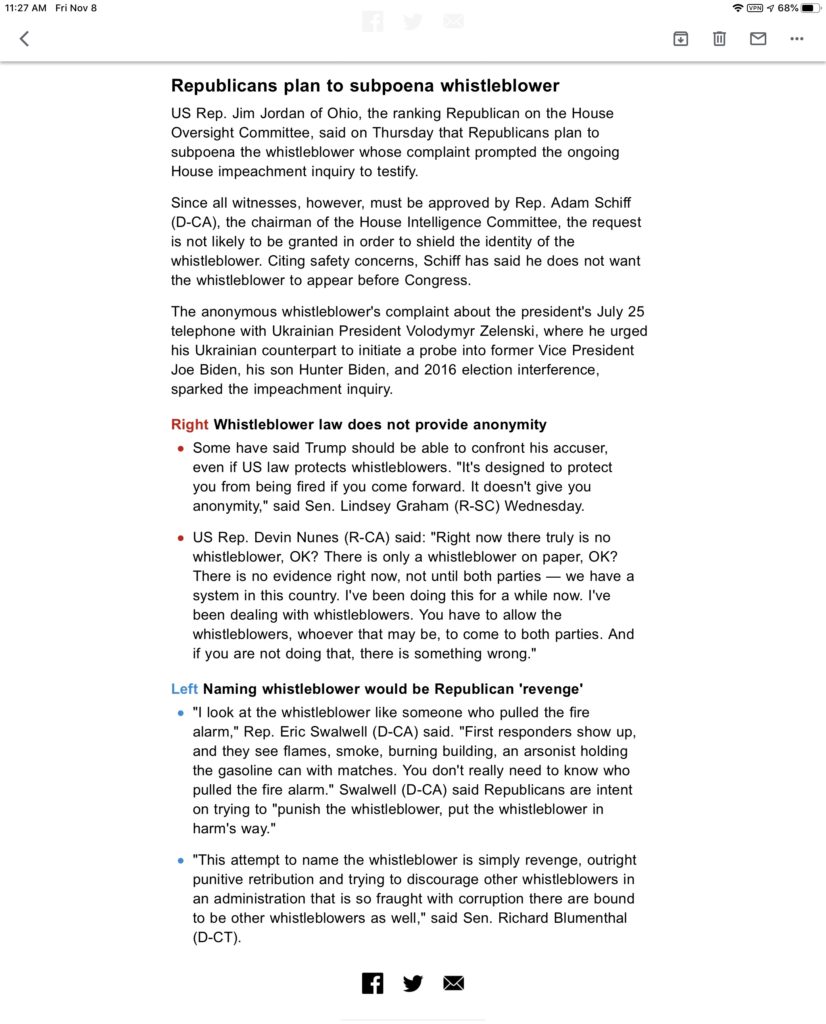
Nowhere News is a recent news service attempting to use artificial intelligence to identify bias in news. The service accesses a large number of news services and identifies popular stories of the day. The service than uses the content from multiple services to create a neutral account and also generates a right-wing and a left-wing version (or positive and negative view if more appropriate). The developers have weighted the sites they access by reputation for accuracy and do review and edit the generated summaries before publishing. 

I read multiple descriptions of Nowhere News to try to understand more about what the AI is doing [ TechCrunch, Singularity Hub, Vice]. Services that summarize web content have been around for several years. One approach might involve summarizing multiple accounts from news services known to have right, left, and neutral biases. This does not seem to be what is happening here. As I understand AI, you input many signals and identify a characteristic of the source (in this case, right, neutral, and left) and the system learns how to use the signals to more and more accurately predict the designated category. I am not certain this appropriately summarizes what has been done here.

However generated, the three versions of a story generalized from multiple sources would seem to have some educational value. Just reading the three summaries offers readers insight into what bias means. [see Common Sense Media comment on educational potential].

At present the Knowhere News site is free and I would assume would eventually need to find some way to monetize. If you enroll as a user, you receive emails with story summarizes. You can also just visit the site and read the stories summarized for a given day.

This service is interesting and useful. I doubt it could be regarded as a solution to the fake news crisis.  First, I don’t see brief summaries the equivalent of reading long-form news stories. Knowhere does provide links to multiple sources, but often not to sources I would read. I am not clear how major news sources with some version of a pay to read model regard content being used in this way. Second and as acknowledged by Knowhere, there is a difference between bias (spin) and quality. See my previous post.

Loading

Implementation Science

I would argue that not all research is given the same credit. While this may sound like sour grapes because I mostly worked on projects that tested ideas in applied settings, I still believe that basic research is often more respected and certainly easier than applied research. Certainly research that carefully controls all but a few variables and randomly assigns participants to treatments is the best approach for the discovery of new principles, this is not the situation practitioners face. I am guessing that many valid principles identify factors that even if addressed are not sufficient to overcome the variability in learner samples and messiness with which different application attempts create to produce consistent positive results. Investing your time evaluating “proven” principles in applied situations tends to mean you spend more time on a given project and have more frequent studies producing nothing of statistical significance. If this is your thing, you are simply less likely to generate the number of publishable studies in contrast to those who focus on cleaner controlled studies.

I have been reading a book (Everyday Chaos) that seems to me to take a similar position. The author, David Weinberger, uses examples from big data and A/B testing to argue that a focus on simple causes may be fruitless. Technological approaches allowing a search for patterns in large data sets can generate useful strategies that are very difficult and sometimes not possible to explain. Whatever works for a given large dataset may not work for a different dataset.

EdSurge offers a recent article describing a new Department of Education grant competition focused on the type of issue I have described here. What is described as implementation science involves the study of variations that impact the efficacy of applications

“The agency kicked off a new research competition to better understand how technology programs that IES previously deemed effective can perform in specific but varied settings, from different geographic regions to different populations of learners, educators and schools.”

Thinking about what it would take to achieve the goals of this grant program I can think of no way I would have been in a situation to participate in such research. On the surface at least, this work would seem to require access to a variety of settings and educators willing to attempt a similar tactic. Metaanalyses attempt to do this after the fact, but designing an approach up front will take programs with tremendous resources.

Loading

Digital Literacy Week Recommendation

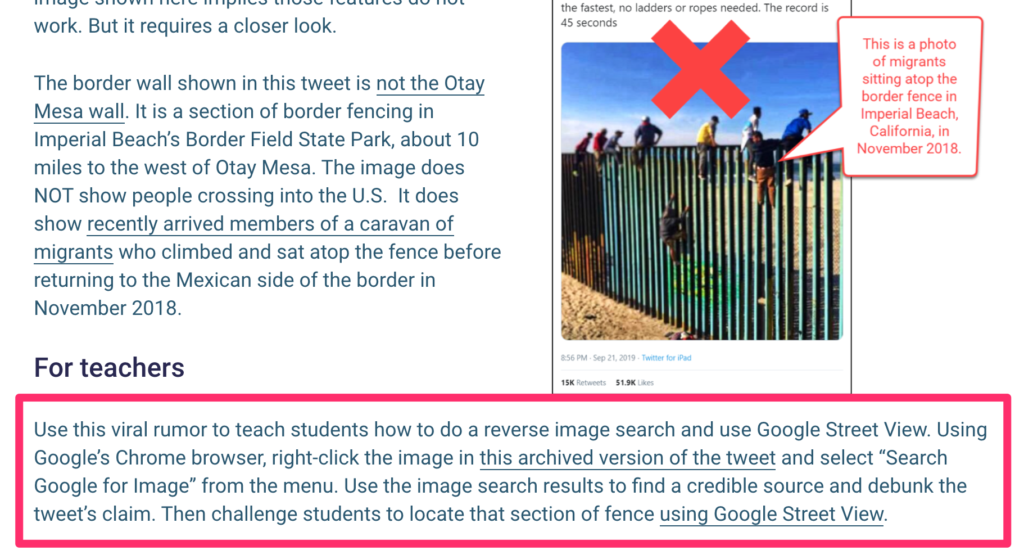
Educators are designating this week for a special focus on digital citizenship. In keeping with the theme, it makes sense to offer a resource educators may find helpful. The News Literacy Project makes a variety of resources available including Checkology which provides a series of interactive lessons. Get Smart About the News includes individual lessons focused on specific skills such as reverse image search (see image below) as ways to investigate claims. The project seeks donations to supports its efforts.

Loading