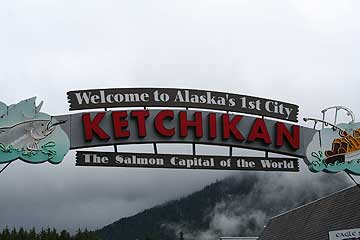
Today we took the Misty Fjord cruise on the boat (the St. John) Kim is working on for the summer. It was a sunny day and I managed a sun burn – not an easy feat to accomplish in Ketchikan.
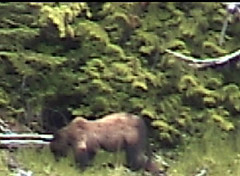
Midway in the trip a brown bear was spotted on the shore. I was using a video camera at the time and have some video, but it is difficult to watch because of the movement. It is difficult keeping a camera trained on a distant object when the object and you are moving.
In the evening, we returned to the spot from which we had previously viewed black bears. We watched a bear that was obviously hurt in some way. The bear was limping badly and seemed to have to rest after moving a short distance. A State Patrolman showed up and after viewing the bear for some time had to kill it with a shot gun when the bear started to move back into the woods. I did not film the final scene.
Sometimes reality can be a little tough.
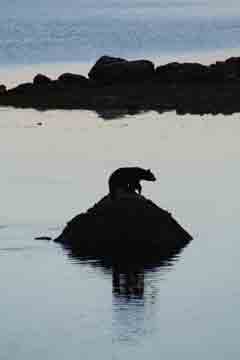
I can’t claim this final picture. My daughter took it with my camera – her tribute.
I have had the opportunity to view and sometimes photograph bears on several occasions. I don’t count dumpster bears. The Ketchikan experience is at an entirely different level. The habitat is ideal and the salmon in the streams brings the bears into the open.
In this setting, bears and fisherpersons sometimes mix.
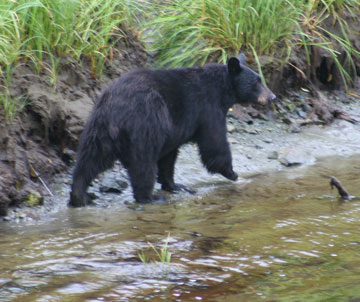
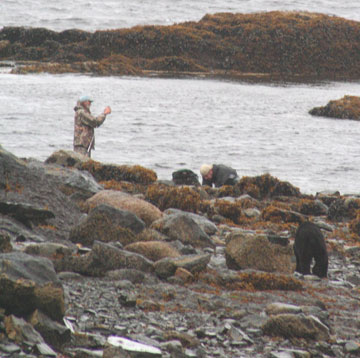
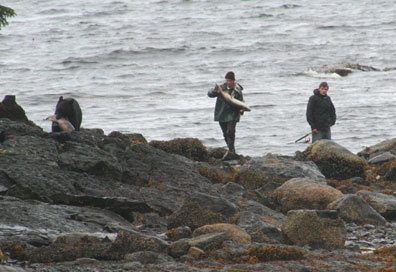
Last evening we were watching bears fishing in a stream (first picture) and I was taking pictures. I turned in the other direction and I saw a bear moving in behind several fishermen. I estimate the distance here at 300-400 yards and I have my 200 mm. telephoto lens cranked out to the maximum. The fishermen did not see the bear coming and I considered shouting but just watched.
The bear took a fish they men had caught and headed off. One of the men then headed after the bear and it appeared he was trying to exchange one fish for another – perhaps a post-spawn fish for a pre-spawn fish. The bear was not interested. Then he started throwing rocks at the bear. Not smart. The bear just headed back into the woods.
I have added some higher quality bear photos to my Fickr account – see badge to the right for access.
We slept in this morning after a very long day of travel. The day began with fog and rain, but according to the brochure (160 inches a year) this would be typical. No bears last night.
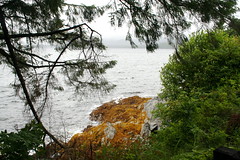
This is the view across the road.
Our daughter is at work. They are not coffee drinkers so I am stranded 6 miles from town with no coffee. This problem was not covered in the survival handbook.
In a book, “they go through a lot of details that aren’t really needed,” Hunter said. “Online just gives you what you need, nothing more or less.” (comment of Hunter Gaudet)
The New York Times intends to offer a series of articles examining how the Internet is changing the way people read. The first offering in this series examines whether online reading is a positive or negative influence on the development of reading skills.
The facts are that children are spending less time reading traditional content, i.e., books, and scores on tests of reading proficiency are stagnant. My interpretation is that researchers have yet to relate these two trends in a way that would argue for a causal relationship, but some early data and the opinions of some are leaning toward pointing to the Internet as a negative influence. A potentially independent and much more optimistic observation notes that online literacy (locating and processing online information) may represent a different and valuable form of literacy. Some organizations are urging that this proficiency be developed and also evaluation. Perhaps both sustained reading and online scanning are valuable.
At present, positions range from the nature of online reading is rewiring the brain to process information in a different fashion, to the nature of online searching rather than thinking has resulted in the loss or failure to develop sustained thinking/reasoning strategies (see earlier post – Has Google made us stupid?), to the opportunity to explore and search has resulted in the development of additional strategies.
The Times article offers a nice overview of the alternative positions.
As an aside – I hate the way the Times makes use of linking. Rather than linking to a related article, the link is to a themed collection (articles about the Organization for Economic Development, articles about the University of Michigan, etc.). Perhaps I am missing the point – the link is to the organization and there is no article on the specific issue – but what would be the point of making such a link?
A knol is an authoritative article about a specific topic.
Google has entered the competition for your information needs. Of course, Google has always been serving your information needs via search, but now it wants to organize and serve information more in the format of Wikipedia.
Acording to Wikipedia:
Knol is a Google project which aims to include user-written articles on topics ranging from “scientific concepts, to medical information, from geographical and historical, to entertainment, from product information, to how-to-fix-it instructions,” according to Google
For some reason, being able to learn about Knol from a competitor strikes me as amusing. Maybe that is just me. Maybe that is Wikipedia confidence.
Knol is a different type of venture for Google. This is not about software engineering in the way I normally think about complex programs, unlimited storage, and large server farms. Wiki software is pretty much wiki software (or at least it seems so to me). My students do a project using MediaWiki which is pretty much how they would author an article on Wikipedia and the software runs on very low end equipment. Anyone with a server can attempt to attract authors and offer information. The advantage in this “market” goes to concept and visibility. There might be an advantage in doing something a better way (sometimes it is better to go second). Authoring a Knol can be a solo venture and the author can keep it that way. OR, others can be invited to modify a post.The default places the original author in the role of moderator (edits must be approved).
There is also the opportunity for revenue. Google includes Google ads in Knol posts and authors will receive some revenue when a reader clicks through a Google ad.
Now the challenge will be to ramp up to critical mass. All things being equal, the Google concept has some advantages – IF, Knol can attract readers.
It is interesting to consider where this might be going. The idea of securing a publisher for some writers may be solved by Google. I am guessing most writers receive very limited financial benefit for their products. Here you have a distribution channel and the potential for some compensation. If readers shift their attention to online distribution, authoring “nonfiction” material for Google may be attractive.
We are in Chicago so Cindy can attend a conference for her job. I was able come along because airfare was over 1K and it was significantly less expensive to drive even with gas prices. Now, I have several days to explore the city and work in Borders.
I walked down State Street to the Apple store this morning because I needed a new battery for my laptop. There was a long line awaiting the opening of the store. Evidently, iPhones are still in big demand.
I am a fan of the iPod. I might be a fan of the iPhone if we had access in North Dakota. To repeat my complaint – “iPhone – available in 70 countries, but not North Dakota”.
I have upgraded the software on my iPod Touch to take advantage of apps (promoted for the iPhone, but also functional on the Touch).
Here are my recommendations:
Evernote – a complete solution for storing information (I have the paid version), but experiment with the free version.
Google Apps – Google tools for your iPod – access Google notes and Google Apps – hard to add text, but good to access.
Last.fm – the music social networking site I like.
NY Times – the paper on your pod
Twitterrific – just in case I have something to say that can be said in 140 characters.
We are heading to Alaska in about a week to visit our daughter and enjoy some vacation time. We have enjoyed Alaska throughout our adult lives and this will be our 4th trip. Kim ended up working there for a summer partly as a consequence of our previous experiences as a family.
I started to look around our house last night to see if I could round up video from our previous Alaskan adventures. The last trip I know we took mostly digital pictures. The first trip was so long ago the Alcan highway was a gravel road for long stretches and I was using the type of VHS camcorder you held on your shoulder. I was searching for tapes from the second trip. I can see in my mind two Hi-8 digital tapes with a label – Alaska. I found probably 50-60 tapes – most without a label. Cindy was busy and one of the issues we argue about is whether I am capable of locating lost objects. I did not ask for help and gave up.
I have enjoyed still and video photography all of my life. Somewhere I have resources that are likely valuable to my family and possibly to others. I have no idea how to combine the material that is saved on multiple computers, discs, tapes of many different formats. As the expression goes, after a while one mountain looks pretty much like another. How do I catalog the material at this date?
I really don’t know, but these are issues I need to think about. I always thought I would eventually transfer all of the material I have to a consistent format (I have 30 reel to reel tapes of music from the 60-70s under my desk and no reel to reel player which both channels working). I was going to start last night.
So, I am beginning to think seriously about this issue and I encourage you to do the same. I like iPhoto – I wish I had a GPS on my camera so the location of my photos would be recorded. I am trying to be more consistent in adding annotations. I upload some photos to Flickr and have am spending $25 a year for the pro version. I have not thought a lot about video until now. I think I need something more than Flickr and Youtube.
I did find some vacation video from 1998 and created a CD. For fun, I cut the CD material down to 10 minutes of snippets and uploaded to Youtube (see below). I have viewed things in the past I think will now be very difficult to see again. I get that is what some folks call history. AND I WAS THERE.



You must be logged in to post a comment.