First it was copied music and now copied textbooks. The NY Times describes how students are now sharing pdfs of textbooks. The article describes a student who scans and distributes an organic chemistry book.
As a prof. and also an author, this disturbs me. Textbook companies have resisted moving their content to a digital format because they are convinced it will be ripped off. News like this will certainly not encourage a shift to a more cost-effective and flexible format.
On a similar theme, it appears a site is trying to generate traffic by offering to serve as a repository for magazines scanned and submitted by “readers”.
You may be interested in the present conflict involving Georgia and attempting to see what you can learn (where is Georgia?) from the Internet. Bloggers have begun to post on the topic of what content is available.
I tried Google Maps (search for Georgia Europe) after reading a post from Google Lat Long Blog. Use the link “explore the area” to bring up photographs and video.
I am guessing most readers have no idea what HyperCard is (actually was). For many of us, HyperCard was the beginning of many things. It was the beginning of hypermedia and multimedia authoring. It was often the beginning of scripting. HyperCard was very powerful. Perhaps you have heard of the graphics-intensive game Myst – originally a hypercard project created by the Miller brothers. I created projects in HyperCard I have been unable to duplicate as I have moved to other languages and delivery systems.
One of our first student projects consisted of individual images created by young students in KidPix. We extracted the audio, pasted the image on Hypercard cards and embedded the audio. I wrote a simple script attached to each card that moved the viewer on to the next card after a specified delay allowing the audio to be played. As far as I kow, it was an automated slide show that predated KidPix slideshow and any other program of that type. I still remember the first time we showed the student work at a parents’ night. We ran it on the largest TV monitor we could find. None of the adults had seen such a thing before.
I have heard rumors for years that HyperCard was going to make a comeback. It really never has. However, a new online app (tilestack) allows the creation of Hypercard-like stacks. I have created a small stack with their system to offer a simple example. TileStack is such a close relative of hypercard you can upload old hypercard stacks and it will convert them.
If you are not familiar with HyperCard, tilestack operates something like HyperStudio (now back in production via MacKiev) or perhaps products from eZedia (e.g., QTI). There have always been features I missed. For example, HyperCard functioned based on the selection of elements (buttons, fields, etc.), but also made available a powerful scripting language. I think I threw away the collection of manuals on hypertalk the last time I made room in my bookcase.
I wonder how I would do that. I have old stacks on 3.5 disks. I may have to fire up an old machine just to give the conversion program a try.
TileStack is under development. Many of the commands exist, but have “yet to be implemented”. I am not certain if you can try this out at this time. I read about the venture and put my name on the waiting list. I was notified by email that I had access. It appears the developers have big plans and many features are still in the works. I hope this venture makes it and people give it a try. Hypercard deserves a better fate than to fade into oblivion under piles of paper in one of my file cabinets on disks that no computer can now read.
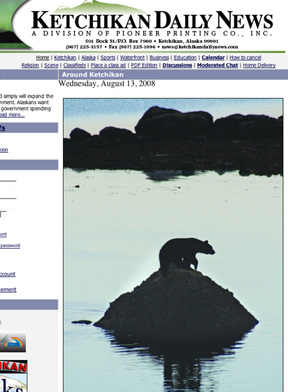
BTW – Ketchikan is spelled correctly. I am not certain why it shows as a spelling error.
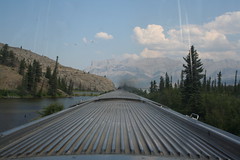
Just made it home. The last leg was a little tough. Approximately 24 hours sitting on the train from Jasper to Winnipeg. Some folks can sleep anywhere. Not me! However, the view leaving the Rockies was great.
Those who follow my blog for the emphasis on educational technology may wonder about this series of “off-topic” posts. For example, I have not written anything that on the surface may appear to have educational relevance for several weeks.
If you care, here is a justification.
I have a habit of reading over people’s shoulders. I admit this to be completely inappropriate, but I cannot help myself. While on this trip, Cindy has been reading Rafe Esquith’s ‘Teach Like Your Hair is On Fire”? Catchy title! Anyway, the last paragraph in the Prologue reads as follows:
There are so many charlatans in the world of education. They teach for a couple of years, come up with a few clever slogans, build their Web sites, and hit the lecture circuit. … I hope that people who read this book realize that true excellence takes sacrifice, mistakes, and enormous amounts of effort. After all, there are no shortcuts.
The point? If you believe in something, you practice it first, continue to engage in the activity as part of your normal routine, and talk about it as a by-product of this commitment.
I have been just been practicing in what for me is a little different setting.
As the title for this blog indicates, blogging is a way to learn through the processing of personal experiences. There are all kinds of learning experiences. There were some “traditional educational experiences” during this past week. I exhausted my supply of podcasts stored on my iPod. I also listened to “Looking for Alaska”, “The Search”, and “Earth: The Sequel”. There must be 20+ hours of content in the collection so getting through 3 books in less than two weeks would exceed my normal reading load. I also had the opportunity to take several hundred pictures and about an hour of video. Some have been uploaded to Flickr and more will end up there. For an old biologist, the setting was nearly ideal. I have a collection of material for a podcast I want to do on making Fireweed jelly, but it is back to the office tomorrow and working up the material on making jelly will require a little more research,.
I have taken a cross-country trip on a train before so I assumed I knew what to expect. The “Empire Builder” comes through Grand Forks daily and I have taken it to the west coast. Actually, I took it almost all of the way to the coast. It was a -20 or so December day and we were on our way to Southern Oregon to visit relatives for Christmas. The train had to travel slowly because the tracks were brittle. At some point, the train folks decided it was going to be faster to bus us than keep us on the train and we made the final part of the trip on the bus.
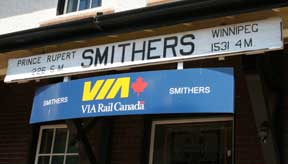
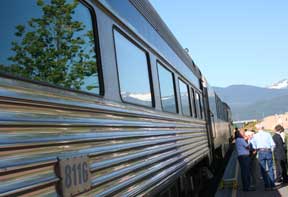
I have known about the Canadian train for some time. I had heard you could buy a pass and get on an off as frequently as you wanted within the time period covered by your pass. This may still be true, but the seats are filled so I do not understand how the system is supposed to work. There were other surprises. When the train left Prince Rupert this morning, there were three cars for passengers. One “fancy” car for the foreign tourists and two cars for the rest of us. No observation car and no dining car. Cindy thought there was Internet access. We don’t even have cell phone access most of the time. I guess things change as you move east.
The trip from the coast to Winnipeg will take 5 days. The trip on the Empire Builder took about a day and a half (although it did seem much longer). This train takes breaks. We stop and get off and walk about for 10 minutes. The whistle blows and everyone gets back on. The train also stops for the night. We have one lay over in Prince George and we take two days off in Jasper. Fine with me. No need to get back for a little while longer and a little more time to take pictures.
I take reading material with me on all trips, but I have abandoned the topics for Muir’s Travels In Alaska. I have read several of John Muir’s works before, but I can’t remember if this title was among them. I don’t recognize the content to this point. While afield, Muir kept copies journal notes and wrote his books later relying heavily on his journals (with sketches).
Today’s picture is from the Totem Bight rain forest. I like the light.
Tomorrow we are fishing for halibut and salmon. It is also the commercial opener for “dog” salmon so the view (hopefully with some interesting pictures) from the boat should be spectacular.


You must be logged in to post a comment.