The net neutrality debate has become more real with Comcast’s decision to cap downloads. However, with Comcast, the present cap is set so high, one would have to be into a lot of online video to approach the cap. I suppose heavy use of NetFlix might quality, but the targeted folks are likely BitTorrent users. As long as the cap is based on volume and not MIME type I am less concerned.
I wonder if there is any way to actually learn how much content a household downloads? If providers keep such data, it would seem reasonable to make it available to users.
TechCrunch has put together a post that summarizes many of the pros and cons and has generated a good deal of discussion.
I have not commented on the words of Thomas Friedman for several months. It is about time. His themes are pretty much the same, but I think we need reminding.
Friedman’s editorial of Aug. 26 used China’s impressive display in hosting the olympics to reiterate his position on what the U.S. is up against. In about a week, a new book, “Hot, flat, and crowded” will be released. I have my copy preordered through Audible and I have listened to the short “teaser” offered for this commitment (similar to another book I recently completed – Earth: The Sequel).
As I understand the theme, Friedman is trying to argue that the current energy situation offers anyone willing to seize the opportunity a tremendous opportunity for innovation and related economic rewards. Of course, the question is whom is best positioned and most motivated to seize the opportunity.
If the hurricane presently taking aim at New Orleans and the gulf does anywhere near the damage of Katrina, energy will very quickly become foremost in our minds and probably the leading election topic.
Maybe the frequent ads of T. Boone Pickens will be taken more seriously.
I went to a football game last night and missed the final evening of the democratic convention. I have since learning that iTunes offers all of the speeches from the Democratic convention (and I assume from the Republication convention) as a public service.
I decided to explore a bit online and see what resources were available.
I met my two Fall classes for the first time today. A total of 270 students and an impossible situation for making a personal connection with many of them. In commenting on this topic, I noted that my syllabi offer a link to this blog and suggested that I use this blog to comment on professional and personal topics. I indicated that most of them were probably more familiar with MySpace and FaceBook and I suggested that I would leave those sites for them.
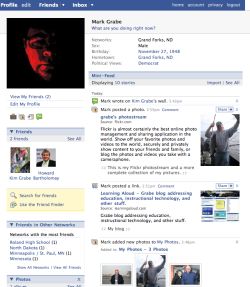
I do have a FaceBook account and within a couple of minute there was an invitation.
I do think the social networking sites are interesting, but I have mixed feelings about the “friending” thing within university academic settings. I remember listening to a presentation in which the presenter basically said – let’s let them have their space. The power of the sites for multi-way and multi-level interaction is what makes the sites so powerful, but also what makes them a little weird in my situation. My daughter is my friend, but the site suggests I might want to “friend” these other 20-somethings who are friends of my daughter. Hmm. Whether or not I had ever actually met any of them with a few reciprocated clicks of the mouse I might introduce them to 200 Intro Psych students at UND. Not saying this would be a bad thing, but I think I will concentrate on writing blog posts.
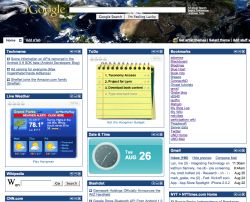
This is kind of useful. Mashable.com offers a comparison of 14 options for personal home pages. I use both Netvibes and iGoogle myself. The core idea is that personal home pages provide the means to integrate a wide variety of information sources and make this information available at a glance. You can craft this page using widgets so you need little experience creating web pages. You can set your browser to automatically bring up this page when it is launched. Local weather, a todo list, RSS feeds, images from Flickr, etc. integrated as your home page.
• Research, development and demonstrations of learning technologies that could include simulations, games, virtual worlds, intelligent tutors, performance-based assessments, and innovative approaches to pedagogy that these tools can implement.
• Design and testing of components needed to build prototype systems. This could include tools for answering questions, for building and evaluating the construction of simulations and virtual worlds that could include sophisticated physical and biological systems or reconstructions of ancient cities brought to life with intelligent avatars (models of humans in virtual spaces).
• Research to determine how these new systems can best be used to build interest and expertise in learners of different ages and backgrounds. This will give educators, parents, employers, and learners the information they need to make informed choices.
It will be interesting to see what research funds are eventually made available and what realistic opportunities various institutions have to compete for these resources.
This is move-in weekend at UND. I love this part of university life – new faces arriving on campus with great hopes for the future. I have always said that one of the great benefits of being a university prof is the opportunity to be part of this annual process of renewal.
Age is becoming an issue. I have worked on a college campus as a prof since 1975. At the faculty meeting on Thursday, one of my age mates announced he was retiring. He is going to work part time doing distance education from Denver. The time for me to make a similar announcement grows nearer. Not quite yet.
Relating is becoming a little more difficult. I used to relate to new students using experiences with my own kids. Now, as one by one my kids have graduated, even this basis for comparison has slipped away.
You would think working with technology would help, but the messages in this field even seem designed to convince me I am out of date – an immigrant instead of a native. However, I was looking through my Flickr account and I came across an image that helped.
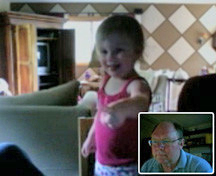
This is a screen capture I generated about a month ago with granddaughter Addie. As a young technology user yet to reach her second birthday, Addie likes to use the computer to talk with “grandpy”. She uses a computer to send video over the Internet and at her age I had yet to experience television. Actually, Addie’s television experiences are limited as well, but that is a parental decision.
So, I walk about campus watching freshpersons exploring with their parents while simultaneously texting to their friends who are back home or showing up at other campuses around the country. I don’t even carry a cell phone. Despite the technical skills that I do have I suppose these students may find me hopelessly dated and unable to relate.
Then, it occurs to me. It is all a matter of perspective and an inevitable part of the grand process. Generations are different and understanding is not always easy. Perhaps these new college students are also already dated and maybe too old to see. The new college students may not understand my life style or values, but Addie cannot understand why they don’t go back to their dorm rooms and contact their own grandpys on the computer. Maybe they just don’t know how yet. Maybe their moms are not there to help.
Change happens and we can always learn from each other as long as we recognize that our perspective is just a perspective.

You must be logged in to post a comment.