In his recent book (Infotopia), Sunstein suggests that we may think we are digging deeply into a topic by participating in an online participatory community, but we must take care that we are not actually echoing and perhaps moving to even more extreme positions by following the premises around which the group is organized (my interpretation).
I have my own remedy. I attempt to purposefully explore contrasting extremes. I have done this in the past sequentially by reading one book and then reading a second book criticized in the book I just finished.
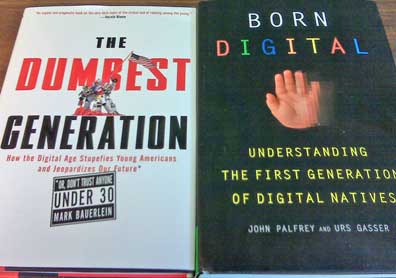
I am now going to try this process in parallel. Two book arrived in a box from Barnes and Noble today.
My next project is to read Palfrey and Gasser’s “Born digital” and Bauerlein’s “The dumbest generation” in parallel. I should have tried this last summer when I had fewer other commitments. Perhaps if I announce my intentions I will make more progress. I am guessing several posts will follow.
I have explored and written about several image storage and sharing sites. LifeSnapz is a new addition to this list. Each time I take the time to experiment with a new service I try out the features and consider what unique role each might serve. If I understand the unique characteristics of LifeSnapz, I would suggest the unique focus is on group collections over time.
By a group image collection, I mean that multiple participants generate a collection. The host invites the participants and as far as I have been able to tell there is no way to offer others “veiwing” priviledges without a specific invite.
The second interesting idea is the focus on “events” that are time-linked. If you imagine a situation in which grandparents might begin to collect images from “family events” (Summer at the lake, 2006; Christmas at home, 2008; etc) over time, you would have some idea where this might be going.
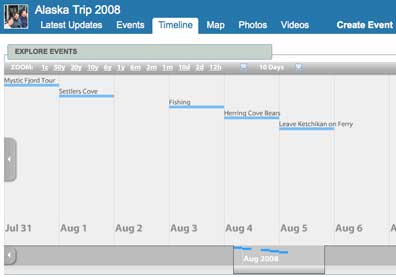
I typically explore by creating a demo. In this case, my demo was based on a collection of images I had from our summer vacation. The events in this collection consist of identifiable activities from each day of the vacation. You see the LifeSnapz timeline below. The timeline is set to the most micro level view because I am exploring events across a week and not years.
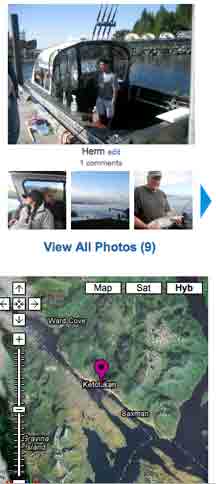
A description of each event and related photos can be created and the event can be geotagged.
Of course, viewers are also able to explore the individual images and associated descriptions organized within an event.
Yes, it was a nice fish!
Consider how a classroom teacher might use this tool. First, the controlled registration system might be useful in dealing with the security issues teachers must address. The event option might also be a way to organize collections of photographs added throughout a year.
I must say that I know little about this company or exactly where it is heading. With all new companies, I always wonder about the funding model. No ads were evident during my exploration. So, the company will likely eventually attempt to charge for access or at least offer a premium version of the system (something like Flickr) or perhaps resort to the inclusion of ads. I tend not to invest a huge amount of time in a service until I have a better feel for the “final product” and until the service has been around for a little while.
At this point, I am willing to say LifeSnapz is worth exploring.
The New York Times uses data from a study by Nielson Mobile to conclude that mobile messaging is now a more popular form of communication than even the cell phone.
The average cellphone owner engages in 204 calls a month, but 357 text messages. The numbers are heavily skewed by those in the 13-17 years who send/receive 1742 messages a month. Is this even possible?
I am hoping their parents have an unlimited texting plan.
My university has held an annual technology conference, Beyond Boundaries, for several years. Some of my past blog posts were generated from the perspective of a participant in this event. Working in a fast moving field such as educational technology from North Dakota is challenging. Internet access and all aside, it is hard to be a leader from the periphery. Hosting a conference of this type was a way to bring some folks here instead of us always going there. I liked the vision and the commitment this demonstrated.
Approximately a week ago as a registered attendee at this year’s conference, I received an email indicating that this year’s conference was canceled. The details were sketchy, but some mention was made of limited travel budgets. I was disappointed and upset by the short notice which I think really makes the university look bad (i.e., we might lose a little money on this so we are backing out), but it was kind of one of those things I just let go.
I have since changed my mind. If you believe in something, it is your duty to say something. Such is the responsibility of the participatory web
So ….
I apologize on behalf of my university, whether I have the authority or not, for this cancellation and for the late date on which it was issued. Sometimes you should do things because it is the kind of thing universities take responsibility for doing. Everything should not be about money and everything does not have to be run on a “charge back” model. Universities have tremendous resources (people, space, Internet access) that are available and paid for. While it would be nice to generate some income with these resources, the resources exist and the money is often spent whether the resources are applied to a purpose or not. If we can find millions of dollars to support moving our sports program to division I despite the reality that nearly every team will lose money, we should find a little money to support a conference we have made a commitment to host.
Perhaps you, as I, have been carefully watching Washington as our elected officials attempt to bail us out of what seems to be a dire economic crisis. Perhaps you can’t figure out why those folks can’t pull the trigger and institute the bail out. I have a theory.
I call this the “You can fool me once” explanation. I propose that we have experienced this combination of national fear, vagueness, and urgency before. Now, as a consequence of quick and unquestioning acquiescence on this earlier ocassion, we find ourselves with thousands of dead citizens and hundreds of billions of dollars of added debt. WMD, Al-Qaeda staging area? It now appears not to be so. Those who signed on in accepting the initial flawed analysis found themselves forever limited in their ability to criticize because of their initial support. FOOLED THEM ONCE!
Now, the concern is that this may be an opportunity to demonstrate that “You can fool me twice”.
I don’t know what should be done at this point. However, in this politicized climate, I understand that despite the urgency urged by some there is a willingness to be careful and go slow. 700 billion dollars? What if we eventually learn we have not used this opportunity to fix the underlying problem and instead have added to the existing financial woes and saddled ourselves and our kids with well over a trillion dollars in debt?
I blame the administration that took advantage of circumstances to “fool us once”. Whatever the causes of the present financial crisis, this is the climate of distrust you have generated.



You must be logged in to post a comment.