Wolfram|Alpha Launch

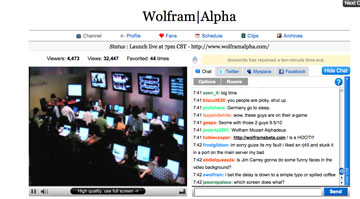
I followed the video feed of the Wolfram|Alpha launch tonight. Offering this as a live feed was innovative and not without several hitches.

wolframlaunch

After a couple of hours, the site went live. I was able to conduct a couple of searches. I was unable to find out anything about me. I was able to obtain a lot of information about Grand Forks.

wolframgf

At present I cannot connect so I decided to just call it a night.

Wolfram|Alpha should be available to everyone soon.

The site is functioning this morning. I am still attempting to understand the intended focus of this service. The FAQ tries:

Is Wolfram|Alpha a search engine?

No. It’s a computational knowledge engine: it generates output by doing computations from its own internal knowledge base, instead of searching the web and returning links.

Loading

Are people getting grumpy?

The school year is drawing to a close. As the end approaches, people tend to get a little grumpy. That was my reaction to a recent post by Wes Fryer. Frustration seems to be setting in. This post complains about the proposed cuts to EETT. The post goes on from there to claim that President Obama  supports a continuation of NCLB. As is typically the case, I expect that the situation is more complex than EETT and NCLB. For example, I anticipate that stimulus money will potentially influence school opportunities to modify infrastructure and invest in technology if decisions at the local level move in that direction. I am guessing many districts in many states are simply attempting to hold on to as many teachers as possible.

Changing minds is important – confrontation is unlikely to convince the majority. The position that drastic reform is necessary only plays well with those who are convinced. The idea is to escape from the echo chamber and influence moderates. I fear some who fancy themselves as visionaries and leaders may find themselves with few voluntary followers.

In my opinion, change will come when advocates:

  • Do something cool that offers the opportunity to inspire learners and convince parents and colleagues on the local level. We need more visible examples. I think we may be getting to the point we have too many visionaries for hire and too few teachers known at the local level with impressive student work to share.
  • Support research. How else will we really know what makes a difference? I am not convinced that we have important answers in hand. Complaining that standardized tests miss important skills is fine. If you are an advocate support research using some other dependent variables.
  • Answer the question of why new teachers are no more innovative in their use of technology. Why is it that supposed digital natives teach like those of us of more advanced age? What about present opportunities fails to translate into classroom practice?

BTW – I have read the Texas “immersion” research as well (the 2009 summary (a pdf) is available) and the results are mixed and in some cases negative. To claim this research warrants a general commitment to a 1:1 model is simply wrong. In fact, the report indicates that following the period of support some schools decided to back away from a traditional one-to-one model. The report (according to my interpretation) also seemed to imply that teacher and administrator beliefs about how students learn influenced how technology is used. This sounds a lot like Windschitl & Sahl (2002) and other older research.

Loading

Coolpix P6000

I bought Cindy a Coolpix P6000 for Mother’s Day. Some husbands get pressured into giving diamonds by those horrid television ads, but I give a present that shows I really care. Just wait – this is so cool – you will see.

So, because it will eventually be her camera, I decided the first pictures should be of her. I caught her in her favorite location watching television while reading blogs.

cindyoncouch

Now, I load the pictures into my Mac within the most recent version of iPhoto. Looks like Cindy so far. BUT, I click on the small “i” (information) that appears on the thumbnail, the picture flips over AND

gpscamera1

I know that Cindy and the couch are located in my house (easier to see when full size).

I think Cindy will have a great time with this camera and she will be very surprised on Mother’s Day. Don’t worry, she seldom reads this blog and she is used to me running around doing strange tech things. She won’t suspect a thing.

Oh – the camera is GPS enabled if I was not making myself clear. Now all my mountain pictures will not only be beautiful, I will actually know which mountain (approximately) I am looking at. I mean which mountain she is looking at.

What a great tool – map images very precisely to a map.

I see the time is wrong – I got too excited and started learning before I read the instructions.

Loading

Hmm – maybe simple is not so good

compositesayings

Every Monday evening I teach a class but I am the only person in the room. It is a graduate educational psychology course which is supposed to be offered face to face and also at a distance. I guess the face to face students have decided they would rather have their dinner and watch me online. Anyway, I sit in this classroom with some fancy technology and a lot of empty seats. Because the technology is not fool proof (or Mark proof which I hope is different), I arrive early and make certain I get things up and running. Usually I can and this leaves me with time on my hands. One of the unusual things about this room that has captured my attention over the weeks are the “statements” on the wall. I was going to call them platitudes, but I looked up the meaning of platitude and decided this might seem derogatory. I will call them statements. This evening was my final virtual face to face meeting and I was able to get the technology working so I decided to spend my free time using my cell phone to capture some of  these statements.

What is it about such statements that would warrant painting them on the walls of a perfectly good classroom? I think we take comfort in simplicity. I think this is what bothers me – I don’t think the world is simple. I keep thinking of complexities and exceptions. I am guessing adding this complexity to the wall of knowledge would not be appreciated.

One of my recent self-imposed strategies for personal development (translate entertainment) is to force my way through books that present very different views on the same topic. My colleagues who are clinical psychologists would likely be fascinated by this behavior, but to my knowledge they do not read blogs so I think most will continue to assume I have a grip on reality. Anyway, I have completed this exercise with several topics. The most recent is copyright. Perhaps you have not read many recent books on this subject, but I can assure you that it is possible and you will find suggestions in the following material in case you feel the need.

I have read several books by Lawrence Lessig over the past couple of years (The Future of Ideas, Free Culture). You may recognize the name and you may recognize his association with the concept of “Creative Commons”. You will find multiple references to Lessig in this blog (some should surface via the automatic “related post” feature. In general, I am a supporter of copyright and tend to see Lessig as much more liberal on this matter.

Anyway, I recently came across a reference to works by an individual who evidently had come into what is by now a fairly public disagreement with Lessig. A fiction writer, Mark Helprin, wrote a piece for the NY Times with the title “A great idea lives forever. Shouldn’t its copyright“. In response (at least as I can follow the story), Lessig opened a wiki site, pointed to the NY Times article, and asked folks to write a response. Helprin reacted to the wiki and eventually put together a recent book (some new material and some reprints) entitled “Digital Barbarism” (Helprin interview). This book focuses on multiple themes – the opposition to copyright, the limitations of collaborative text in contrast to a work that is the responsibility of a single author, the decline of culture, etc. NPR has an page with multiple links associated with this discussion – an excerpt from Digital Barbarism, a short interview with Lessig, a link to the Lessig wiki, etc.

Dueling books. What a great idea? Get folks to purchase the next salvo and pitch in to keep the controversy going.

Thanks for making it this far – there is a point here somewhere and it may surprise you. I turns out that I can agree with many of the positions taken by both authors. My concern is that others who have read less of their content may take a side. BTW – this is what I think Helprin says many do. I am not certain that you will make the effort, but listen to the Lessig audio. He does not claim anything in print is fair game for copying. I am also in fairly close agreement with Helprin and argue that those who feel copyright is retarding education, economic development, or whatever are probably living in an ivory tower, wealthy from works completed before they decided content should be free, or making their living giving speeches about free content. As far as perpetual copyright goes, that idea does seem excessive. You may find Helprin’s style a little too wordy – he generates an analysis and takes a position like a fiction writer. I get the feeling that saying this may brand me as somewhat backward culturally and he may seek me out to tell me so. The prose is somewhat entertaining and I am starting to enjoy it now that I am past the point of assuming that I was about to read was a legal or functional analysis.

I sometimes wonder if folks want to think their behaviors are justified and latch on to a related idea without a full consideration of the context within which it was embedded. They pass their perceptions around and the frequency with which similar snippets are encountered lends further justification. Simple is not necessarily good when life is complex. Simple is not good when it prevents one from dealing with the messiness of important issues.

BTW (I use this improper form knowing full well it has not been approved by the more literate among us), the image of Mickey Mouse is not necessary for the continuation or improvement of educational practice. I agree that holding the rights to the image of a mouse is silly, but just what do we assume we must borrow from the owners to do a better job. We are not talking here about patents and other legal impediments that prevent access to life saving drugs or devices that may assure our survival. We are describing words, sounds, and images. You are completely free to offer your interpretation of these forms and can do so without making a second copy. In addition, as an educational exercise, your efforts to do so likely has far more benefit anyway.

Don’t be evil (sorry if I copied this phrase) and don’t be lazy.

Loading

Trail Camera

My brother Dan is an engineer, but he has a unique hobby. He develops wildlife habitats. The “riparian” is a seventeen-acre plot developed on a farm Dan and a couple of my relatives own in Iowa. Dan hunts there some, but mostly just enjoys the challenge of restoring the habitat and watching wildlife.

His new toy is a “trail camera“. This is a fairly inexpensive digital camera that is triggered by movement. You set up the simple camera in an area (a trail I suppose) where you expect wildlife to be.  After some time passes, you come back and see what images you have collected.

ripariandeer

Dan sent me a few pictures a couple of weeks ago (a partial frame with a deer and some geese on the beaver pond you see above), but this new image is really pretty cool. There must be some educational applications here. What about the reality of not being able to take frequent field trips. What if a class could position a camera (via a teacher or a student with access) and then explore what they might find?

I have had this debate with teachers, sometimes biology teachers, from time to time about technology. I often do not immediately reveal some of my personal interests. The teachers often assume that my use of technology involves siting in front of my computer and exploring virtual worlds. I ask about their last field trip and what they and their students did afterwards. Virtual worlds are actually not my thing – I like being there. I tell them after my trips I continue to explore what I saw.

Loading

Maybe it has been made out to be worse than it is

It has been a while since I have posted here. I have been working on some other writing projects, posting on my microblog, and reading. I have decided I want to use this site for longer and more serious posts and the microblog for identifying resources I come across and for just playing around.

I wanted to finish the book I have been reading before writing something for this site. The book, Fertilizers, pills, and magnetic strips: The fate of public education in America (G. Glass), has a strange title, but a very interesting concept. There are many components to this book, but a core idea is that the reform agenda focused on supposedly underperforming public education is far less about offering quality education to all students and more about the political struggle to reduce the cost of education for most while securing opportunities for the wealthy. The title is weird (I may make the effort to explain later), but there are a couple of useful components of this book – a discussion of whether the data used to evaluate general achievement in public schools really demonstrates the fading of US schools in comparison to international competition and an explanation of how the present constellation of reform strategies (home schooling, vouchers, charter schools, high stakes testing, voucher systems, and tuition tax credits) are really mostly about discrediting public education so that public investment (taxes) can be reduced and those with greater wealth can focus their resources on themselves and their children rather than “other people’s children”.

What about the test data? I have read a book on standardized tests and the perspective that is perpetuated based on shoddy analyses of these data before (Berliner and Biddle – The manufactured crisis). Glass mentions their work and comments on how it has largely been ignored. You have to understand that Berliner, Biddle, and Glass are some of the real heavy weights in the evaluation and applied statistics field. Glass is usually credited with “meta-analysis” – the statistical procedure used to combine the outcomes from multiple research studies in a way that allows some general statement about the effect of the treatments involved. If you come from the position that one should reach conclusions based on sound methodology and data, these folks are legit.

Anyway, Glass concludes that the data from various tests (SAT, NAEP, TIMMS) used to argue that US schools are failing miserably really do not warrant such conclusions. Among some of the issues I highlighted:

The SAT is really not a test designed to evaluate K-12 achievement. It is an test designed to assess aptitude for college performance (hence the name scholastic aptitude test). It was specifically designed to predict performance in some specific areas and not appropriate to test a wide range of skills and knowledge.

The TIMMS is often used as the basis for international comparisons. This is actually challenging and is based on important assumptions – groups are equivalent, content receives equal emphasis, content knowledge and skills are understood in the same way across nations. As examples of some imortant issues, Gage points out that the science and math components rely on the metric system (still not the common measurement system employed in this country), the US was among 4 countries that did NOT allow the use of calculators, and education systems are not equivalent in terms of basic characteristics such as the age of high school students (e.g., Icelandic test takers who happened to score above the US in math averaged 21.2 years of age – roughly equivalent to a US college junior).

Gage suggests that the most appropriate use of exam scores for states or nations given some of these measurement challenges is to determine whether scores are going up or down. Contrary to what one might assume from reading the local papers, scores in the U.S. are increasing.

I do not pretend to be a measurement expert – the issues involved in exploring the complex datasets used for such analysis are not the type of thing I play with when I sit down to run some regressions or a MANOVA in SPSS. I do think it is fair to suggest that the arguments Glass makes are not the message you have probably encountered from the usual sources. If there are counter arguments, I would like to hear the debate.

Blogged with the Flock Browser

Loading