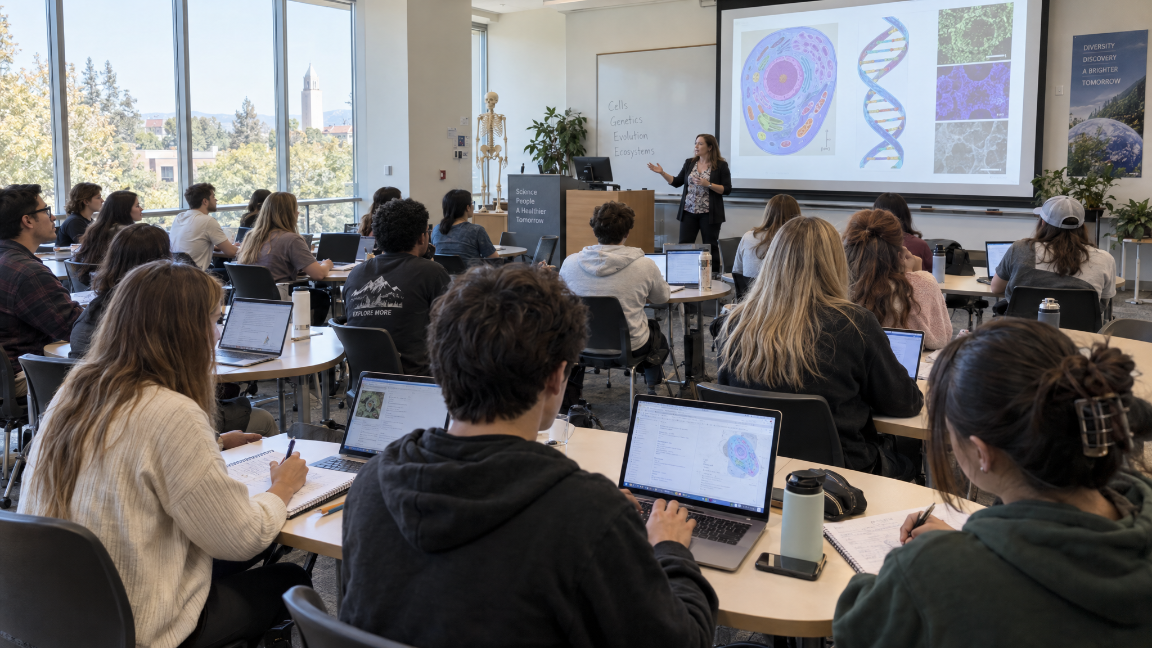
A colleague of mine runs a book club in which I participate and as we often do, we deviated from discussing the “book of the month” to discuss other matters. A recent discussion focused on his efforts to redo his online history courses using microlectures (an example). Ideas seem to “cross-fertilize” for me, and the idea of microlectures (microlearning) surfaced thoughts from recent reading I have been doing on how lectures tend to challenge quality note-taking, and how segmented lectures could improve the related studying that follows. By segmented lectures, I mean a lecture in which the presenter pauses to allow time for a student task. My personal exposure to segmented lectures came from a classroom redesign that faculty colleagues who received instructional development money created, in which students sat around tables to listen to lectures. This arrangement was intended to let the instructor pause and require students at each table to engage in some form of “active learning” task. The demos I witnessed did not involve note-taking, but as I will describe at a later point, comparing notes during these pauses could have been an option. My own classes were too large (180+) so even this special “lecture” setting would not have been adequate.
Microlectures, a subcategory of microlearning, tend to use short, focused videos in which an instructor explains a single key concept or specific skill. These tend to be videos rather than live presentations and are a common nonclassroom “just-in-time” learning approach. Most of us have experienced this approach without ever labeling it. When I spent a lot of time learning specific programming techniques (e.g., PHP), I purchased access to a service (Lynda) that offered video courses made up of short segments (3-10 minutes) covering specific skills. I see Lynda has morphed into something new, perhaps because it is easy to find similar videos at no cost from YouTube. Microlectures are common in what some would describe as “training” environments, but not in academic settings. However, It appears that “short presentation” videos made an appearance during the COVID years to hold the attention of those trying to learn under those circumstances, and they may be an example of what became known as a “flipped classroom” (short videos to watch before a class meeting). Now that our instructional situations have returned to more traditional approaches, the approach my history colleague is using seems relatively rare.
Segmented Lectures and Taking Notes
I created the phrase “segmented lectures” to describe a strategy I encountered while reading research studies that sought ways to improve lecture notes and the subsequent study experience based on those notes. The strategy required the instructor to pause during a traditional lecture to focus on improving the notes taken during the previous presentation segment. Hopefully, you can see how I connected this to the microlectures body of work. My personal interest as a digital note taker was piqued by research that claimed handwritten notes contributed to better understanding because handwriting is relatively slower than keyboarding, and to keep up, students have to select the most important content and summarize it instead of recording ideas verbatim. Through what I see as twisted logic, a less efficient process was somehow claimed to produce a more effective outcome.
The intersection of microlectures and note-taking becomes especially compelling when you examine what cognitive research reveals about how students actually capture and retain lecture material. Most educators and students think of note-taking as a two-stage activity: recording during class and reviewing before an exam. Researchers (e.g., Luo and colleagues) argue that this view overlooks the critical middle stage: note revision.
The practical problem revision addresses is important. When students take notes in a single pass during continuous speech, they typically capture only about a third of the important information presented. While main ideas are noted reasonably well, secondary details and deeper conceptual relationships drop off precipitously, leaving massive gaps. Because missing a concept from lecture notes reduces the likelihood of recalling it on an exam, note completeness directly dictates student achievement.
This is precisely where the design of segmented lectures and microlectures relates to these empirical findings. Researchers proposed that lectures might pause periodically to let students review the notes just taken and make adjustments. Some studies outlined specific ways to make these delays productive. For example, Flannigan and colleagues paired students to enrich their idea collection. When students compare notes with a partner, they prompt each other to recall omitted details and examples through collaborative retrieval. While sharing notes alone doesn’t automatically lift test scores, the interactive dialogue helps students identify blind spots in their individual records. It was this strategy that reminded me of the “active learning” concept I explained earlier.
Studies comparing different revision routines found that pausing periodically throughout a lesson to let students revise their notes yielded significantly better results than waiting until the entire lecture finished. Short, distributed revision breaks, say two to three minutes, allow students to use the fragments they just jotted down as immediate retrieval cues to fill in missing logic and flesh out partial thoughts before cognitive decay sets in.
Contrary to my expectations, Flanigan and collaborators tested the full sequence of recording, revising, and reviewing and found that students taking longhand notes benefited more from revision intervals than those typing on laptops. Longhand note-takers added roughly three times as many complete ideas during pause breaks and performed half a letter grade higher on subsequent assessments. I have no explanation for this difference.
Bringing these threads back to microlearning and segmented design, short, tightly focused instructional segments bounded by deliberate pauses offer a natural answer to the note-taking dilemma. Instead of treating lecture videos or classroom talks as uninterrupted streams of delivery, brief pauses transform passive viewing into active processing. Whether students use those two minutes to flesh out shorthand points, draw connections, or cross-check key takeaways, carving out dedicated time for revision converts a fleeting lecture into a durable, complete study record. (see Zheng).
Summary:
A lengthy lecture overwhelms most learners’ ability to take useful study notes. Both pausing during a lecture (segmented lectures) or using short, focused video lectures (microlectures) allow learners the time to create notes more effective for study.
Sources:
Flanigan, A. E., Kiewra, K. A., Lu, J., & Dzhuraev, D. (2023). Computer versus longhand note taking: Influence of revision. Instructional Science, 51(2), 251-284
Luo, L., Kiewra, K. A., & Samuelson, L. (2016). Revising lecture notes: how revision, pauses, and partners affect note-taking and achievement. Instructional Science, 44(1), 45-67.
Zheng, H. (2022). Short and sweet: The educational benefits of microlectures and active learning. EDUCAUSE Review. https://er.educause.edu/articles/2022/2/short-and-sweet-the-educational-benefits-of-microlectures-and-active-learning
