I have been an Apple in education guy since the 1980s. The potential of the new NEO for that market immediately caught my attention. So many podcasts have speculated about the potential of the Neo in the marketplace and one of the participants on Macbreak Weekly changed my mind concerning the Neo as a Chromebook killer. She argued that the price point of the Neo or lower-end iPads is only part of what the school-based tech people consider. Apple or Microsoft has no viable alternative to Google Classroom and the structure and security issues addressed are worth a lot to school tech decision makers.
How popular are different tech products in K12?
You might think providing data on the recent history of school purchases of Apple, Windows, and Chromebook devices would be simple. Some source must have found this topic to be of interest. I have tough expectations for what this would look like with Chromebooks showing a sharp rise in recent years. What I was less certain I understood was the comparative tracks of Apple and Windows equipment. I have been retired now for about a decade so I have spent only a little time in schools. I expected popularity comparisons would show Apple somewhere between Chromebook and Windows machines.
There are no “official statistics,” and some of the most carefully acquired have value to businesses interested in the education market, and require you to purchase the reports (e.g., Futuresource). Data I could locate was inconsistent and no source fit my expectations. After multiple searches, I asked Perplexity to generate a graph for the 20 year period I wanted and that graph appears below. I did find similar general descriptions elsewhere to my surprise and the issue here is whether the new and less expensive Apple computer will change this trend.
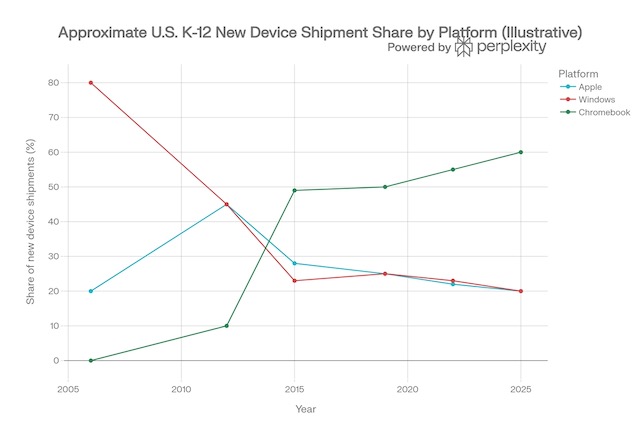
Why Chromebooks will likely continue the tech of choice?
So, Google’s Chromebooks have maintained a stranglehold on K-12 classrooms. While the Neo is a device that brings the prestige and power of macOS to a price point that schools can actually afford, the decisions those who make purchases depend on more than the cost of the equipment.
The real reason Chromebooks will likely still be preferred isn’t just the lower price tag; it is the infrastructure of Google Classroom and the Google Workspace for Education ecosystem. Until Apple builds a direct, functional competitor to Google Classroom, the Neo is just a nice laptop in a room where everyone is already tied into a different system.
When a school district buys a large number of devices, often in the thousands, they are looking beyond a reasonable price point and hardware sophistication. Organizations also consider manageability and deployability – how to oversee how devices are used and how to set them up quickly and efficiently. Apple has always focused on individual users. When the machine assigned to an individual has an issue or selects one from a classroom card, each student simply signs in to the new machine, it is personalized, tabs, documents, and settings like the last time they connected. The design of Apple equipment maintains an individual’s priorities and content on that individual’s machine.
The Google Classroom
Google Classroom was designed with an understanding of the school day and classroom tasks. It connects to Google’s online services – Google Drive, Calendar, and Meet and gives the teacher some level of immediate access to student accounts. Teachers have a way to distribute and grade assignments. Google Classroom allows a teacher to “make a copy for each student” with one click, see real-time progress on an essay, and provide instant feedback. The system works great because Google owns both the productivity suite (Docs/Sheets) and the management layer (Classroom).
Built for Collaboration
Google Docs was built for the web and for collaboration; it was built for twenty students to be in the same document at the same time without the system crashing or creating “conflicted copies.” Students can peer-edit, work on group slides, and share data in real-time. These capabilities can be accessed on the devices from other companies, but if classroom tasks are heavily dominated by tasks Google makes easy why add the complications of equipment that is not as easily integrated?
The Cost Issue at the Level of the System
As I understand it, Google Classroom itself is generally provided at no additional cost to schools as part of Google Workspace for Education. The cost of Google Workspace depends on what schools want. There is a free tier for eligible institutions that provides the core tools such as Docs, Drive, Gmail, and Meet. Schools can also pay for other features that meet common needs, such as advanced security, analytics, admin controls, and additional teacher tools. I couldn’t find pricing details as the charge to the schools depends on the number of classrooms and teachers.
Additional Comments
Teachers don’t choose platforms; districts do. Procurement decisions happen at the IT/admin level, not the classroom level. In considering Apple versus Microsoft in the business environment, the same issue seems to apply. In schools. Google won those relationships early and aggressively in the 2010s, and switching costs are now enormous — not technically, but now in terms of retraining staff and migrating years of curriculum materials. It seems to me Windows and Apple equipment will continue to have value in specific school applications but overcoming the inertia of a device and services suited to the most common tasks would be a massive challenge. If we get to AI on devices, perhaps things will change.
Other companies have attempted to develop competing services. For example, Microsoft has Teams for Education. This product is regarded as capable, but teachers reportedly find Google Classroom much easier to use.
Summary
Understanding why schools adopt a given type of tech hardware may not be as apparent as some may assume. This post argues that even given a similar price point other factors are important and Google has a lead when it comes to the basics of common classroom practice.

You must be logged in to post a comment.