Tim Wu, in his recent book, The Age of Extraction: How Tech Platforms Conquered the Economy and Threatened Our Future, examines the timeline of a variety of platforms and the manner in which they consistently morph from being initially attractive, innovative, and genuinely helpful resources into systems that become confining, controlling, and ultimately draining for their users. Using examples that range from Facebook and Amazon to UnitedHealth he argues that this transformation, from open utility to extractive gatekeeper, is not an accidental side effect, but rather a predictable, structural characteristic of platform business models as they achieve scale and market dominance.
In considering the examples from Wu’s book it occurred to me that while he emphasized the major players a wide variety of people use, the same issues apply to smaller platforms. Those of us who write and use platforms to share our work (e.g., Substack, Reddit, Medium) have likely experienced the same timeline.
Many authors who write books with a similar message to The Age of Extraction do a great job of explaining the problem and its history, but even though they make an effort offer little as a remedy. I have read many such books. I typically find myself contemplating but failing to generate suggestions to augment what the author was able offer.
Like Wu, I bought into the original promise of the Internet as a leveling platform that would give content creators, sellers, and the “little guy” in general greater opportunities. In the early days (2002), I started a blog and did so from a server that was also my desktop computer (I worked at a University and had a dedicated IP which was more of the challenge than the ease with which any Mac could be used as a server). Things change. I now pay a hosting company a couple hundred dollars a year to allow me to run blog software and the related backend database and register my domain name. Still, as a hobby, once I pay for the space, I can function independently.
I believe the way we create and share content has changed. You can still do it, but it seems you have fewer and fewer regular readers. I have noticed a change that suggests more and more of my posts are read through search rather than by readers who regularly view the blog. I track hits out of curiosity and find little immediate interest in most posts. I check say a year or six months later and find that some posts have been read hundreds of times. Logically, I interpret this to mean I have written something that people found through search. I shouldn’t complain about this, but the switch from pure search to AI search now being developed by the big platforms means there will be far less attention to source material when an AI summary based on this homogenized and integrated material is made available. This is an emerging but I think obvious issue and a perfect example of what Wu means by platform extraction.
The big switch (another book) to focus on extractive platforms has resulted from a) integrative platforms such as those I have already mentioned hosting multiple content creators and b) a related move away from the use of RSS readers by individual consumers. I certainly understand the benefits of single-stop platforms that provide a convenient way to reach a wide audience. My complaint is based on the history of these platforms. The pattern of extraction is evident. Start by offering a service in which the platform and content creators share in the risk and the rewards, and once a critical mass for a network effect is achieved, reduce the benefits to the producers and to the consumers. Wu suggests Amazon makes a familiar example of this approach.
I do post my content to one of these community platforms and continue to post the same content to my own blog. Yes, this means I pay twice and I continue to be frustrated by this situation. One approach allows me to own my content and the other to reach a larger audience – for a price.
My solutions:
I do have suggestions for an alternative approach, but I understand that each requires an effort that most consumers are unwilling to invest. You can be your own platform with easy-to-use tools.
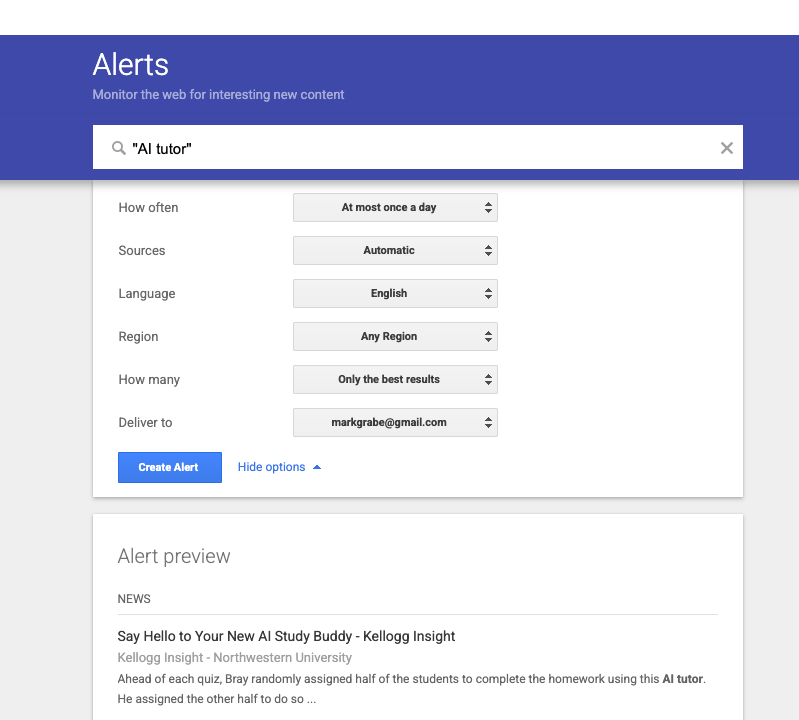
Use Google Alerts – Yes Google is a big company, but it does offer some beneficial services. Google Alerts might be imagined as a period search process based on specific interests you specify. You provide a typical search request, then select how often you want to receive the results. Updates are sent to you in an email periodically according to the time intervals you request. I have multiple alerts that generate a week list of new content. In this approach, you are following a topic rather than specific content creators.
RSS is still around and modern readers make the process easy to implement. With RSS, you designate the sources (e.g., specific blogs) you want to follow, and an RSS reader accumulates new content generated by these sources. You check in to your reader when you have time and see what is new. Some contend that Google’s abandonment of its very popular Reader in 2013 signaled the end of this tool category, but more modern alternatives have since emerged.
Yes, RSS readers do offer a subscription level and any provider realistically has costs. While the pro level offers great features, most users will find the free level meets their needs.
My preference is for web-based readers – the service is accessed through a browser rather than standalone apps. Feedly is my recommendation. I like Inoreader and Reeder (Apple) as apps.
I have written more detailed descriptions elsewhere (Feedly, Inoreader) and you could consult these sources if you need more information.
Summary
I didn’t really intend this post as a book review, but Tim Wu’s book is interesting and informative. As I suggested, the book identifies the typical timeline of extraction consumers should recognize and use to guide their decision making. Again, solutions, should that be what you are seeking, are not easy to imagine.
I think we have a classic “chicken and egg” problem with platforms versus independent sources. Content creators will go where their content is more likely to be consumed. Tools for sharing will exist and be improved where there are content creators and content consumers.
For the great majority of creators and consumers, the motivation of income is deceptive and a trap. Most writers would seem better off thinking of their goal as visibility rather than profit. Writing for a platform for the vast majority should be treated as a hobby, recognizing the reality of being trapped by the network effect.
