Serious Hobbies

Educators sometimes look to experiences outside of the classroom in order to identify ways in which classrooms might be improved. Such was the case with games. In studying games, these researchers were attempting to understand what about games seemed to encourage the passion and learning that seemed to be associated with complex games. Some go so far as to believe that skills can be learned from existing games (not necessarily designed to teach traditional subject matter) that are relevant to  academic skills. You hear the phrase “serious games” used quite frequently in reference to this area of research.

Why games? If I were to apply this same logic, I would study hobbies. I know this is already being done with citizen scientists. I have a retired professor friend who studied amateur astronomers on NSF funding so I know that mine is not an original idea.

I think the serious hobby thing needs a promoter. The first thing I would do would be to make the activity sound more exciting and relevant. I think a more descriptive title would be helpful – serious hobbies. I think serious hobbies could give us a better way to expand our educational perspective than serious games.

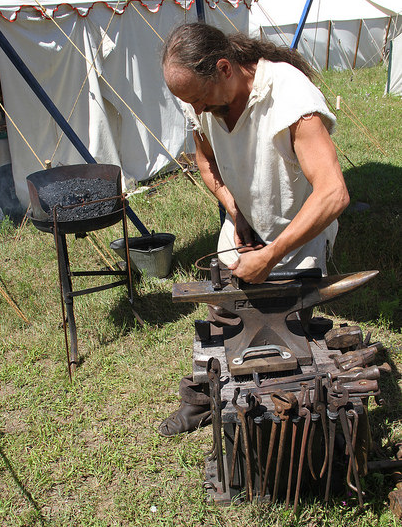
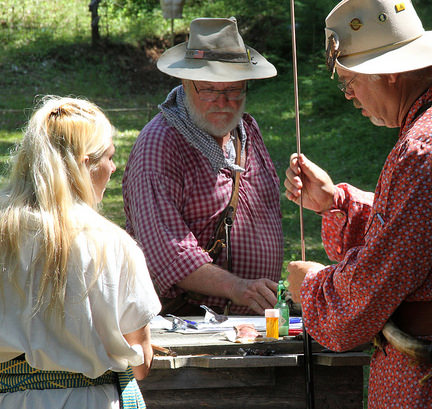
I have been attending a rendezvous for several years just because I find the people so interesting. I would have assumed that these folks were history teachers and this vocation encouraged the “live in the woods in less than ideal conditions in the summer experience” as an avocation. From talking to some of the folks this seems not to be the case. Some are retired. Others seem to just find the quest for the “authentic” experience challenging. So you have the blacksmith hobbyist, the baking hobbyist, the black powder marksman hobbyist, etc.

One thought that always occurs to me. How do these folks convince their spouses and children that this is a cool thing to do. Live in these tents without mosquito netting and wear authentic period clothes.
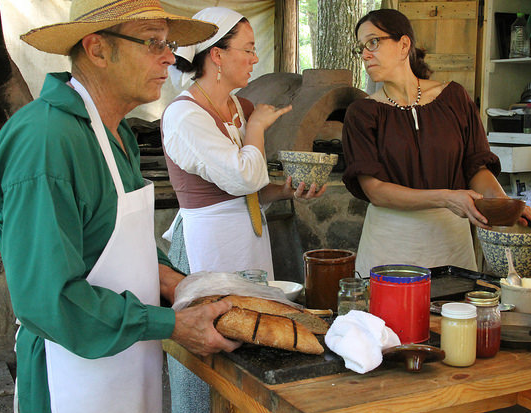
baker


bpowder


smithie

Loading

Office Online

I frequently write about Google apps which I feel offer students great opportunities and value. While I believe Google offers the best resources of this type, I also believe that without competition companies fail to improve and take advantage of the commitment of their users.

So, I propose that if you are a committed Microsoft user that you try out Office Online. I was surprised when I tried to investigate this service and found that I already an account. Evidently Office Online is the follow-up to Microsoft web apps and documents created with Online are stored in OneDrive with is the follow-up to SkyDrive.

Online is a free product that offers a software as service equivalent of Word, Excel and PowerPoint. The free version comes with 15 gigabytes of storage. Microsoft offers a service similar to Google Apps for Education – Office 365 Education.

The Verge offers a comparison

Loading

Real names

Google will no longer require that you use your real name on Google+. A comment from the company indicates that the change was in response to user requests.

How a blog, web page, or social account should be attributed is likely one of those issues for which there is no perfect answer. Those of us in education may see the issue as it relates to the use of social media by students.

However, it is useful to recognize that privacy protects both the good and the devious. What is that expression about a dog on the Internet? While I understand the privacy argument, I also would like to know when I should not assume I know who someone actually is. Perhaps the Google policy should allow pseudonyms, but require that such “names” be identified as such. We have the hashtag for a purpose. How about ~grabe?

Loading

Newsify

I still make use of rss and an rss reader. My workflow for reviewing new online resources is to search my feed using Feedly and send the URLs I want to store or work with more extensively to Evernote. I use the personalized Evernote email option to save content.

Feedly has announced a pro version that has some interesting additions. One stores the entire content of a page to Evernote. My issue with the pro version is that the cost difference between the free and the paid version seems overly large to me. I do pay for a pro version of Evernote and would do the same for Feedly at a more reasonable price.

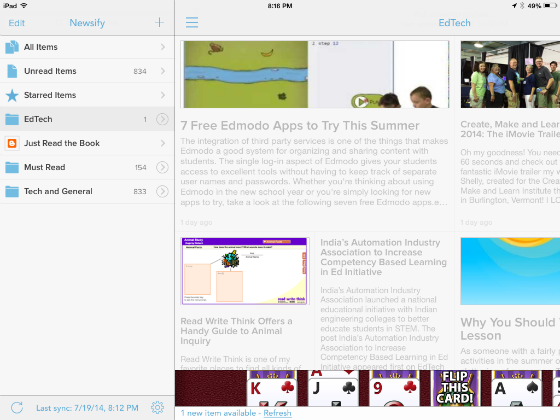
Newsify is a  new RSS reader that taps into the Feedly feed, but presently saves the entire page to Evernote at no cost (the app is free). I assume Newsify will eventually figure out how to make money and charging for some services may be part of the transition, but a present the service is probably trying to build market share and offers some advantages.


newsify

Loading

Tablets and Reading

I encountered two posts today that concern “deep” reading and tablets – one negative (Chronicle of Higher Education) and one positive (te@chthought). Just for the record, both articles are observational/opinion pieces and the Chronicle article seemed primarily focused on long form (books) reading in the humanities.

Both papers make some sense – e.g., we are distracted when we can use the same device for reading and for other things, we can follow links to explore a basic idea in greater detail. There are some oversights – not all tablets (basic Kindle reader) are designed to encourage multitasking, cost is an issue educators/students do care about, online reading can result in fairly detailed annotation and highlighting, etc.

I must admit that I seldom purchase a book (since this is the focus of the negative position) in hard copy anymore. However, I purchase many more books than was the case say 15 years ago. I quit reading scientific journals in the paper format because reading online was far more efficient, allowed me access to many more journals than I could own or my library carried in paper form, and allowed more sophisticated note taking and highlighting because of search and storage capabilities.

I am pretty much convinced that ebooks are the format of the future. Technology tools associated with reading (broadly defined) will continue to improve (paper books would seem to have little upside). We may have behavioral flaws that have permeated our reading activities, but the distractions are there unless we seclude ourselves in a setting without access to devices or the Internet. I would hate to think that isolation is the only role for the libraries of the future.

Loading

Disco

I have discovered disco. My discovery has nothing to with mirrored balls, Donna Summer or the Bee Gees. Disco is a disc copy utility for the Mac that is still available, but not longer under development. The developers are now offering downloads with a password at no cost.

The problem

I am working on the revision of a Kindle book. My plan was to create a more current version of the existing book using Pages. It turned out that Pages 10 can not be used for this purpose because it has been “simplified” and features I need are no longer available. I need iWork 9. You cannot obtain version 9 from the online store, but Cindy had 9 on a DVD. The problem was getting the install to work on my Mac Pro – no DVD drive.

disco

Disco allows you to create a disc image. So, the solution to the driveless Mac problem was to create a disk image. Load the image on a flash drive and install from the flash drive. The install worked great.

So, if you have been frustrated installing software from DVDs you used on older machines on a Mac Air or Powerbook, try this technique.

Loading

Evaluating Kahn

The government is spending nearly 3 million to evaluate the “efficacy” of Kahn Academy math tutorials. The research will be conducted by WestED and will follow the randomized-control methods proposed as the best way to eliminate the confounds present in  so much applied research. Careful research methods require this level of funding.

This evaluate effort seemed familiar and a search of my blog confirmed a similar evaluation of math software that was part of the original NCLB initiative.

Loading