Much has been written and argued in opposition to the “long form”. Whether it is opposition to textbooks or lectures, those thinking something different is required argue that the long form is too passive, too boring, and not sufficient to develop the skills required for some new form of job or citizenship. I am careful to use the term “argued” because to my knowledge there is little data to authenticate these claims. Reliance on argument over data seems a more acceptable practice in politics and social sciencs in constrast to what are typically labeled “the sciences”.
When someone offers a defense of the “long form”, what is your approach in interpreting the arugments advanced? It is challenging to recognize that similar arguments can be advanced for competing positions.
If you are in favor of active thinking, how do you interpret the position that active means developing the capacity for sustained attention and personal processing of information provided by others (thinking and note taking related to lecture)? How do you interpret the position that what the future requires is the capacity to critically evaluate the positions taken by others and contrast them with your own. What do think “spoon fed” implies – extended arguments by experts or isolated bits of experience assuming the capacity to integrate? Where should the personal commitment (motivation) to learning originate – the student or the instructor?
The Newseum has a new program directed at teachers and students – NewseumEd. The site offers resources (primary sources and lesson plans) focused on media literacy, freedom of the press and related topics associated with the media. The collection is extensive – 500 documents and more than 80 lesson plans.
I have generated several posts making the argument that the use of ad blockers ignores the desires of those making the effort to generate content. I recognize that the use of pop-ups and multiple banner ads on a page can be obnoxious, but the solution is to avoid this content. Avoidance allows the author to offer content as he/she desires and prevents you from experiencing content in a framework you find annoying.
Anyway, I do use Google ad links. These links are minimally intrusive. An issue with ad blockers is that most block everything whether the ad content is actually intrusive or not. I have been interested more as a matter of principle than income. My use of ads makes only a minimal dent in the cost to me of renting server space.
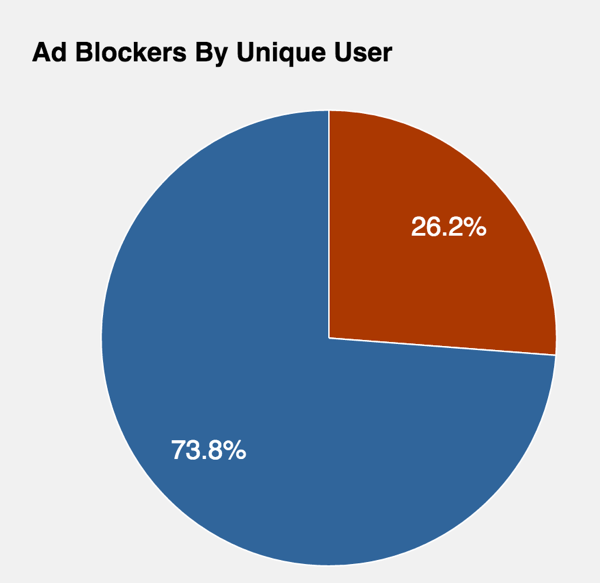
I have been tracking the percentage of viewers who examine content on this site and block the ad that appears in the left-hand column. Here is graphical summary from the past month. The red section represents the use of an ad blocker.
Watching my kids raise their kids is interesting. I am a psychologist with some expertise in the area of adolescence, but I can’t say that my approach as a parent was that planned. I guess I would describe my approach as be supportive, be aware, and try help when problems develop. Perhaps my wife was more prescriptive, but I don’t think so. We wanted our kids to do well and be well rounded, but beyond sharing expectations we required few specific choices. Again, what I describe is my impression and not necessarily the impression of all involved.
Screen time is one of those issues that seems new to me. I do not think we had household rules regarding screen time. My kids missed out on several technologies we now take for granted. Internet activities were not part of their experience. We had two phone lines (no cell phones), but this abundance was allowed so we could use the “teen line” for a phone modem. Disputes were related to who had priority on the second line, but not how much time was allowed. What I don’t think we had were rules regarding how much television viewing time was allowed.
My own children as parents vary in their expectations but they do talk about screen time. Of course, we gave our grandchildren iPads so we have played a role in shaping the environment that must be addressed. Specific time limits do come up and I sometimes hear reference to a specific number – you can have 30 minutes of iPad time and then you need to do something else.
Our kids get these numbers from somewhere. All are well educated and with their spouses seek out information on parenting. One influential source of such information has been American Academy of Pediatrics. I must admit a bias here. As a psychologist, I am always surprised when folks from the medical profession weigh in on topics such as child rearing, bullying, etc. My major professor (a WWII military veteran) refused to refer to MDs as doctors. He always called them medics. The preparation of PhDs was different with far more time focused on doing and reading research without a biological connection. I admit to a certain ignorance regarding the preparation of medical professionals (our two daughters are in the field), but I do know how much course work and field experience goes into the preparation of clinical or developmental PhD psychologists.
Anyway, the AAP had a rather absolutist position on screen time – nothing before 2 and then up to two hours by adolescence. Simple rules are easy to follow so I understand the impact on parents seeking simple guidelines. Of course, the world is far more complicated and everyone should have considered that screen time can mean very different things. Unless there was specific evidence that focusing one’s attention on a light emitting surface did neurological damage, what is viewed and heard can now expose the viewer to such a wide range of experiences with varying consequences. Some can be interactive. Many can be educational. Some can be damaging.
AAP has released a new report (there is an executive summary if you do not want to read the entire document) with specific suggestions and a more nuanced position. The recommendations require judgment on the part of parents, but the ideas seem pretty much what I would regard as common sense. The real issue here may be getting parents to forget what they were told previously.
Perhaps if I explain screen time as similar to food consumption the medics may understand. Some is good and necessary. Different inputs have different consequences. It is possible that too much of anything can reach the point of causing problems, but how much this amount is will be determined by many factors.
If you are concerned that tablets provide learners an inferior reading experience you might be interested in this Educause article. The article outlines a study conducted at the Coast Guard Academy, but also offers an introduction that reviews the existing literature on the topic.
I regard this as a multi-level question. There is the question of reading behaviors as they might exist in the “real world”. There is also the question of reading under controlled circumstances. Reading in the real world involves additional factors that go beyond the basic question of whether comprehension is influenced by whether text is accessed from paper or a tablet. In the real world, it appears that factors such as attractive distractions or display format may impact the reading experience. These issues have practical significance, but can be potentially addressed via technological means. For example, the larger IPad pro will allow more complex page presentations. The reason Kindle text is unadorned is partly to control cost. Access to other apps on an iPad can presently be controlled if distraction is an issue. Tools for deep reading (highlighting, navigation, etc.) will improve.
The bare bones comparison of reading from different displays seems quite different. I can think of no reason I would expect the display type to make a difference, but I guess this is an empirical question. The study reported in this article describes an experiment (and references others) addressing this basic question. The study found no treatment differences (but also reached what I thought were strange conclusions related to the pattern of scores associated with each treatment). The pattern finding and interpretation seem a bit of a stretch. The author suggests that paper may be suited to more capable learners. The data on which this proposal is made would also then encourage the conclusion that more average learners should use tablets.
I have long been interesting in tools and tactics for personalizing text. This is my way of saying I am interested in highlighting, underlining, and annotating. This interest predated technology and influenced some of the educational research I did. Who should highlight or take notes and who should not? Do we benefit from the practice of marking up content and/or from the review of this personally enhanced content? What about the highlights and notes of others – there is a research topic that considers the potential benefit of using the material generated by “expert” note takers rather than relying on our own work. I cannot say I remember similar work with highlighting.
Technology has added some new wrinkles to my interest and the topics to be considered. For example, with Kindle books, there is the opportunity to consider the most commonly highlighted material. Think of this as a “wisdom of the crowd” replacement for the expert highlighter. Other technological options make shared highlighting easier. This brings me to my suggestion for a service you might explore.
Highly is an extension for the Chrome browser. It is presently available, but in beta so whether it will show up for other browsers or whether additional features will appear has yet to be determined.
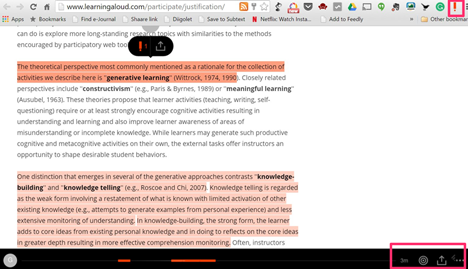
When the extension is added, a highlighter icon will appear in the upper right-hand corner of the browser window. This icon activates and deactivates the tool. When activated, dragging text adds the highlights. Tools at the bottom right-hand corner of the window allow access to the multiple ways for sharing highlights.
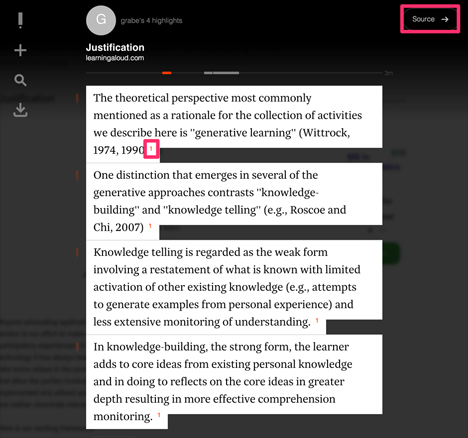
If shared with another user who has not installed the extension, the user will see the highlighted material only and not the highlighted material in context. Try it to see some content I highlighted.
How might this be used:
1) highlight a recommendation for peers or students – the highlights are a way to demonstrate what it is that you wanted them to notice
2) ask students to show you what they have highlighted – do they seem to identify the content that is relevant to a particular task. I remember a research paper I read (too long ago for me to recall the reference) that compared no, free, and restricted highlighting. Without review, the study found that restricted highlighting was most beneficial. One interpretation is that making decisions about relative importance requires a deeper processing of the content.
I wish Highly allowed both highlighting and annotation. Perhaps additional features will eventually be added.
In my opinion, the connection between educational researchers and educators is problematic. Researchers tend to be hesitant to offer specific recommendations and educators label researchers as removed from practical situations. My concern is that educators end up influenced by sources offering specific suggestions which ignore basic principles of learning. Suggestions can be framed in a way that sound good but are based on concepts that are known to be flawed. Some common practices have been proven over and over again to be less effective than other practices that suffer simply because the practices have long been promoted. New ideas are not always superior.
Deans for Impact is an organization attempting to establish a list of principles that are supported through research. This group working with Dan Willingham are attempting to put together a document that summarizes these principles and offers related classroom guidelines. The document is short, but well referenced. My thought was that a grad ed psych class might find the reference list to be a great reading list.
Science of Learning (this link will download as a pdf the present version of this document)
Manage Consent
To provide the best experiences, we use technologies like cookies to store and/or access device information. Consenting to these technologies will allow us to process data such as browsing behavior or unique IDs on this site. Not consenting or withdrawing consent, may adversely affect certain features and functions.
Functional
Always active
The technical storage or access is strictly necessary for the legitimate purpose of enabling the use of a specific service explicitly requested by the subscriber or user, or for the sole purpose of carrying out the transmission of a communication over an electronic communications network.
Preferences
The technical storage or access is necessary for the legitimate purpose of storing preferences that are not requested by the subscriber or user.
Statistics
The technical storage or access that is used exclusively for statistical purposes.The technical storage or access that is used exclusively for anonymous statistical purposes. Without a subpoena, voluntary compliance on the part of your Internet Service Provider, or additional records from a third party, information stored or retrieved for this purpose alone cannot usually be used to identify you.
Marketing
The technical storage or access is required to create user profiles to send advertising, or to track the user on a website or across several websites for similar marketing purposes.


You must be logged in to post a comment.