This post is chronologically inaccurate, but the order in which you are reading this material is possibly more interesting.
I took this picture a few minutes ago. This is my front sidewalk. In a way, it is a remarkable image. What you see is water between the snow banks. This is January 6 in Grand Forks, North Dakota. According to the Weather Underground, the average high for the day is 15. The temperature at 3 today was 41. My little story would have been more spectacular if this was an all-time record, but alas this was not the case. In 1990, it made it to 43. I was here for that day as well.
I purchased An Inconvenient Truth from the iTunes music store before Christmas. I own an iPod Touch and the plan was to watch the movie while on the road over break. I finally watched most of the movie today while I worked out. This documentary is very compelling and I highly recommend it. I would like to say it was enough to get me to move from the powered elliptical to a self powered stationary bike, but this would not be true. I have written on the topic of this documentary before, but each time I am exposed to the information I feel the need to comment again (see this TED talk). I guess it was the connection between the content of the documentary and the view out the window of the health club that prompted this post.
Of course, any single event offers little proof of a trend. However, it seems to me that I have experienced a large number of record temperatures. The data are there. As I looked for the records for the day (43, -31), it occurred to me that student projects might be derived from these data. For example, I wonder how many record temperatures were set in the past 5 years.
Will Richardson offers a recent post focused on personal development. The post begins with the modest proposal that one might acquire an MBA (unofficial) by reading appropriate material while simultaneously engaging in related conversations (online I assume). It was unclear who such conversations would connect you with. I assume it would not be Guy Kawasaki or George Leonard, the examples given of authors appropriate to the proposed MBA, and I assume it would not only involve other like minded seekers of knowledge or one would have the “blind leading the blind”. Perhaps this model assumes the participation of business professionals who would serve as mentors (funding source unknown) in what might optimistically be described as a learning community. It appears the community is also to provide the contacts needed in the eventual transition from “student” to employee.
I am all for continued personal professional development (hence the name of this blog) and assume that continued growth is one of those factors that brings enjoyment and success in nearly any profession. However, I am also a member of the education establishment; the folks responsible for the $100,000 bill the hypothetical student might build up in earning an MBA (not at my institution). I am still working for an institution because I share some of the assumptions on which institutions operate and possibly because I could not get enough gigs as a convention speaker or workshop leader to support myself. It is difficult to fashion a role as member of the establishment into an edgy or sexy image. However, rather than ignore “new proposals”, my training is to examine the logic and raise questions.
Here are some questions:
Do individuals have the motivation and understanding to explore a broad range of topics at an appropriate level of mastery? How many individuals have the appropriate vision and determination and who makes the decision regarding which are true believers and which are simply pretenders?
There is a large body of research (e.g., Lesgold; Mayer; Sweller; Chall) that indicates self-guided education is substandard. To be fair, some do offer counter positions (e.g., Downes). My analysis is that the data presently favor the position that self-guidance as a general approach is a bad idea. I think it is very possible self-guided learning is a great idea for some individuals and perhaps for some purposes, but I think we are presently unable to identify the factors that would guide the identification of who this subset of individuals would be and what the circumstances might be. Perhaps “hobby” learning is great for areas of personal interest and when no one actually must depend on our skills/products BEFORE making commitments to us.
How are comparative decisions regarding who knows and can do what made? I sometimes tell my students that they only pay part of my salary – the state pays the rest. In addition to assisting students acquire knowledge and skills, I must made comparative judgments regarding the mastery of the knowledge and skills of others. This process is intended to inform and guide my students, but also to offer information to employers, graduate programs, etc. If I only concentrated on the development of the students I work with, I would be ignoring this other responsibility.
Many of the issues that come to my mind in considering collaborative, self-directed education remind my of the “vocational school” complaints that often arise within higher education when institutions become too closely aligned with business/industry or when humanities programs feel they are being threatened. What would compel a student to learn a language, take biochemistry, calculus or philosophy, or take an art class if the imposed curriculum did not force future doctors, psychologists, or engineers into some of these options.
The “de-institutionalization” of education would leave many other gaps (service, research), but it is Saturday morning and I have real work to do so I will wait to see if this discussion advances before I take the time to continue.
Here a few more comments related to yesterday’s post on “fair use” in educational settings.
My understanding of what educators should encourage is based largely on my reading of the TEACH Act and related commentary (e.g.., Georgia Harper). The very necessity of the TEACH Act suggests to me that educational fair use should not be interpreted as extending to sharing products online. Note that fair use standards were clearly limited to “face to face” classroom settings before the TEACH Act and limited to specific online circumstances (e.g., protected environments) after the TEACH Act. I can now include limited amounts of video, text, music, etc. in my online classes in the same way I could previously use such resources in my FTF classes. As I understand the 2002 law, the notion that an educational product using protected resources (small quantities or whatever) offered in an open way online does not fall under the fair use guidelines of the TEACH Act. Open access amounts to publication – whether for commercial purposes or not. If there are other more liberal guidelines available informing what products resulting from educational experiences can be offered online, I would like to be directed to these resources.
A recent analysis from the EFF entitled Recut, Reframe, and Recycle is now available. But, be careful to recognize the difference in what advocacy groups suggest and what exists in law or through such review processes such as CONFU. Organizations (Center for Social Media) have a way of being focused on an organization-f0cused agenda rather than attempting to balance the rights of all parties that may be impacted when a more formal decision/recommendation is made.
Again, I am not a legal expert (however, I do play one on the web – 😉 ). Unlike those who interpret things in a very loose way, my advice is unlikely to get you in trouble.
Whatever your interpretation of fair use, I stand by my position that expecting students to rely on their own talents to create all components of products they want to offer is the best policy. I would argue that it is nearly always better as a learning experience to develop your own skills or collaborate with willing partners to create products.
I hate to begin the new year by complaining, but I find that I must. Perhaps I should suggest that my comments are intended to offer a different perspective. I guess you are free to interpret my remarks as you will.
This post was prompted by a recent post on the 21st Collaborative blog concerning intellectual property. I do not intend to single this blogger out – the post just happened to be the trigger for these comments.
I respectfully disagree with the position that “our kids” are being limited because copyright law is too restrictive. In my opinion:
It is inappropriate to decide what you have a right to do with the property of someone else (digital or not). It is especially troubling when educators take this position. The notion of entitlement in education is very dangerous.
Those who advocate the use of the content of others often target a specific type of material making artificial distinction between situations/formats in which it is acceptable and unacceptable to use the work of others. I find it especially troubling when some advocate the use of the digital objects created by others while assuming they personally should be compensated for the delivery of information in other circumstances or in a different format (e.g., paid for teaching, paid for presenting).
The argument that someone else has made enough money on a product cannot be an excuse. If you object to the cost of a ticket do not attend. If you object to the cost of a CD, do not purchase. While you can probably get away with appropriating digital content, the income a talented individual has generated hardly seems a reasonable justification for theft. To me, there is something wrong with acting on this premise in some circumstances (digital content), but assuming you cannot in others (sneaking into a theater because the movie is too expensive, stealing the book because it is over priced).
I think a sound argument can be made that creating your own digital objects is the best learning experience. Write your own material. Take your own pictures. Converting the ideas of others into your own method of representation is a superior learning experience to relying on the creativity, talents, and physical representation of someone else. If the focus on the “polish” or impressiveness of the product encourages the use of music, video, computer code, artwork, etc. created by those with greater skill, the focus on personal learning has been lost.
The end of the year typically brings many “best of” lists. Time offers a list of the best 50 websites of 2007. The categories (e.g., art and leisure, web services) do not include a grouping focused on education, but as is often the case with web resources many of the sites are suited to multiple uses. In fact, sites that are what I would describe as tool or service sites appear to dominate the selection process. In addition to the list (and a page of information devoted to each site on the list), you can listen to a podcast debating the selections, examine a list of the worst sites (MySpace and Second Life appear here), and a list of long-time favorites.
The top pick? It was mozy.com – an online backup site (with 2 gigs of storage for free).I must admit that many of these sites, including Mozy, were new to me. So – it is worth a look just to see what is out there.
P.S. Since I am on the topic of lists for 2007, here is a suggestion. NPR: All Songs Considered offers a podcast consisting of the top 25 songs of the year as selected by listeners. In total, it is about 1:40 of music from last year. If you want, you can download the episode from the iTunes music store (under podcast locate NPR and All Songs Considered – it is the program for 12/20). Thanks to daughter Kim for this suggestion.
We have gathered with our family and friends at a rented cabin in Wisconsin. It is a beautiful location and we have enjoyed the opportunity to relax and view the great scenery.
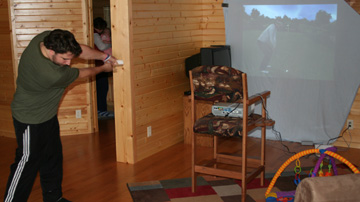
Eventually, we revert to our natural tendencies. We gave Wiis for Christmas. During a trip to MSP in the fall, we heard that Target had the Wii. We stopped at Targets along the way back to Grand Forks and were able to purchase 4. Coming up with one for each family in December would have been impossible. We have set up a projector and a sheet in the basement. Let the games begin.
Many, including those in the education sector who take advantage of free services, have benefited from the many free Web 2.0 resources that are available at no cost. Some analysts are now predicting that a major funding source for such ventures, advertising, may be reaching a saturation point. As more and more ventures are launched, the array of services may reach the point at which very few generate enough funding to keep going. Consumers may follow new developments leaving existing services without the attention to generate necessary revenue.
The options at present appear to be advertising or creating a service that will be purchased by Google/Yahoo/Microsoft. Perhaps 2008 will surface a new option.