MySpace Motivates Teen Beating?

My wife watches the Today show every morning before we head to work. If you happen to do the same, you know that one of the featured stories “today” examined the beating of a girl by 6 acquaintances in Florida. The beating was supposedly in retaliation for comments made by the victim on MySpace. The beating was also taped so the perpetrators could use it later to further humiliate the victim.

This incident will likely generate a great deal of media attention. I am concerned with the “spin” that may be attached.

The Sheriff investigating the case was quoted in the Today show online summary saying:

“Our goal is not only to deal with this issue, but to try to educate parents across the state and across the nation that this is what your children are watching,” he said. “This is what some children are participating in. And we as a society have got to say, ‘This has to stop,’ because if we desensitize our children to this today, then what’s next tomorrow?”

Today does include a segment from the beating for viewing. It is shocking and potentially could  encourage parents, educators, and law enforcement personnel to take bullying more seriously. Actually, I am not certain who must be convinced this is a problem. I am concerned that the video also serves as a positive example for misguided adolescents. Somehow recording the bullying of peers has become cool. How do you change such a perception? Certainly not by filtering and pretending it does not exist.

Loading

Washington Post – Education Favorites

I follow technology and columns from the Washington Post. I must admit this is a matter of habit and I cannot really remember why I started. Let’s just call it inertia. Anyway, the Post published a list of favorite education blogs for 2008. If I remember the post, the section writer asked an ed blogger friend for help and together the list is a product of their collaborative effort.

I must admit most suggstions I have not encountered before. I guess there is nothing wrong with expanding my personal RSS list and this may be a place to begin. Checking out the picks of someone outside your normal clique may be a way to avoid the typical spin cycle.

No, I am not on the list. I think the only list I make is my own.

Loading

Ask Useful Questions – Collect Meaningful Data

Access to EdWeeks’ Technology Counts issue used to be a big deal for me. The resource served as a source of information on student access to technology and we used the data in our writing activities. I used to even buy the special issue so I could carefully examine the numbers.

I have grown more and more disappointed in the direction this publication has taken and the value of the data provided. More and more the topics seem to concern whether policies are in place. I want to know what kids are doing with technology.

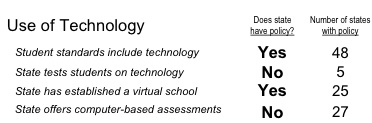
For the past several years, I have read the headings, was exited to learn what was happening, and ultimately ended up disappointed in what I learned. Here is what I mean. Use of Technology. What does that imply to you? Here is what Technology Counts was able to offer on the “Use of Technology” in North Dakota.

Tech Use - North Dakota

This looks like the results of a survey sent to Departments of Public Instruction.

Loading

Would you liberalize fair use if you could?

Ed bloggers (here unnamed) have latched on to a School Library Journal article suggesting educators often unnecessarily limit themselves (and their students) with a conservative interpretation of fair use.

Fear and guilt seemed regularly in the way of innovative teaching and creative expression.

While I am not a lawyer (anyone who comments on copyright says this, so I will too), but I have written on the issues of copyright and fair use as these issues relate to student created multimedia in our books for future educators. I am likely one of those people who takes a conservative position based on my reading of the law and the participatory activities I feel are of greatest educational value.

The “take a more liberal few of fair use” seems to focus on promoting the value of transformation as unique expression.

What I would like to see are classroom examples arguing for the need for “mix-up, mash-up” projects. I want such examples so I can ask myself and others whether such projects would really be the best choice for engaging students. Why not focus on projects that require students to create their own content from scratch – take your own pictures, write your own prose? Why not share resources with other classrooms if location is an issue? I am not suggesting that it would be impossible to create a scenario in which repurposing the work of another might be necessary, but I am thinking such situations would be extremely rare and creative opportunities by their nature are basically unlimited.

I think a more significant issue is the confusion articles such as the Library Journal create. Will educators read the article carefully enough to inform their practice? Is the article informative enough to inform practice? Will the impression that others are doing it serve as an excuse? Are Grateful Dead concert posters really cultural history? Will people who advocate mash-ups as good education understand what the previous question meant?

Loading

BBC on Social Networking

The BBC news site has an interesting article on UK children (8-17) involvement in social networking sites. 50% claim to have an online profile. A claim that 25% of those in the 8-11 range claim to have a page is made at one point. The article references a more detailed report (available via a link) and also includes tips for those concerned about safety issues.

In an attempt to generate comment, the site asked readers to comment on the role of parents. Some suggestions encouraged schools to take a more active role.

One solution to this problem would be for schools to set up sites of their own that could be grouped by age

Loading

Adobe Photoshop Express

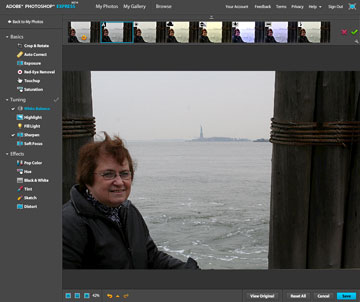
Adobe has brought its expertise in digital image editing to “the cloud”. It now offers a browser-based application – Photoshop Express. The service not only provides powerful image editing capabilities, but also the opportunity to store up to 2 GB worth of images. This screen shot may give you some feel for the tools – left column.

Adobe Express Interface

I have read concerns in another blog related to the user agreement.

Sharing Your Photos

As part of registering for the Service and creating an account, Adobe may require you to create a user name (“User Name”) and user-specific URL, such as xxx.photoshop.com (“Personal URL”). The Service allows you to share Your Content that you upload to your account in the following ways: (a) by using the “Gallery” function to publicly share Your Content on the “Gallery” site of the Service, (b) by using the “email” function to send an email containing a URL link to Your Content, and (c) by using the “Link” function and the “Embed” function to include a link or embed Your Content on a web page. Please note that when you share Your Content, your User Name and Personal URL is made public, and recipients may in the future be able to share Your Content with others, add Your Content to their own accounts, and make photographic prints of Your Content. Adobe may revoke the right to use that URL for any reason deemed appropriate by Adobe in its sole discretion by giving you at least thirty days’ prior notice of such revocation, except in the event your URL or content therein is determined by Adobe in its sole discretion to contain infringing or illegal content or content that otherwise violates these Additional Terms or the General Terms. In such event, Adobe reserves the right to revoke the right to use your URL immediately without notice. Adobe owns and retains all right, title and interest in the use of “Adobe,” “Photoshop,” “Photoshop Express” or other Adobe property in association with a user’s Personal URL.

I have been trying to decide if any of this agreement bothers me. I think Adobe is just warning me that they are not responsible for how others may use my images. I would use this service for images I wanted to make public in much the same way I make images available on Flickr. I understand that I must accept the possibility that my online storage opportunity may be terminated, but I should have 30 days to deal with this situation if I must. Nothing here that seems too negative. I doubt my images have commercial value and I typically am trying to offer my images to others who may find some educational value in a few of my pictures.

As suggested in the user agreement, some images are available at http://grabe.photoshop.com.

Loading

Social Sites and Self Control

I probably did some stupid things when I was a college student (according to my wife). Let’s just say I did. I wonder if I would have the good sense to not compound the stupidity by sharing my accomplishments with the rest of the world.

There seem to be case after case in which young people give in to the temptation to “share something stupid”. Here is but another example.

The University of North Dakota has long used the Sioux name as a representation of the university, i.e., “Fighting Sioux”. The mascot issue is the focus of a great controversy here now involving the NCAA. My intent is not to discuss this issue, but I note this situation to set the context for my remarks about student online behavior. For the record, there is no “mascot” (unlike say Florida State), but the name is associated with the athletic teams and does appear on “sports gear”.

Recently, the Gamma Phi Beta sorority had a cowboy-theme party that somehow morphed into a party in which participants dressed as Indian “maidens” and “warriors” with paint, loin cloths, etc. Photos made their way to the web and eventually the story broke in the local paper. Inappropriate anywhere, and certainly inappropriate and damaging within an environment that promotes sensitivity to specific issues of this type.

Given the “affordances” (sorry, I just returned from a conference and while terms such as this typically annoy me, this is a situation in which the term is useful) of social networking opportunities, are such examples unavoidable? I am guessing so. Poor judgment and lack of self control (under the influence) are unavoidable. Combine these realities and this is what you get.

Hold the students responsible? Absolutely! College is about learning to be responsible. You can’t seriously ask to be treated as a responsible adult and not accept the consequences of such a request.

My wife talks to future teachers in her classes about this situation all of the time. The challenge is how to get students to listen.

Loading