A recent NY Times editorial examined the cost of college textbooks. The piece outlined factors the writer contends are responsible for rising prices. The editorial also points to the efforts of Congress to require companies to sell resources as individual products rather than as bundles and proposes that online resources could be made available to students at 1/5 of the cost of conventional books.
… costs of textbooks that have nearly tripled since the 1980s, mainly because of marginally useful CD-ROMs and other supplements. A bill pending in Congress would require publishers to sell “unbundled” versions of the books — minus the pricey add-ons. Even more important, it would require publishers to reveal book prices in marketing material so that professors could choose less- expensive titles.
The argument is traditional. Textbook companies are greedy and bring out frequent editions with unnecessary bundled add-ons to increase profit margins.
The article turns to an ex-company executive Erik Frank to explain why companies might engage in such practices.
He says prices started skyrocketing after the used book market moved to the Internet. College bookstores started scooping up books and redistributing them nationally.
Frank has started his own company, Flatworld Knowledge (Created By Experts. Enhanced by Users. Free to All). with a new funding model. Frank proposes giving away college texts online, but making profits from the sale of related resources such as study guides. When I read the Times editorial explaining Franks concept I wondered how the Times writers could present their analysis with a straight face. The writers argue that costs are inflated partly because of unnecessary add-ons. They use an executive from the industry to explain the problem and present this expert as someone who has a new approach and now has his own company. The new approach appears to be to get someone to write books for free and convince them they will make their money by selling add-ons. Let’s hope these writers don’t read the Times article which explains that there is no real market for such add-ons. OR, let’s hope they understand the way things work so they understand this is what those of us in higher ed call “service”.
” … will give away college texts online for free. He hopes profits will come from the study aids sold on the side.”
Public radio also offers a perspective on this same issue.
My reaction, admittedly reflecting a personal bias, is that the situation is more complex than described here. Sometimes a simple explanation is the way to gain public support (someone is ripping you off usually works well), but does little to move anyone toward a real solution. I do believe online resources are an important part of a solution, but what valuable resources do you typically receive for free?
Louis Gray has generated a post contending that blogging may be moving from blogging 1.0 to 2.0, identifying the issues involved in this transition, and reflecting on why 1.0 bloggers may be frustrated. The 1.0 to 2.0 transition was not described in the manner I expected. I think of the switch mostly focused around the one-direction vs. bi-directional distinction. 2.0 apps to me are intended to be participatory. I would regard comments and track-backs as 2.0 participatory, but perhaps this position just shows how 1.0 I am.
The impetus for the post comes from general concern being raised by bloggers who find that viewers can access their content without coming to their blog site. But, as I understand the Gray post, the trend also involves the movement of the conversation offsite via twitter or other social media services encouraging more conversation.
Part of this trend I like and part concerns me. I think greater interaction is a good thing. If a few words and a link is what you have to offer, I guess that is better than nothing. This reminds me of the early days of blogging when many blogs were a series of posts directing readers to useful web sites one had encountered. However, this seems more of a form of active consumerism and offers limited value in terms of personal reflection. Hard to think deep thoughts and then externalize the results in less than 20 words.
I am going to the mail room to see if I received any mail today.
I have a little time between the end of the Spring semester and the time when things pick up for the summer. Cindy still has a couple of weeks to go before the schools are done. Recently, I have taken advantage of this time to make a trip from Grand Forks to Iowa to visit my mom.
I really like traveling long distances by myself. I load the ipod with something interesting and take my tech toys. I like the opportunity to think.
For years I have noticed an old building just over the line into South Dakota. I have always wanted to take a picture. It is a tough picture to get. Even when I have my camera sitting next to me, the building appears just over the top of a hill and there is typically not time to pull over. The same thing happened this trip, but I was by myself so I took the next turn-off and circled around. After all these years, I finally have my picture.
The audiobook for this trip was Obama’s “Audacity of Hope”. I purchased the book several months ago and read part, but I buy so many books and sometimes don’t have time to read so I decided to purchase the audiobook for this trip. I like the message and I admire the writing talents of the author. There are many interesting ideas that are worth considering no matter what your political orientation. Perhaps the notion of political orientation and how we are influenced by self-defined orientations is even a topic worthy of comment. Positions have been reduced to simple statements and issues are really so much more complex. We probably really know this. Perhaps the simplicity of the 30 second TV ad contributes to the problem. Six plus hours of listening to a book offers a better perspective.
One of the problems of thinking while you drive is what you should do if you happen to have an interesting thought. My ipod touch would allow an input option, but those folks who text while driving are a danger. What I do is use my phone to talk to myself. Actually, I call a service called Jott and record a message that is then sent back to me as an email.
Here is an example (from the book). I think it says “magnitude of problems versus the smallness of politics”. Voice recognition is a great technical challenge, but it works pretty well. Perhaps the limitation is me. Cindy claims I mumble a lot.
—-
This from the “how strange is this” column. The image I include above was taken just short of Watertown, SD, where I then stopped for lunch. I get to Iowa and learn that Barak Obama was speaking in Watertown, SD.
Finals are over, grading is done, and now I have some time to generate a few blog posts.
Over the next couple of weeks, I hope to generate a few posts (maybe 3) concerning the cost of instructional materials. I have written about this issue before (If you interested use the search box, I have actually written about this a lot.), but I have a little different purpose in mind this time. I intend to announce a little project I have been working on for about a year and these posts will be my way of leading up to the announcement.
Again, like the folks on television who talk about television or parent communications companies, I will begin with a disclosure. My wife and I write textbooks. This should be taken into account in reviewing the comments that follow. Some may now interpret what follows as biased and self serving. I would like to think what follows is informed.
Here comes the math part. If you must, you are allowed to use a calculator. Absolutely no computers.
Some basic math. Our book sells for approximately $85-90. Actually, this is what I call the adult price. The adult price is what college students tell their parents they paid for the book. The statement is kind of true. What they forget and hope dad does not realize is that they resold the book for half value and spent the difference on whatever. Books are expensive. Okay, so $90/2=$45.
The authors of a book make 14% (at least the authors of our book make 14%). This is 14% of the wholesale price under ideal conditions. If the book is sold in Canada or as part of some special promotion the % can be much lower. Of course the authors and the publisher only make this on the first sale. Books tend to be bought and resold several times (contrary to what one might assume from those using the adult price). Here is another number you might want to consider. When the bookstore gives a student $45 in beer money in return for our book (BTW – don’t get me started on the price of beer – you can’t buy a round for the cost of a used book these days), the Barnes and Noble clerk takes the used book to the back of the store where the textbooks are sold and labels the used book as worth $68. Net profit for moving book from front of store to rear of store and then accepting payment for said book – $68-45=$23. Payment to author for original sale of book 65 (I am guessing here – optimistically) x .14= $9.10. Payment to to author on $23 to Barnes and Noble restock and buyback effort – $0. Please keep some of these numbers in mind when I generate the next post and summarize the analysis provided by the NY Times reporter.
The Business Part
Again, a disclosure. I have never taken a business course, not even economics. Note – I am also not charging you for this information.
There is the perception that publishing companies and the talent they hire (me) are making large profits. I write for Houghton-Mifflin. Houghton-Mifflin was one of the last independents in the publishing industry (not sure what this means but that is what they told me). The company has been struggling for some years. A few years ago HMCO was purchased by Vivendi (kind of like a French Time-Warner). Vivendi began to have financial difficulties and sold off some of the less profitable parts of the business (books) to a holding company. Rumors now indicate that HMCO has finally found a new home. Cengage has purchased HMCO and Thompson and possibly other companies. Passing small businesses around from one large company to another large company is not what happens when the money comes easily. The market for college “education” books is a challenge. One of the problems in writing for education classes is that education courses are small and not taken by droves of students from other disciplines. Companies cannot afford to develop many products for a small market. The money is in large classes and companies are reducing offerings in areas where there is little money.
All this means is that business is business. Barnes and Noble feels it has a right to make a profit. The local representative of Nebraska books, Barnes and Nobe online, Amazon, and even the student groups who feel they should buy and resell books assume they should make a profit. I am guessing the used book store will offer students a better rate than Barnes and Noble to lure students to the other side of campus if they can do this and still make a profit. Barnes and Noble likely would prefer this not happen and will do what it can to keep students purchasing books at the same place they buy their lattes (again why is no one concerned about the cost of coffee). I am guessing Allyn and Bacon will sell their Intro Psych book at a lower price than Houghton-Mifflin if it would help sell more books and still make a reasonable profit. This is what those of us who analyze the business world call “competition” and the idea in a flat world or the round one we have lived on for so many years is what keeps prices in check.
Lots of things seem to cost more money these days. I am not certain how much the cost of our book has increased in the past 12 years, but there are certainly folks alarmed by whatever this increase has been. It is hard to know when you are being ripped off and when things just cost more. I wonder what the proportional increase in gas or bread has been in the last 9 months.
I made the mistake of reading some of the customer reviews of our book when I researched the book’s price on Amazon. There were only a few reviews – I don’t think students write reviews and most instructors don’t buy their copies from Amazon. The gist of the reviews was that ours is a pretty solid book. One critical comment stated that while a good book the content was dated. This person needs to read the recent article from the NY Times on book prices. The Times writer claimed textbook companies put out frequent editions in order to battle the used book sellers and unnecessarily inflate prices. The Times writer also claimed that book companies and authors create worthless adjunct resources to inflate the cost of the book. Now if the person writing the review would have bothered to evaluate the HMCO site (and our own book related web site) the reviewer might have found much more current information. It seems very difficult to please everyone.
Our Mothers’ Day tradition is to participate in the Susan Komen breast cancer walk in Minneapolis. Cindy is a two-time survivor. This is a mammoth event starting at the Mall of America.
One of my favorite parts of the event is near the start when the route dips under a major highway and you get a sense for just how many participants there are.
Another year and another finish. Hope there are many more.
Clay Shirky notes that someone has taken “Here comes everybody” and created a set of links that annotate concepts/examples he discusses (see my previous post on this resource). The list is complete and the links I checked (e.g., a nice summary of the Tragedy of the Commons) were appear to be carefully selected. What a great way to illustrate the theme of the book and organizing without an organization (at least here comes someone).
I would like to think that one factor giving our writing some credibility is that we prepare teachers, but are also directly involved with classroom activities. I have written before about Cindy’s unique employment with both the university and the Grand Forks Schools.
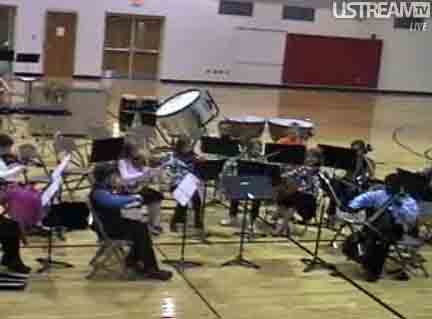
The school in which Cindy does most of her work is located on an air force base. This situation presents some unique challenges. One and sometimes both parents may be deployed and as a consequence miss their son or daughter’s school activities. This reality became part of the school’s interest in streaming today’s end of year band and orchestra concert (actually the full concerts are this evening, but performances during the day allow the students to perform for peers).
The project was accomplished using UStream, a wireless connected laptop, and the type of camcorder you probably own. This is what the video looks like. I selected a frame with the intent of not revealing too much. The content was not recorded (although an option) because of copyright issues. I listened from my office. I have a pretty nice AV setup (Klipsch speakers, large monitors) and the sound quality was great (reminded me of the concerts I used to attend when my kids were the same age). The concert drew 33 online viewers.
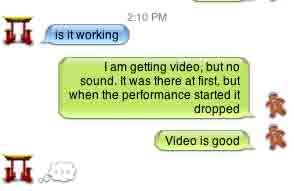
There were a few glitches. Cindy had to operate the camcorder in record mode so that a signal could be sent to the computer. At one point, the tape had to be rewound so the camera would continue to function. The camera was plugged in, but the connection was bad so the battery ran down.
Cindy and I are chatting during the concert. I was attempting to let her know the first time I lost the signal. Mysterious things always seem to happen when technology is involved. Cindy seems to find the unexpected problems an interesting challenge. She decided she would go back this evening just in case.
The UStreamTv technology is very easy to implement. My previous experience was in viewing the distribution of conference presentations, but there would seem to be many school applications. The equipment requirements are minimal and getting started requires little preparation or background. Information is available online if you want to explore.
Manage Consent
To provide the best experiences, we use technologies like cookies to store and/or access device information. Consenting to these technologies will allow us to process data such as browsing behavior or unique IDs on this site. Not consenting or withdrawing consent, may adversely affect certain features and functions.
Functional
Always active
The technical storage or access is strictly necessary for the legitimate purpose of enabling the use of a specific service explicitly requested by the subscriber or user, or for the sole purpose of carrying out the transmission of a communication over an electronic communications network.
Preferences
The technical storage or access is necessary for the legitimate purpose of storing preferences that are not requested by the subscriber or user.
Statistics
The technical storage or access that is used exclusively for statistical purposes.The technical storage or access that is used exclusively for anonymous statistical purposes. Without a subpoena, voluntary compliance on the part of your Internet Service Provider, or additional records from a third party, information stored or retrieved for this purpose alone cannot usually be used to identify you.
Marketing
The technical storage or access is required to create user profiles to send advertising, or to track the user on a website or across several websites for similar marketing purposes.