Why proven ideas are not used

I don’t focus on the research literature on this site, but I want to make an exception. I encourage those of you interested in educational research make the effort to read the article by Rohrer & Pahler in the June/July issue of Educational Researcher (2010, 39(5), 406-412).

The article argues that researchers have made a number of concrete suggestions that would improve student learning and that these suggestions are often ignored. The three examples offered include – learning through testing (increasing retrieving), spacing of practice, and interleaving. These examples were selected because the basis for the suggestion are quite solid AND because the suggestions are about studying differently rather than studying more.

Perhaps the most interesting part of the review was a speculative addition at the end of the presentation which asked the question “Why are inferior strategies so popular?” It is this focus I think should receive wider consideration because it may extend to many current topics in education. The authors pose the question in an interesting fashion. Since some of these suggestions could have developed as common practice simply as a function of student trial and error, why do students typically spend their time in inferior strategies? Remember these proposals are about a different way of doing things and not about the expectation that students spend more time. The authors suggest that these strategies tend to produce a higher error rate during study which may be more discouraging for students. It appears students prefer passive strategies because there is less challenge to their illusion of understanding. I wonder. Perhaps students do understand that a technique is less effective, but still persist because it is what they know and it is easier.

Powered by ScribeFire.

Loading

Multi-Taskers? Not really.

I had my educational psychology class complete a short in-class writing assignment related to the topic of working memory and multi-tasking. I originally had no specific motive beyond getting them to apply some of these ideas to their own experiences and so I asked them to write about listening to music while they studied. There were some specific prompts, but this was the general topic. I have read so many who claim younger folks are multi-taskers and prefer this or that environment for learning that I guess I was somewhat surprised with how the students responded.

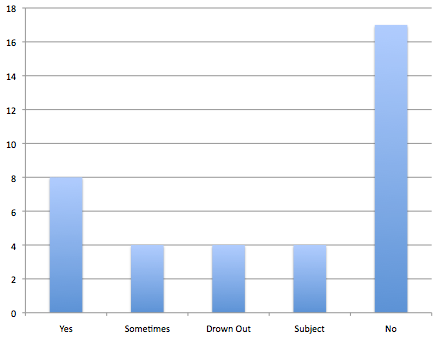
After reading the responses, I created a simple way to organize what I thought each student had said and I came up with this distribution. If one combines the students who say they listen to no music with those who say they use music to mask out other sounds, it would be pretty difficult to argue these students must multi-task.

I did encounter some interesting comments regarding musical tastes (what works while studying) and when music is helpful and when not. Avoid popular music with lyrics (one student claimed to listen to game tracks). Music while writing and working problem sets (math, chemistry) seems workable, but do not try to listen to music while reading.

Of course, there were some who say they listen to music constantly, but the point is these individuals were not typical. Sometimes I wonder about the methodology used by those who attempt to make the case that learners are changing and educators need to take notice and make adjustments. What I did was quite informal as far as research goes and not really designed to test formal hypotheses, but the typical student in this group is not a multi-tasker.

Loading

Shutterfly Classroom

I have been wanting to explore Shutterfly for some time, but because I pay for a Flickr account and have spent considerable time with Picasa, it seemed like just one more version of what I have been recommending. In the back of mind what I knew was unique about Shutterfly was that while it was a photo sharing site it also offered a way to offer general web content. This struck me as an important distinction.

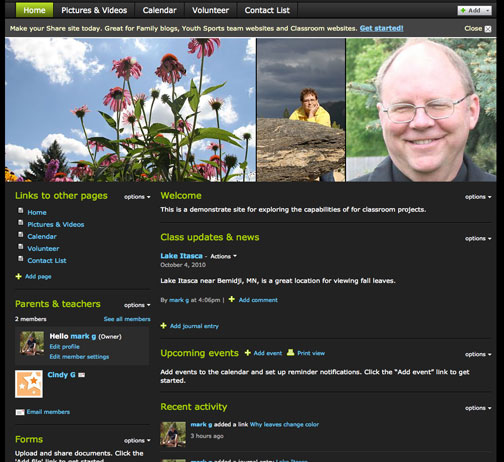
A few days ago I came across this strange post on MarketWatch (strange because MarketWatch is not exactly the place I search for ideas for the classroom). The business oriented post that includes the present stock market value of Shutterfly explained Shutterfly’s effort to offer classroom web sites. The article explains that parents would like to see images from the classroom and from student field trips, but providing such images is difficult because of security concerns. So, Shutterfly has offered a version of the tool allowing the creation of web sites to meet this and other classroom to home communication needs. The classroom web sites are by invitation only which is the way the teacher or a parent volunteer controls access. While Shutterfly’s main business model is printing user photographs in various formats (images, calendars, photo books) and photos are clearly what Shutterfly does well, the template and modular-based approach makes it relatively easy to create an impressive site.

Main web page

Shutterfly album

Powered by ScribeFire.

Loading

Missing data

I read a recent post from The Blue Skunk Blog that is evidently a repost. I actually think I remember the original post and belief I responded to that post as well.

Johnson states – I would find standards in the following areas extremely helpful as I try to evaluate our district’s technology infrastructure and plan for improvement :

  • 1. Connectivity (LAN, WAN, and Internet I & II capacities)
  • 2. Security (firewalls, filters, policies)
  • 3. Tech support (technicians per computer, tech support response time, reliability rates, policies about technology replacement,)
  • 4. Administrative applications (student information systems, transportation, personnel systems, payroll systems, data mining systems, home-school communication systems, online testing)
  • 5. Information resources (e-mail, mailing lists, blogging software, online learning software, commercial databases, library automation systems)
  • etc.

As I understand this portion of Doug Johnson’s post on standards, he would like to know just what resources schools should have available in order to provide effective educational experiences for students.

I develop resources to prepare future teachers and part of what I attempt to do is to offer descriptions of the situations they may face in the schools they will eventually enter. My interest is in the variability in such situations. Perhaps this is also what Doug Johnson is looking for – what are the standards that educators should be able to expect and what are the typical means and standard deviations for some of these indicators. In other words – how does my school compare, what should be expect to be able to provide?

I think locating good data on technology in schools – what is there and how it is used – has become increasing difficult. I know that good data on what technology exists is there, but these data are collected by businesses that intend to sell the information to vendors. I can’t afford access and evidently neither can the libraries I use. I used to use the National surveys conducted by Henry Becker and the Technology Counts annual publications to locate such data. Technology Counts abandoned the state to state comparisons. Perhaps some states were embarrassed and resisted offering up information. The vast differences among the states was pretty clear evidence that students had very different experiences.

I am thinking researchers found it difficult to secure funds to actually conduct quality surveys and this has cut off on-going, independently collected descriptions of what is typical in this area. The best resource I can find is offered by the National Center for Education Statistics (Teachers’ Use of Educational Technology in U.S. Public Schools: 2009 ). Still, even on the descriptive level, I do not think the data are complete enough. Wouldn’t you like answers to some of the descriptors Johnson identifies?

Loading

Which end of the pool?

Which end of the pool? This is a question that occurred to me because of Carr’s book “The Shallows“. This book seems another example of a new genre which seems to imply that most of us have a tendency to turn potentially useful opportunities into experiences focused on immediate gratification and in the long term diminish our cognitive potential. Other examples – The dumbest generation; Infotopia; iBrain. If these books do not interest you, try Carr’s original article in the Atlantic. Carr and the others are proposing that our use of the Internet has changed the way we prefer to take in information perhaps at the biological level. Even though the potential might be there for deep contemplation, the experiences we select tend toward brief encounters. We have lost the ability for prolonged focus as might be the case when reading a traditional book.

I have been trying to write today and in preparing I have been reviewing data on how adolescents use the Internet. For years I have followed what some have called the participatory culture. The generative potential of media creation seemed to have great educational potential. However, recent data appears to indicate that the style of participation is drifting toward the shallows. For example, the most recent PEW data on social media and young adults indicates that the proportion of young adults who blog has been halved between 2006 and 2009. Use of Twitter started slow, but has begun to increase in this same age group.

If we are models for the use of technology are many of us being sucked into the same pattern? Perhaps it is too easy to get into Twitter and stop blogging. Perhaps many folks just pass resources around with few actually reading the resources. Hard to fake it when you attempt to author in long form. Pretty easy to assume you have accomplished something when the system limits you to 140 characters. Here – you read it. I don’t have time.

Powered by ScribeFire.

Loading

Mark Quits and Then Pays For Diigo

Ever have one of those situations when you learned something, made a decision related to what you learned, found that the information on which the decision was based had changed, and then not been sure that you understood what you thought had happened in the first pace had actually happened? Probably not. I could have sworn a week or so ago Diigo added a premium service and severely reduced the capabilities of the free (and education) versions.

The price for the premium service was $40 and this seemed like a long way from free and for me a lot for the advantages the service would offer me over Delicious and other premium services I have already invested in (e.g., Evernote). The combination of Delicious and Evernote would allow me to accomplish pretty much the same things as the Premium Diigo. Half of the price and I might have bit.

Then, like someone out there was reading my mind or perhaps my tweets, the $20 “basic” membership appeared. My credit card was out of my pocket in an instant.

I think educators must get beyond expecting online resources and services will be free. $40 a year was just a bit much.

Loading

Stories are the weak form

I will warn you up front that you may interpret this post as an attack on digital story telling and those who have popularized this concept and related classroom activities. If you come to this conclusion – 1) my communication skills need to be improved, 2) you need to carefully reread this post. My concern is more accurately captured in my version of the expression – “if the only tool you have is a hammer, everything else begins to look like a nail”. My concern is that many  important educational purposes for student generated multimedia may not be apparent when teachers interpret the phrase “digital storytelling”.

I am assuming that digital storytelling is proposed as a generative activity. By this I mean an external task (writing the story, creating the video) that encourages understanding and retention of some topic. If you assume storytelling is a unique form of communication and the primary function of such activities is to develop communication skills, your perspective is perfectly acceptable. However, I am thinking others see a broader potential in such activities.

I think my concern is that we confuse “description” with “explanation” (and if you are the individual doing the explaining – personal understanding). I happen to think of this perspective today while presenting to my undergrad class. The topic happened to be the different goals of science and perhaps the confusion of consumers as to what each role has accomplished. So, one role might be description. Those in the field of developmental psychology might collect data in order to inform parents of developmental milestones just because parents might be curious as to when they might expect their child to do this or that. The issue was really whether the data the researcher had collected really allowed for more and whether as consumers we would notice should other claims be made.

It occurred to me that those interested in generative processes have a history of noting a similar distinction in student tasks. The distinction between “knowledge telling” and “knowledge transforming” comes to mind. I understand that story telling can be quite transformational. For example, the documentary filmmaker sometimes generates a product to make a point. This is different from a documentary that chronicles an event and assumes that the viewer will bring meaning to the description.

What is it the teacher assumes when setting out to engage his/her students in generating a story? Here is what happened when we visited the zoo could be a description of events or it could be reflection on the nutritional needs of various animals and what we might want to consider in regard to our own nutritional needs. Nothing wrong with either “story”, but I would suggest the two stories accomplish very different things.

Are there better ways to explain the generative potential of student productions? I don’t know. How about “Teach what you know” or “Teach what you have learned”? I suppose any tactic could lapse into description, but we need at least some activities that are likely to encourage reflection and the construction of a personal understanding.

Loading