This blog will take a different direction for a few weeks. We leave this evening for a three week stint in Russia and I might as well take advantage of this unique opportunity as a source for my posts.
The picture? We had a tough time getting our visas. We had to drive to the FEDEX distribution site to get the visas this morning because the “there by 10” thing does not work for rural areas. Waiting for delivery would not have allowed enough time to make our flight. It looks like we cut this far too close.
You may have never heard of an RSS feed. I begin with this statement because I would have assumed the opposite. I would have guessed anyone reading blogs would have heard of and be using RSS. I have learned otherwise. When Google announced that it would shut down Reader I asked my graduate educational technology class what they planned to do for a replacement and I was met with several blank looks. It is important to understand that not everyone sees the world as you do.
Following the elimination of Reader (an RSS aggregator used directly or indirectly by many who made use of RSS), there was a good deal of online commentary on the purpose of RSS (e.g., TechCrunch). The point seems to be that Google knows all and must have decided that RSS readers and RSS were no longer necessary. This was a surprise to me, but when I searched the question “is RSS relevant” I was able to find negative reactions as far back as 2006.
RSS (Really Simple Syndication) offers a way to identify changes to web content. So, instead of visiting say 25 blogs (or other web content) you might follow to see if the author has generated anything new, you can make use of an RSS reader that will identify what has changed. RSS saves a great deal of time. Visit one service instead of many sites. If you were a blogger, you wanted to be certain readers could subscribe to the feed from your site. If you were a reader, RSS was about increasing your efficiency and probably increasing the number and range of sites you followed.
Sometimes we seem to tire of good OLD ideas and gravitate toward the new and shiny. This does not seem productive or efficient, but it may be human nature. We seem attracted to the changes in our environment as a survival mechanism.
I think about learning from online content as search and discovery. Search implies I know what I want to know and I use powerful tools to locate the best sources for this information. Discovery implies I admit to being unaware of information that would potentially be quite important and commit to scanning recommendations to see what invites my attention.
RSS is a good way to discover. It is like making a commitment to a news source and then reviewing what this source offers. There is danger in the biased selection of sources, but with a little self discipline a variety of sources can be identified.
What has changed in the world of information consumption? I suppose that services like Twitter, Google+ and to a lesser extent Facebook offer a source for recommendations. Individuals who you identify as trusted sources (really?) offer suggestions and you follow up. This is pretty much the only reason I use Twitter. To my taste, there is too much junk in the Twitter feed. Even with careful selection of individuals, there seems to be so much spam.
The blogs I write do send a short message to Twitter so others who do not use RSS, but who might be interested in my comments know when a new post has been generated. You may have identified this post from a Twitter link. The use of Twitter to identify your blog posts is controversial. I am not certain why. I suppose it is regarded by some as self promotion. A one tweet per post model is fine with me. I do find it annoying when multiple tweets advertise the same blog post.
I guess the concern is that the RSS model is preferred by geeks and others have moved on. Facebook and Google+ bring a stream of content from those these individuals chose to follow and that is evidently enough. A quick scan of Twitter might be used to fill in the gaps. Perhaps Google abandoned Reader because it offered little benefit to the their business and because RSS does compete with a function of Google+.
For the time being, I will continue to promote RSS with my students. I see this as promoting the contribution of bloggers. I am concerned that the audience and hence the motivation for an active blogging community will suffer when social media moves exclusively to Twitter, Google+ and Facebook.
BTW – RSS did not disappear with Reader and my recommendation for a Reader replacement is Feedly
Cengage, one of the major publishers of college textbooks, has filed for bankruptcy in an effort to stabilize the financial fortunes of the company. We had a relationship with Cengage for many years beginning when Cengage picked up our book when taking over the holdings of Houghton-Mifflin.
Chief executive Hanson claimed the step “will reduce our debt and improve our capital structure to support our long-term business strategy of transitioning from traditional print models to digital educational and research material”.
About five years ago, we tried to explain to Cengage that digital textbooks were coming and our book on the integration of technology would offer a great opportunity to explore new ways to offer content. We never were able to work out an agreement, but there is now some satisfaction in suggesting that they should have explored early instead of putting themselves in the position of trying to catch up.
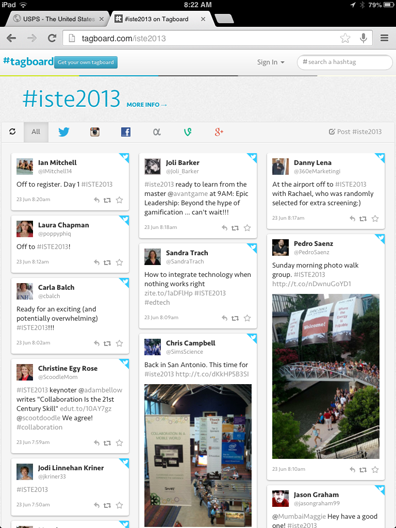
Tagboard allows users to follow content across multiple services (e.g., Twitter, Google+).
It occurred to me this might be a perfect time to try it out. ISTE (International Society for Technology in Education) is underway in San Antonio. This is a very large conference focused on the use of ed tech in K-12. We always attend, but this year decided to stay home and save our energy for an upcoming trip to Russia. Anyway, with 15-18 thousand attendees generating all kinds of content based on their experiences (good and bad), you can pick up a lot by just following the stream of content.
The tag for the conference is #iste2013. You can search for this tag within a given environment (e.g., Twitter), but why not search across services. This is what Tagboard allows. This is a web-based service. Use the link above to give it a try and see what you think. This would be a good time to experiment.
Microsoft recently announced their tablet would be donated to 10,000 educators attending this year’s ISTE conference and the device would now be sold for $200 in the education market. You wonder whether this is a way to get rid of inventory that will not sell, a clever long-term marketing strategy, or both. Anyway, these announcements got me thinking about why it would matter which device I use and which I would recommend. Have we reached the point that price should be the deciding variable?
This question has frequently been framed as whether tech hardware (e.g., laptop, tablet) has become a commodity. My interpretation of this term, given my ag background, is that the value of different products is roughly equivalent (e.g., corn, milk) so the expectation is the cost to purchase should be very similar and because of competition low. A Mac Pro would not fall into this classification. The question, if you are an Apple advocate, is whether the term should be applied to the iPad and say the Air.
I assume the coming days will see comparisons of the iPad, Nexus, and Surface. I do not own a Surface, but I have both iPads and a Nexus. My consumption and production needs can be accomplished with either. I still find the iPad a little easier to use and there are apps I prefer on this device. I admit in nearly all cases there are alternatives or I assume developers will eventually get around to making unique apps cross platform should the number of competing products reach a critical level.
What I happen to value now is that a device get me to the things I want to do in the cloud. Frequently, I need to work with Google apps, but this access could also involve Feedly, Evernote, DropBox, Box, Flickr, Diigo and probably a few others that do not come immediately to mind. Both Apple and Microsoft seem to be attempting to ramp up their cloud presence – the cross-platform opportunity to use iWork apps and Microsoft Office 365 seem promising (as long as the work better than Mobile Me). I bothers me a bit I do not see the revenue stream in all cases, but I leave that to the companies to work out.
For those of us who work to support classroom use of technology, a commodity mentality would discourage such a great focus on the identification of the next new thing and a greater focus on creative and productive ideas for using a core set of tools. Consider the popular conference sessions during which several well-known presenters attempt to wow the audience by demonstrating services and devices few know about. Entertaining, but not that productive. Interesting activities for classroom use would end up being far more helpful.
That all sounds like we are moving into an era of DULL. What could be wrong with commodity devices? The concern I think is the lack of motivation to improve capabilities rather than reduce cost? You might imagine this as the Dell vs. Apple approach. Where will the profit margins necessary for innovation come from?
Data protection is obviously a very important issue and companies that encourage us to use their services to store our data must take security seriously. Two-factor authentication has been developed to offer greater security. I have heard two factor authentication described as something you own and something you know. Cute and easy to remember, but the operationalization translates as “you know your password” and you “own your phone”. In concept it works like this, once you turn two-factor authentication on, your existing services are immediately disabled. You now must use the two factors to activate them again. So, instead of using your password which is initially rejected, you use a code (a number) that is sent to the SMS system on your phone when your password fails.
Here is my problem with this system. It seems designed by engineers with little insight into how real people actually use devices. It first assumes you have a smart phone (there is a way around this, but the way around makes the process even more complicated). Second, it is not system wide approach and must be completed for each device. My situation involved authenticating (so far) on my phone, two iPads and a Nexus 7, three lap tops and three desktops. This may be a little extreme, but not really. I have equipment purchased for me by my university and equipment I have purchased for my personal use, etc.
It gets worse. I commonly use Google apps through a browser. For a time, I had to authenticate each time I opened the browser. This was a hassle because I am not one of those tech guys who carries my phone or enjoys doing all possible things with it. The issue here concerned my phone settings. As a security measure (I use so many different devices – mine and public), I had my browser set to delete cookies when I shut down. Hence, the engineer’s solution of permanence was to set a cookie. So, I changed this permission and this seemed to fix the problem with browsers. It is kind of funny though, don’t you think, to address a security issue by eliminating a security precaution?
OK, so you authenticate once using something you have and you use your password (something you know) each time and you have a cookie set and this fixes the browsers (once for each one by the way). Then there are your apps. Apps don’t set cookies (I don’t think) so this process will not work for apps. Google has apps. What were they thinking?
There is a completely different system for apps. Instead of the app sending a message to your phone and setting a cookie, you request an app-specific password using your device and you are sent a 16 element password to enter. You destroy any evidence of this display. Then, the app works. Again, repeat with all devices.
OK – perhaps there is a better way and I don’t understand. However, what I have described here works, but was labor intensive.
I am concerned. I am heading to Russia for three weeks. I value security, but I also do not intend to take my phone. I know there is a way to request multiple codes I can take with me (printed on a piece of paper in my bill fold). I keep thinking there must be a better way.
I find the data generated by my web site to be very interesting. Big time web players study such data carefully in order to optimize their web business. I study such data because I am curious.
I have noticed a specific down turn in traffic lately. One factor that seems to have changed is the number of hits that result from search. So, analytics can determine the referrer for a hit and I can identify hits resulting from searches.
So why might search hits diminish (aside from the obvious possibility that I write about stuff others find less interesting). Here is something I wonder about. Can Google tell the difference between a link farm and a social bookmarking service?
One prominent variable in the Google ranking strategy involves the number of sites linking to a particular site. A simplistic way some have tried to “game” this system is to set up multiple web pages with links to other sites the scammers would like to see ranked higher in Google searches. The Google ranking model attempts to identify such artificial way of creating more links (link farms) and to discount such sources.
There are legitimate sites that consist largely of links to other sites. For example, a social bookmarking service or even a simple effort to archive useful sites as a service to others would consist of content with high link density.
One of the services on my site was developed as an open source bookmarking site. I became interested in a service called Scuttle because it allowed me to operate my own bookmarking site. It was written in php/MySQL and I spent time adding some features. I created a ranking systems based on the number of times users actually visited one of the sites listed. I also created a way for users to evaluate the sites (one time only) when conducting a search and this also contributed to the ranking.
I have had some difficulties with this site. I ended up disabling the evaluation feature and the login feature because both involved users logging in and logging in allowed users to add links I might find objectionable. There was one upgrade to Scuttle. I did not make the transition because of the changes I made to the original and the lack of enthusiasm for starting over again.
I am not trying to decide whether I should delete this service. It does generate some activity, but it also causes problems. As a hobbyist I enjoy creating resources for others to use, but I do not want my other content to go unused because the content would infrequently surface in searches. There must be a way to figure this out.
Manage Consent
To provide the best experiences, we use technologies like cookies to store and/or access device information. Consenting to these technologies will allow us to process data such as browsing behavior or unique IDs on this site. Not consenting or withdrawing consent, may adversely affect certain features and functions.
Functional
Always active
The technical storage or access is strictly necessary for the legitimate purpose of enabling the use of a specific service explicitly requested by the subscriber or user, or for the sole purpose of carrying out the transmission of a communication over an electronic communications network.
Preferences
The technical storage or access is necessary for the legitimate purpose of storing preferences that are not requested by the subscriber or user.
Statistics
The technical storage or access that is used exclusively for statistical purposes.The technical storage or access that is used exclusively for anonymous statistical purposes. Without a subpoena, voluntary compliance on the part of your Internet Service Provider, or additional records from a third party, information stored or retrieved for this purpose alone cannot usually be used to identify you.
Marketing
The technical storage or access is required to create user profiles to send advertising, or to track the user on a website or across several websites for similar marketing purposes.




You must be logged in to post a comment.