We and probably most folks who read this blog live in a world where folks have multiple tech devices, are aware of the newest online participatory web tools, and may even debate whether universities have a place now that we have PLNs. We are beginning to work on a new edition of our book. Sometimes it feels like we should be apologizing.
The 2009 Speak Up Survey (pdf available) suggests that preservice teachers are still not being exposed to the applications many took for granted 5 years ago. It appears they are most likely to learn about productivity software and how to find resources online. One wonders how these students get through their other college classes competing against colleagues who likely acquired these skills in middle school.
Sorry if a little sarcasm crept in. Maybe it is best to understand that it is easy to make assumptions about what others know or find interesting. The Speak Up Survey offers a useful perspective.
Today, Cindy’s tech colleagues are giving her a retirement party. As these things seem to go, a photo of Cindy appeared in today’s local paper recognizing one of the final projects she has worked on (GF Herald article on Books of Hope – free registration required). Cindy thought the article focused too much on her comments and not enough on the teachers who executed the project. Possibly – but Cindy is quotable and has a nice way of framing what the students accomplished.
BTW – the title of the newspaper article, “From Students to Teachers”, could serve as a summary for a what we think may be one of the more productive models of project based learning – technology projects that are essentially peer tutoring.
Offering comment or tutorials for iPad apps would be almost too easy. One could offer several such posts a week for about as long as you could stay motivated. I don’t own an iPad, but I can borrow Cindy’s iPad and I will offer an occasional post when an app seems unique and relevant to my interests.
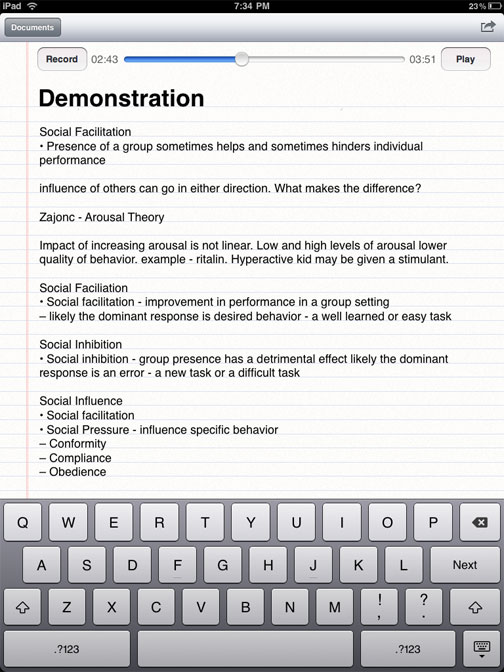
One of the research topics I pursue concerns college study note taking and how note taking and note using can be improved with technology. About 6 months ago, I described a laptop program (Pear Note) that allowed note taking and simultaneously recorded audio. The idea is that the user would record to a lecture or presentation and simultaneously take notes. The unique feature was the the text notes were linked to the audio. So, the user could click on a location with the text and hear the corresponding audio. In other words, the program time stamped the audio each time the user entered a new segment of text. If the value of this is approach is not apparent, consider that a student probably does not want to listen to a lecture she has already heard repeatedly. What she wants to hear is the parts of the lecture that correspond to a section of notes that do not make sense.
It turns out there are similar apps for the Ipad. SoundPaper does exactly the same thing.
In addition, once the presentation is completed the user can email the audio and text to an email account. I translated the audio I recorded (generated by playing a segment of a recorded lecture from this semester through my desktop machine) from the mpeg4 format to mp3 format to insert below.
I became familiar with Posterous by accident. I was reading a series of complaints identifying security concerns in Facebook and came across a Wired article by Ryan Singel. The article addressed the issue of controlling your content and I interpreted the author to indicate that the flexible and simple blogging platform Posterous would serve as an alternative to Facebook allowing control of which users could see what. For some reason, I understood Posterous to be a way to aggregate content from multiple sites and then control who could see what. At present I appear to be wrong about the aggregation part, but in the process of discovering this I became a Posterous fan.
Posterous may be one of the first online services I have encountered that requires very little explanation. The simple version in this case is actually very simple.
Email stuff to post@posterous.com and it will add the “stuff” to a blog. Really, that is it. The heading for the email becomes the “subject” of the blog post and the stuff contained in the email (plus attachments) becomes the content of the post. The attachments can be images, video, sound files, etc.
The first time you do this Posterous will respond to your email and ask you to provide a few details (e.g., password, blog title, ) and if you want you can enter this information and proceed as a blogger.
Explore a little more and you will learn that you can customize the blog in ways that may make it a useful educational tool. The settings below establish my blog name and the address for the site (grabe.posterous.com). You note I can also select a theme for the site and control who can post. Near the bottom of this captured image, you will note the possibility of assigning a password to the site. Control/privacy are important considerations in any online educational site.
I have my Posterous site set up so that only “contributors” can post and I have control over who qualifies as a contributors. I generate a list of email addresses the site will accept input from and these individuals become contributors.
I am coming to believe that SIMPLE is an important key to effective online educational tools. Efficiency is important. Tools that are difficult to learn reduce the time available to learn “content”. Tools that are cumbersome to use once learned reduce the time available to learn other things. So much about learning in a group setting comes down to time and efficiency. Successful learning on an individual level also depends on the availability of sufficient cognitive resources to think and reflect. Tools and tasks that are too complex simply overpower the cognitive resources of many students.
BTW – it turns out Posterous works in pretty much the opposite way than I had originally hoped. It is a great tool for saving content and then passing that content on to designated social sites. It is an efficient way to add content to another blog or Facebook or to tweet. Once one or more outlets have been identified, you can even control what goes where – twitter@posterous.com – adds the comment to Posterous and forwards to Twitter.
I do have a Facebook account. I guess I have this account because people I know make heavy use of Facebook and having an account connects me with them. I spend very little time in Facebook, but I send excerpts from the content I generate elsewhere to Facebook so “Facebook only” acquaintances see this content.
Facebook initially annoyed me because of a personal bias. The phrase “digital native” and the unique qualities ascribed to those who happen to fall within this group by function of their birth date seemed elitist and simply wrong. Perhaps I was jealous of an attribution that was beyond my control. To me, Facebook became the face of the digital native. Facebook as a place where many spend great amounts of time often doing things that seemed frivolous. I did not argue the generational difference in the time spent, but I did contest the value of spending this amount of time.
I have been following issues related to user privacy on Facebook for some time. The problem of control has long been an issue with naive users failing to appreciate the longevity of inappropriate content shared online. After listening and reading about recent developments, I have additional concerns.
We drove 500+ miles last Friday and that means that Cindy and I listen to many hours of podcasts (when the Twins are not playing). We happened to listen to a TWIG program (This Week in Google – and the cloud) that got heavily into an analysis of Facebook privacy challenges AND what appears to be a strategy of collecting user data of several categories within the Facebook environment. Part of the conspiracy theory is that these two issues are inter-related; i.e., Facebook is purposefully making it difficult for users to control who can view their data in order to increase the amount of data Facebook can collect and organize.
If such issues interest you, the following resources may be helpful.
The issues with Facebook are evolving beyond whether instructors should friend their students or whether educational organizations should maintain a Facebook presence. I admit to distrusting consolidation, but I am trying to decide if this is something more.
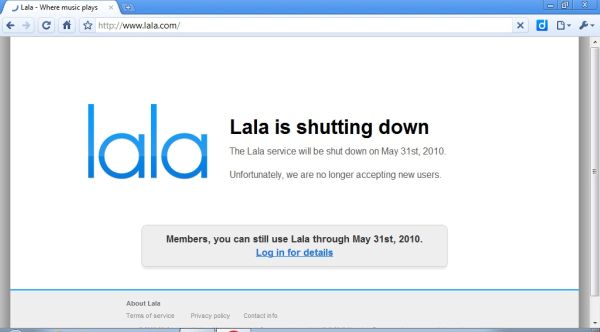
The news broke today that LaLa was shutting down. I have been a loyal LaLa user for a long time and have invested several hundred dollars so I could play the music I wanted to listen to online. I knew Apple had purchased them. I suspected this would happen, but I assumed existing commitments would be honored.
Apple is going to give me credit at the iTunes store. First, LaLa did not allow the download of a song, but gave you access for 10 cents. Apple wants to sell you the song for $1+. I do not want to have 1/10 the number of songs on one computer. At the very least, the appropriate thing to do would be to credit my credit card, not my iTunes account. I already have thousands of songs I purchased through iTunes. What I wanted was to be able to play my music from any computer connected to the Internet. This is what I paid for.
So, what is the lesson. Is it you can’t trust online companies to provide the service users pay for? Clearly some companies go out of business and can no longer honor their commitments. This is not the same thing. It looks like you get a better deal and commitments you have made no longer matter.
It has been a tough week for those who make a commitment to online services. First, Ning discontinued the free service it provided stranding those who had used this service to offer large amounts of user created content. OK, so users did not put any money into this company and maybe you get what you pay for. This situation with LaLa is a little different.
The more recent Learning and Leading has an article authored by Judi Harris and colleagues. There are certain writers who have promoted core ideas that appeal to me and Harris is one. She has a concept – activity types – that makes sense to me as an important idea in professional development. Rather than promoting specific examples she proposes that educators think in terms of categories of activities. I have always understood the purpose of this approach as an attempt to steer folks away from the duplication of specific examples which may or may not be appropriate for their unique situations. Instead, the idea is to understand tasks at a more general level. I am guessing the use of examples in instruction is typically not attempt to promote the exact same task, but does it come across in this fashion? Harris and others have established a wiki to outline the various activity structures they have identified.
So, this distinction between activity types and examples has caused me to consider what structural variables guide my own thinking. Sometimes I think such organizational patterns exist but we fail to reflect enough on our own thinking to externalize these patterns. Here is an initial effort.
I think I organize my take on tech integration in terms of:
Conceptual frameworks – e.g., authoring to learn, 21st century skills
Tools
Tactics (something like activity structures),
Examples
So, authoring to learn is a general generative framework that assumes students can be encouraged to process content they have experienced by explaining this content to others. This process can be accomplished using various tools (e.g., podcast, wiki, blog). Various pedagogical strategies (cooperative learning, editing, discussion) can be employed in implementing a given project. Of course, to explain various nuances of the combination of framework, tool and tactic, it is likely useful to use multiple examples to illustrate various combinations and the strengths and weaknesses of each.
I wonder how teachers make instructional decisions. Is there a process to what they decide to do? Would a structured approach help?




You must be logged in to post a comment.