Complex cognitive skills such as reading comprehension are an instructional challenge partly because it is difficult to explain what the learner should do when executing the desired skill. Often, learning becomes a trial and error process with someone indicating the success or failure of attempts. The method of reciprocal teaching offered a different approach. In this strategy, the teacher first applies a specific skill related to the desired general skill (comprehension) and thinks aloud while making the effort. With reading, the skills in the original approach were to 1) ask a question, 2) make a prediction, 3) identify a confusion or difficulty, and 4) summarize. The teacher would first read a paragraph and then engage in one of the skills while verbalizing. Students would then try to execute one of the subskills after reading the next paragraph.
This approach can be generalized to other skills and I have often tried to explain how I would apply the approach in a classroom setting. What always came to mind was the teacher standing in front of a group of students with a computer, projector, and white board. Show a portion of content and apply the strategy.
I recently encountered an article from the Reading Teacher with very much the same idea, but executed in a different way. This article proposed that both teachers and students could apply this general strategy, but apply the strategy by making use of a screen capture video program. The author noted that students are spending more time learning from online resources and why not use this same content to develop cognitive skills taking advantage of the opportunity to record the screen and audio while working online.
In thinking about this approach, I can think of several benefits. First, students may not be teaching in face to face settings for a while. Recording such efforts would allow teacher and students to share their efforts to execute a specific skill. Second, use of this approach might be most effectively and efficiently applied with individual students taking advantage of recorded content.
White, A. (2016). Using digital think?alouds to build comprehension of online informational texts. The reading teacher, 69(4), 421-425.
Today, I watched the first three panels from a White House event focused on the importance of opening schools in the Fall. Other then the session consisting of the President and wife, I have been unable to locate video of the other sessions for sharing [summary].
Many of the sessions relied on a recent report from the Academy of American Pediatricians which argued that school plays many important functions in the lives of the young and the health risk to children and adolescents is quite small. Given the health benefits of face to face education (activity, food, identification of out of school problems such as abuse, mental health benefits related to being with peers and adults outside of the home) and the terrible educational performance of online education, it was important that the young experience face to face education.
There is a conflict between optimal academic and social/emotional learning in schools and strict adherence to current physical distancing guidelines. For example, the Centers for Disease Control and Prevention (CDC) recommends that schools “space seating/desks at least 6 feet apart when feasible.” In many school settings, 6 feet between students is not feasible without limiting the number of students. Evidence suggests that spacing as close as 3 feet may approach the benefits of 6 feet of space, particularly if students are wearing face coverings and are asymptomatic.
The statement on social distance is similar to the position taken on other guidelines. I would describe this position as “it will be difficult to implement many of the suggestions familiar to most aware of CDC guidelines so take these guidelines as recommendations and not requirements”. The report from the pediatricians acknowledges that it has focused on young people and not the adults (teachers, school personnel, parents, etc.).
The issue I have with the presentations made by the WH panels and the AAP is that the positions taken did not involve discussion/interaction with other experts who might have different opinions or represent different populations. I have many questions: Did the short period of learning from home most schools experienced in the Spring represent a fair test of distance education and the role of technology? Certainly, distance education is the means by which many now learn (including many programs for educators) and what about these programs is different from what students experienced in the Spring? Would more schools and educators be able to offer a more productive approach if given more training and time to prepare? My understanding of plans for implementation offers a fuzzy picture of what resources will be available and I know in some situations schools are cutting and not adding human resources I would think would be essential to deal with the new reality (health care experts in schools, mental health experts in schools, additional personnel to handle the added requirement for those who cannot or will not participate in face to face learning).
My expertise is more in considering educational issues, but I also wonder about what seem to be inconsistencies, many recently surfaced, that seem to contradict the AAP position. For example, the notion that the danger of the illness and the spread are not a significant issues for young people. I am seeing reports that the age issue recently has been moving to younger and younger individuals. For example, this from Edina, MN, as reported in the Minneapolis Star Tribune [I live near the boundary between Richfield and Edina].
So far in Edina, the city has reported 35 COVID-19 deaths and 393 cases, including 98 cases involving people 19 and younger. Edina is unusual in that children and teenagers make up its largest age block of COVID-19 cases.
Another recent medical issue concerns the distinction between the danger of spread via droplets vs aerosol. The concern regarding aerosolized transmission has implications for the danger of spending extended time in a confined area and the importance of air circulation which may be inadequate in many school classrooms. [Scientific American]
I simply don’t like the President, Secretary of Education, and Governors making demands that are tied to financial incentives for schools. While these are difficult decisions and the AAP did take a definitive position, there are other categories of experts with different perspectives that need to be considered. I am not yet convinced that a model that rotates students between Face to Face and online instruction does not make the most sense and would be the best solution when it comes to the health of all concerned. Political pressure can be exerted on different entities and educators make a target that is simply too convenient.
As always, I encourage your review of the sources I have summarized to reach your own conclusions.
Google photos has a great new feature that allows a search of your collection using a map that offers a heat map based on photos that contain GPS data. This video explains how this work and offers a way to use this feature to locate photos by location not stored with GPS data stored in the EXIF.
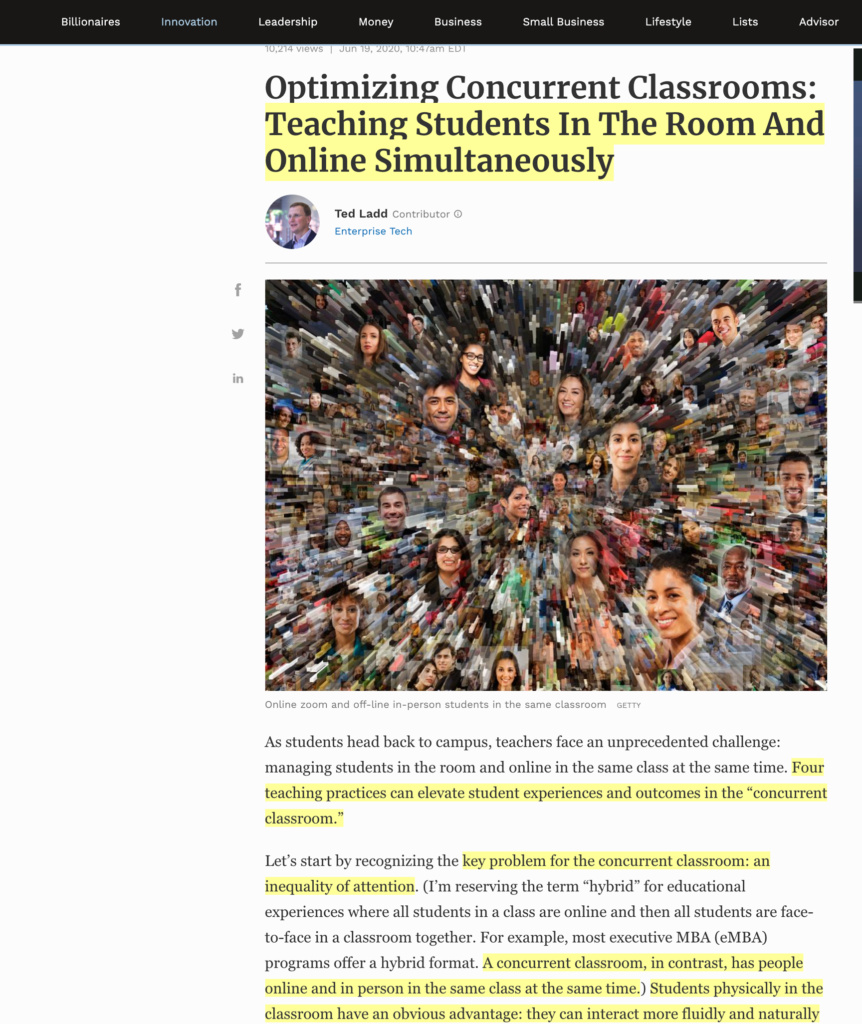
I found this resource from what I think is an unusual source – Forbes. The article identifies the challenges of teaching in a concurrent classroom. As I understand what is meant by concurrent as compared with a hybrid classroom, in a concurrent situation some students are always FTF and some always online. This would be the way I have taught my Instructional Design and Technology grad classes and I admit I never thought about the unique challenges of this arrangement. Concurrent can be contrasted with hybrid which means students rotate between being FTF and online. This arrangement seems what many K12 schools are planning for the Fall in order to reduce the number of students present in the physical classroom. Some issues are likely the same so it is worth reviewing the Forbes article for educators facing a hybrid arrangement in the Fall.
Problems:
The major problem in a concurrent arrangement is described as inequality of attention. This results from the limitations and predictable failures of being online (forgetting to mute, sound dropping out) and educator failures (tendency to focus on students in front of you, drifting out of the view of the camera).
Solutions:
Use a flipped classroom approach for any block of teacher presentation longer than 10 minutes. So students receive information presentation and demonstrations via video. The author then describe what happens with working synchronously as talk less and smile more.
Make frequent use of output-oriented breakout tasks. Students both in the FTF and online work in teams (learn how to do this in your video environment) on short duration tasks with the requirement of reporting a solution of position
Alternate gaze – Remember to focus both on the camera and students in front of you. I know this is an issue from personal experience. The article recommends even finding ways to remind yourself to do this. Calling on students is another way to do this. Call on students both FTF and online.
Asynchronous presentations – have student groups create short presentations on assigned topics/issues. Store links to these presentations in Google docs (note skills that would have to be developed). Assign students to these different presentations and ask that they add questions after reviewing the content.
The article notes that these could also be argued to be reasonable ideas for traditional classroom instruction.
P.S. – I use a social bookmarking system called Diigo. An interesting feature (the social part) is that you can designate entries for access by the public. There is a way to offer access to a specific entry in this collection and that is what I have added below. The free Diigo extension must be installed to see the annotations of another Diigo user.
I have been waiting to generate this post until I felt certain educators would be providing at least some instruction at a distance this Fall. I have decided Fall instruction will not be like the Fall of 2019 and tools for teaching online are worth considering.
I understand that educators have been overwhelmed by suggestions for teaching at a distance. I want to limit what I add to one concept. I call this concept “layering” (explained here) which is my way of suggesting that educators should learn how to take existing online content (web pages and video) and add elements that guide the learner. Informational rich content is not necessarily prepared as learning resources. Adding elements such as questions and annotations to remember something already learned can improve understanding and application. Help the learner process the information to increase understanding and retention.
I am making some assumptions about the tools educators already have mastered. I assume that educators have learned to use a tool for managing learning and reaching students (a course management system of some type – Google classroom, SeeSaw) and video communication tools (Zoom, Google Meet). I would then suggest educators spend time with the type of tool I suggest here. The tools I suggest are versatile so that the investment of time educators and students commit translates into frequent applications. It makes sense to spend time on such tools before exploring other tools that might be used now and then.
There are several different layering tools and you need to learn a different one for video and for web pages. Here are my two suggestions.
I am a very experienced screen reader. This has been the case for many years. Ironically, I am interested in the screen vs. print research and I have read much of this research. The screen vs. print issue seems to pop up frequently. [Example1, Example2]. I find my own reaction to be very different in several ways from the conclusions of this research.
The literature, quickly summarized, finds an advantage for print reading over screen reading with a greater advantage for informational than narrative texts. I read nearly everything I read on a device. I strongly prefer to read on a device for informational text particularly when reading longer texts (books vs. journal articles). I understand the methodological danger in anecdotal research even when the case used as evidence is yourself so I have tried to think carefully about why I have come to ignore the research and stick with my preferences.
Here are a couple of issues I use to bring some personal understanding to the difference between my perception of my own experience and what the literature seems to be suggesting.
The research tends to focus on reading comprehension; read and then complete some measure of comprehension. Most of my reading I would describe as reading to write. I highlight and annotate heavily when I read. I find this far more practical to do on a device allowing me to search my annotations quickly and in some cases use the record of my highlights to provide a basis for creating an outline to be used in writing. The time I spend doing this kind of reading may influence my preferences. First, this type of reading is more interactive than the way one would read in preparation for a post reading assessment not allowing review. Perhaps the interactivity changes the nature of my reading in a way that avoids the skimming some see as the reaction of text on a screen. People read for different purposes (enjoyment, understanding). Reading to write as I define it seems similar to what I would describe as reading to study. I think if I were taking classes having the option of a print or digital textbook, I would prefer the digital version. The issue is not so much if I can remember something immediately or later. The issue is whether at a later time I can review effectively.
I read a lot – probably averaging more than a couple of hours a day. I read many different types of material (books, journal articles, fiction, news) and I do nearly all of this reading on a screen. This has been the case for many years. I wonder about the impact of the amount of experience with online reading of long-form documents.
I like to change the size of fonts. I find the fonts in many print sources too small. I am older and I find it easier to read with speed with larger text.
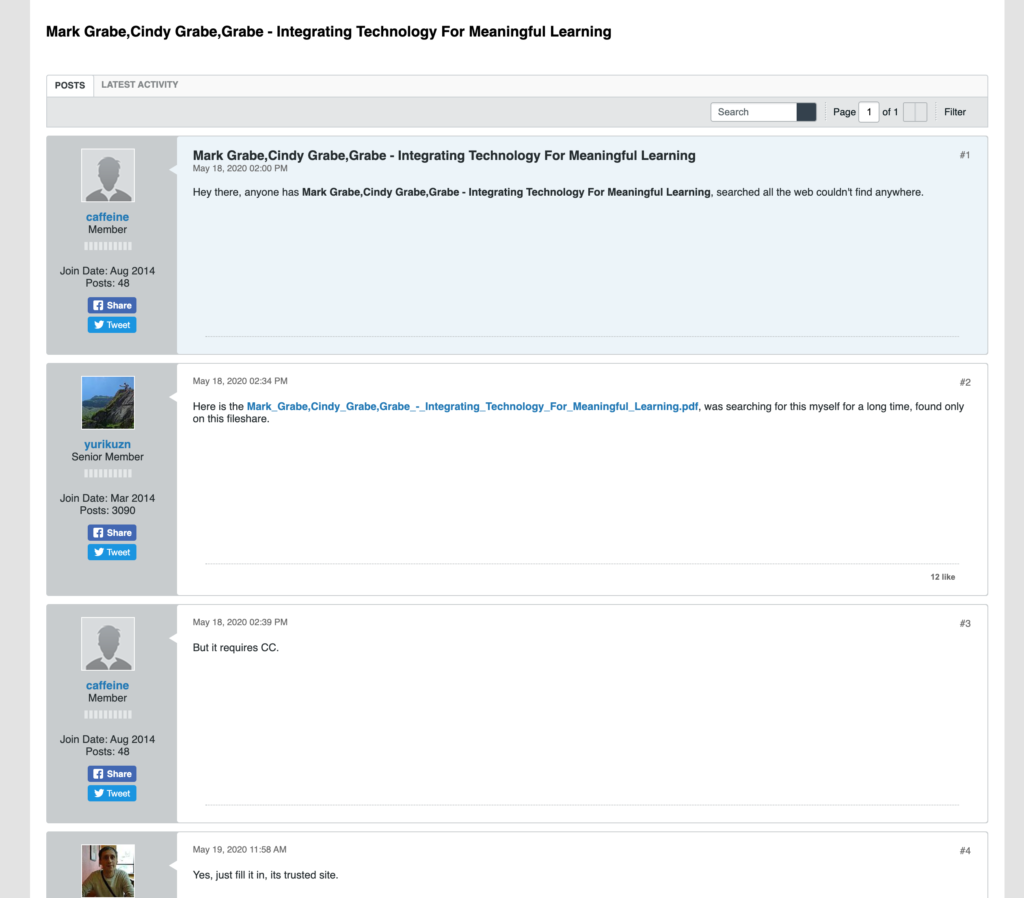
When I was doing the research for my previous post and doing some searches on my own content I came across this site.
What this site provides is a way to download at no cost, our textbook. You can get it as a pdf, mobi file, and a couple of other options. Going through the letters of appreciation (not to me) and the notes about it being provided under a CC option (creative commons), I could not help but become a little frustrated and a bit angry.
This content was stolen. Our book is sold through Amazon for $9. We sold previous versions of this book through first Houghton-Mifflin and then Cengage for well over $100. We opted out of that arrangement which was quite lucrative because we were unable to convince Cengage to go to a $29 model consisting of a paper Primer and a free web site. Through an arrangement that returned our copyright, we moved our Primer to Amazon ($9) and offer our supplemental resources at no cost on our own server. If you are interested in the logic for our model, search this site for book (I will tag this post so you can read our explanation). In short, there are advantages to our model that include lower cost, less dated content, and greater flexibility in what instructors can assign. This was not a decision we made intending to make more income and without the promotion of a major publishing company we receive a fraction of the income generated by our original paper textbooks.
I find it hard to believe that college students cannot afford to purchase this textbook for $9. Whatever anyone thinks of the cost of textbooks and what complaints one might have about this industry, these issues do not apply to us. Because this is a textbook intended for practicing teachers involved in graduate education and preservice teachers, I find it disturbing that people in this line of work would be so unethical as to steal a $9 book.
Maybe I am being too hard on the students who did this, but I assume they know or don’t want to know. This is a current book and not a book developed through a source of external support to warrant the phony creative commons representation that someone other than me has claimed for this work.
OK – end of rant. Just be honest and respect the effort and skill required to generate the content you use.
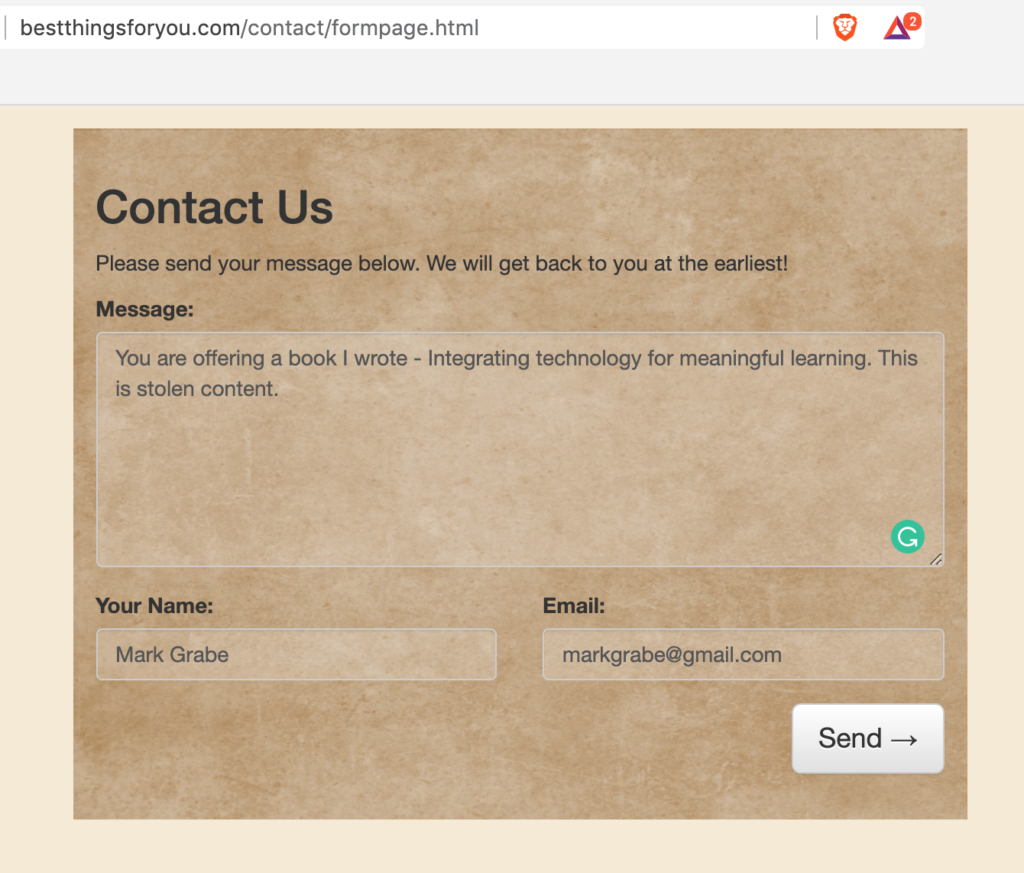
P.S. – The day I wrote this post I also responded to the site using a form that was provided. I kind of knew that if the site wanted responses in this fashion instead of via email I was unlikely to receive a response. I have not and the pirated book is still available.
Manage Consent
To provide the best experiences, we use technologies like cookies to store and/or access device information. Consenting to these technologies will allow us to process data such as browsing behavior or unique IDs on this site. Not consenting or withdrawing consent, may adversely affect certain features and functions.
Functional
Always active
The technical storage or access is strictly necessary for the legitimate purpose of enabling the use of a specific service explicitly requested by the subscriber or user, or for the sole purpose of carrying out the transmission of a communication over an electronic communications network.
Preferences
The technical storage or access is necessary for the legitimate purpose of storing preferences that are not requested by the subscriber or user.
Statistics
The technical storage or access that is used exclusively for statistical purposes.The technical storage or access that is used exclusively for anonymous statistical purposes. Without a subpoena, voluntary compliance on the part of your Internet Service Provider, or additional records from a third party, information stored or retrieved for this purpose alone cannot usually be used to identify you.
Marketing
The technical storage or access is required to create user profiles to send advertising, or to track the user on a website or across several websites for similar marketing purposes.

You must be logged in to post a comment.