A few days ago I wrote a short post commenting on Time Warner’s proposal to evaluate a plan calling for different rates for Internet use based on the amount of content moved. Today, a Washington Post article proposes that the issue is bandwidth limitation brought on by the increased interest in online video.
The article mentions illegal content, but I think it might be me doing legal things. I am sitting at my office desk catching up on the blogs I read AND watching CNN via my Slingbox. Evidently, according to CNN, the diet drinks I enjoy may be making me fat. That and finding out I am ruining the Internet at the same time.
I know UND does ‘traffic shaping” so we must still be under our allocation.
Way back when, the talk was of media convergence via the computer. For a long time, there was almost a disappointment that the predictions were not coming true. Now, perhaps, we are realizing that change is upon us.
Here is another Cindy suggestion. If you do Flickr projects, you might want to experiment with TiltViewer (from Airtight Interactive). The viewer allows you to browse and manipulate flickr images within a type of 3-D environment.
You can create a URL that allows others to view public images within this environment.
Why visit this site (or any other specific site)? I read a post by Kevin Kelly that dealt with a related topic that I found quite interesting. Kelly begins with the topic of digital copies and asks the question why should we pay for anything we can get for free. I consider the copyright issue a great deal and the issues Kelly raised in identifying motivation for payment certainly apply.
The post did cause me to think about a somewhat different topic – with so much recycling of ideas/news/etc. among bloggers (as is the case with this reactive post), why visit the site of any given blogger?
Consider some items from Kelly’s list:
Immediacy – do you need the resource first
Personalization – is the resource suited to your needs
Authenticity – is it the real thing
Patronage – the desire to support a particular individual (the author)
Findability – free does not always imply easy access
It is pretty easy to repurpose this list to address various topics that involve “version choice”. With Kelly’s focus, an example might ask do you watch the original broadcast of a television program, watch it via TIVO, buy the end of season compilation at Best Buy, or look for a copy online? You can work your way through Kelly’s list to see how the issues apply to the decisions you make.
The same questions might be asked with regard to the bloggers we follow. We do make choices and some would argue we would be better off if we were more discriminating. Some bloggers offer the original ideas. Some we trust. Some we follow because others do. Some we follow out of loyalty.
There are probably some other issues that apply with blogs. One core idea in online social environments amounts to taking advantage of differences in the perspective/experience of others with whom you share a common interest. The “common interests” becomes the reason for commitment. That individual offers content/insights likely to be useful to you (because of core interests) but that you have not had the time to locate. Maybe this is just another variation of what Kelly calls “personalization”.
There is a downside to “common interests”. When does the input from an individual with common interests encourage deeper thinking or useful insight and when does it simply confirm biases? I think those who think of their blogs as a certain type of educational tool might offer a different approach. Can we locate the individuals who challenge us in addition to offering information to consider? Can we locate the individuals who have a way of explaining how they think and not just what they think? That may be the value added to the copy.
Integrating input from many individuals is a common online task. Think questionnaire. Input from an online form is sent to a server allowing the input to be stored in a format appropriate to a database or a spreadsheet.Writing the code to do form processing is a basic task those who work with PHP and MYSQL (or other server scripting languages) cut their teeth on, but what seem like such simple tasks still requires a good deal of work.
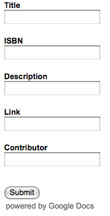
Google Documents now offers a convenient way to collect and store data from participants. Any spreadsheet can be updated using the new “form” option. After creating the structure of a spreadsheet (creating column headings), all you have to do is click the “Share” tab. You can then invite people (specify email addresses) to fill out a form. Those invited have access to a simple web page with textboxes corresponding to the cells in the spreadsheet. Fill in the blanks and submit. A new row of data is added to the spreadsheet.
This process if very easy to implement and there must be many educational applications. I like to create simple demonstrations when I encounter a new tool and the idea that first came to mind was to create a list of book recommendations. What follows is a link to the output from the demonstration I created.
I could share the address for the input, but I decided that might not be a good idea. No telling what contributions anonymous spammers might offer. An open contribution process is not what Google has in mind. This is the reason for the email invitation to participants. There is an URL address for the form and this address can be passed around however you might feel to be productive and safe.
BTW – if you would like to contribute your own recommendations to my list of education/technology books just send me an email and I would be happy to send you the form URL. I do insist you provide enough information I would feel comfortable with you adding to this list.markgrabe at gmail
It really bothers me when anyone connected with education seems to accept the inevitability of digital theft and proposes alternatives to support creative individuals without condemning the behavior. We should begin any comment on the matter with a clear statement that theft is wrong and those wishing to access digital content that comes few restrictions should learn how to locate such content. I would prefer encouraging students to focus on Creative Commons material and educators to contribute such resoruces.
Will Richardson’s recent remix and commenting of a post from Edge.com verges on the “the give up” or perhaps even “the ignore”. Call me naive or idealistic. I am neither. But, the implication that we might as well concern ourselves with other models for supporting intellectual property is troubling without a statement of concern is troubling. Kids drink. Kids have sex. Kids do drugs. Kids bully each other. Educators need to accept the student and help. This acceptance of the student is typically accompanied by an effort to prevent when possible.I think it is sad that capable individuals get ripped off and I think it is important to say so.
HowCast offers very brief instructional videos – short training videos offered by folks who know how. Today’s features include:
How to paint a wall
How to pack a carry-on bag
How to pray the Rosary
How to increase the life of your iPod battery
One category is focused specifically on “kids”. The offerings in this category and actually throughout the site may be helpful to teachers looking for hands-on ideas.
TechCrunch explains the startup and the format of HowCast.
Washington Post writer Steven Levy outlines a Time Warner proposal to charge Internet users by the Gig. The monthly cut for basic service is 5 gigs (I assume this would be for less than the current price). The article mentions the capacity eaten up by those involved in illegal file sharing. New and legal online video services – the article mentions iTunes, but I would think NetFlix would possibly be a bigger problem because there is no charge per download – are also a concern.
Of course, if such fees can be applied, it will again be less expensive to rent the DVD at your local store. It will also be less expensive to use “pay per view” through your cable company.
Levy contends this is somehow different than the net neutrality issue.
This is in contrast to behavior that violates the principle of “net neutrality,” which asserts that providers shouldn’t be able tilt the digital playing field to favor their favorite Internet services (i.e. their partners or those who pay them).
I don’t see it that way. If the cable company owns the pipe, digital cable content and Internet content are still coming into your home through the same connection. If the company can restrict one form of digital content in order to increase sale of the other, they certainly are not neutral. I’ll bet the download tax won’t be applied to pay per view purchases? Perhaps pay per view downloads require no bandwidth.