When I was a kid, we subscribed to Life magazine. According to Wikipedia, Life offered its last issue on April 20, 2007. I must say I hadn’t noticed. I guess many of us have moved on to other media.
The Life collection of images has historical value and now Google is providing all of us access. It looks like Life is going to launch its own venture, but Life.com is not yet available.
This is another resource educators may find helpful.
Typealizer claims the ability to identify your personality type based on a substantial sample of your writing. Blogs make a good data source. While I am skeptical, I did give it a try and the results make some sense. Actually, my wife gave it a try and said this sounds exactly like you.
Typealizer categorized me as “Scientist” – long-range thinking and individualistic, intellectually curious and daring. Sounds good so far. It also says “scientists” tend to be so abstract and theoretical they may difficulty communicating their vision to others. I suppose some of my students might agree.
My wife’s blog – With eyes wide open – also resulted in a positive category. “The Doers – high energy and social. Especially atuned to people. Impulsive and more keen on starting something that following through.
I have been trying to figure out if I would rather be a thinker and individualistic or high energy and social. I guess you are what you are.
I make no claims for this service and the developers suggest that the results should not be taken too seriously. I wish they gave a little more information on what features their system picks up on.
Recently a group of folks convened in an effort to consider the topic of fair use in education. The group generated a report and some have gone as far as to proclaim “Finally the end to copyright confusion has arrived”. The document generated by this group is available online (Best practices document – pdf) and various blogs have discussed the document and promoted the conclusions of the group (e.g., Speed of Creativity, Blue Skunk).
Here are some thoughts on this topic that are somewhat pessimistic on the conclusions of this group and concerned for how the the conclusions will be interpreted by the average teacher. I also think the case can be made that in many situations taking advantage of legitimate fair use may not be the best educational decision.
Here are some thoughts that are an attempt to establish a certain logic for these statements.
1) Copyright law is just that – “law”.
2) Copyright law is “ambiguous” – read it yourself and see if you don’t immediately think of specific situations for which the law does not explain what you should do.
3) EVERYONE has an opinion on what the ambiguous parts of the law may mean. There are experts with opinions and amateurs with opinions. Some folks are willing to share their opinions, but most are very careful to indicate the position(s) taken are only opinions. In the end, these opinions are tested in court and legitimacy of a given position is established.
4) Groups are sometimes convened to offer an interpretation of law – i.e., to offer opinions. CONFU1 and CONFU2 were convened to offer an opinion on copyright in the early days when it became clear that the digitization of content presented some unique challenges. The CONFU groups offered fairly conservative opinions and lacked specificity in areas that concerned educators (e.g., online fair use). The TEACH act offered a solution to some of these questions.
5) The CONFU groups appear to me to differ from the group responsible for the Best practices document in an important way. CONFU participants reflected the multiple stakeholders who had an interest in the interpretation of copyright and fair use. In other words, both content creators and content consumers (or users) were represented. The participants in the Best practices group appear on page 18 of the pdf. You will not find representatives from publishing companies, the film industry, etc. represented in this list. I would be more impressed by the findings of this group if the group were more representative of stakeholders.
6) Media literacy often involves the use of samples to demonstrate and illustrate topics in media literacy. Media literacy is a narrow topic and typically not the focus of much instructional/learning time.The issue I raise is not whether this topic should be considered more frequently, but to identify a concern that some may misinterpret comments concerning media literacy as relevant to what they teach.
7) The vast majority of those who violate copyright will never be prosecuted or even criticized. However, some still take a conservative approach. A group consisting of “experts” who identify best practices will likely encourage more liberal actions among those originally taking a conservative position. There will likely be no consequence for this shift despite the possibility that those with a legitimate stake in this discussion made no contribution to the suggested practices.
8 ) A more liberal position will result in less income for content creators.
9 ) There are multiple reasons for taking advantage of fair use opportunities (whether legitimate or not). For example, I may lack the opportunity or lack the funds to secure certain information sources on my own. I may also secure certain resources because the resources were generated in a more professional manner than I am capable of generating or simply because I do not wish to spend the time. As a learner, producing less polished, but constructed resources may result in a generative learning experience while borrowing more polished resources created by someone else may not. Best fair use practices are not necessarily best learning practices.
10) There are important ethical decisions involved in taking advantage of resources I encounter and can collect. Whatever decisions I make as an educator, I model the ethics associated with the decisions for my students.
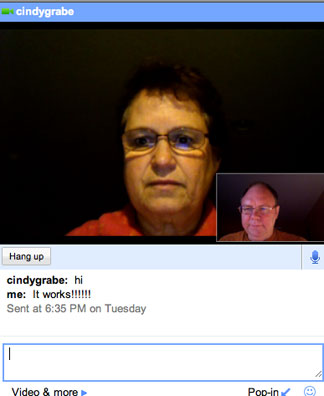
Google has added a new tool to the arsenal. Gmail has included text chat for some time, but now you can also use your gmail account for video/audio chat.
If you are a Mac user, this feature only works with Intel machines running 10.4 or higher. Use Firefox. I am less certain regarding the requirements for the Windows OS. MacBooks with the built-in camera work well.
If you are interested in experimenting, the plugin can be downloaded now.
This is a basic product at this point. Google has the advantage of being able to integrate it with the popular mail service. I like the option of being able to record a video/audio conversation, but there are several other ways to do this and this option may eventually come to Gmail.
I recently purchased a Blackberry Curve because I do not live in a region of the country allowing me to make use of an iPhone. I have owned smart phones before, but the newer devices offer a range of additional services and one can really get some work done. A combination of the keyboard of the Curve and the more authentic browsing experience of the iPhone would offer a great combination. Perhaps such a device is on the way.
As I gain experience with the capabilities of these tools I continue to discover new possibilities. Sometimes the best approach is just to explore. Today I found a new task I can accomplish with my Curve. I record my large class presentations for student access. I typically accomplish this task by bringing my laptop to class and using Audacity. On several occasions I have arrived at class without my laptop. Usually there is a student in the class who also records my presentations and a simple appeal results in a file showing up as an email attachment. Today, I found myself in class without my notebook, but I happened to remember that the Curve has a voice note recorder. I have never used this feature and was not certain that the storage capacity would hold 50 minutes of audio, but I gave it a try. The results were more than adequate.
The Curve stores audio in an .amr format. You do learn new things exploring. It turns out AMR stands for adaptive multi-rate and is a codex suited to voice. I discovered that Quicktime will play amr files and Quicktime Pro allows amr files to be saved out in other formats. When I searched the web to discover what amr files are I also discovered that there are several free programs that can be used to convert amr files.
We may be getting close to inexpensive devices that perform nearly all of the functions we expect of our traditional “computers” and perhaps some new ones that are useful in very mobile devices. These devices will be affordable. Now, if we could find an alternative to the monthly fees that accompany no limit “smart phones”.
I came across a new online resource called SimplyBox. It is another entry within the category of tools that allows a user to collect and organize research resources (e.g., Evernote). I have heard this category described as “clippers”.
I think these are great tools for personal research. What I wonder about is the use of such tools for presentation/sharing (e.g., SimplyBox proposal for teachers). Two options are provided for sharing collected resources. One offers stored resources to non-SimplyBox users (anyone) and the second to a designated group of friends. To me, repurposing content AND sharing would require limiting access to an audience of students (e.g., TEACH act). The second option I mention (designate Friends) would fit this requirement. Combining content as part of a display would also seem to require the permission to create a derivative work. Again, I would interpret offering a collection of resources collected without author/creator permission to the general public to be against copyright. This seems like another of those situations in which we are provided powerful tools and it is up to us to decide what represents legal and ethical use.
As we use more and more technology, we also discard more and more technology. This is the way that consumerism and the desire for newer and better products works. While we have learned to recycle our old cell phones and computers, we may underestimate the consequences of this rapid accumulation of high tech garbage.
This evening’s edition of 60 minutes featured a story on the breakdown of computer junk in Guiyu, China. The expose traced the shipment of cast-off hardware from the US to China and the breakdown of this equipment to collect valuable metals by Chinese laborers using primitive and dangerous methods. While the practice is against both US and Chinese laws, the money to be made still encourages the exploitation of desperate people.
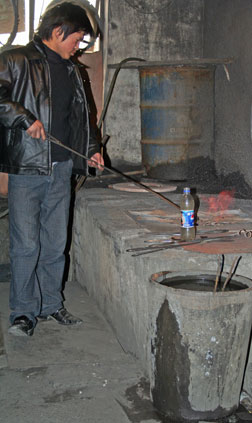
One thing I recall from visiting China some years ago was that the rapid economic advances were largely built on the labor of farmers moving to the cities for a better way of life for family and self. One of the pictures I took in a factory making merchandise for tourists is included below. The hours and conditions were typically far different from our experiences, but I assume tolerated because the alternatives were worse. Perhaps the message here is that we understand what is happening and urge our representatives to support policies that prevent exploitation.

You must be logged in to post a comment.