Custom Search

Google offers the opportunity to create a custom search service and I knew this, but I had never considered potential educational applications until I heard Alan November present some ideas at NECC.

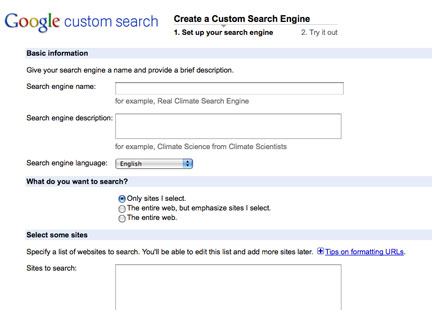
googlecustom

You can set up a search engine and control the web sites it will access (you can probably get the idea from the screen capture I have inserted above. You need a Google account to gain access and then locate the option under the list of Google Products (I can’t offer a link here because the link would not work unless you have a Google account). So, this was not new to me.

What I did not consider was that you can also control who can add sites to search and who can view and how setting these preferences might be of some educational value. Assume a tech coordinator sets up a search engine focused on useful web sites for elementary science and offers elementary teachers within the district the opportunity to contribute URLs. Perhaps the goal is to explore the wildlife of the state. Access to this collection could be made public or shared more privately. What might be made available to students as a consequence of this process might be a Google search engine that would then only return search results appropriate to the topic (level, focus, quality, etc..).

What follows is a custom search engine that will return hits from my two blogs. You can test it be first locating something in this blog and then conducting a search to see if you locate the post you expect (and perhaps others).

Loading

At least failures give us real examples

There is now some distance between the NECC experience and the present. This is true on several dimensions – I have had time to reflect and I have completed the drive home (3500+ miles round trip).

I find that I am beginning to find the “dataless” pronouncements of some who advocate for positions I actually suport to be quite annoying. I can attach this annoyance to names, but this is not my point. I take offense in the implication that truth is obvious to those who understand and asking for evidence is somehow an indication that I lack insight, intelligence, or a degree from the appropriate graduate program (the one that did provide me a degree mant years ago did require I offer data in defense of the claims I made in my dissertation). I am not requesting standardized test data – this is the straw man you attack over and over again. I am simply asking you for working examples in the wild of the great variety of real kids with parents (or not) of real incomes.

My request is simple – don’t complain and enough of the rhetoric – offer me something a little more concrete.  Enough of what others do wrong where they work. Forget about your next speaking gig and the fee it will bring. Spend some of your energy working to create a productive working example of what you advocate in a real working educational setting.

Consider, for example, the Microsoft and Philadelphia School of the Future. The story of the SOF has been covered in eSchool News over the past couple of issues (June and July – current issue requires login). This is not a story of success, but it at least is a story. There is something concrete to consider. What happens when an effort is made to translate vision into reality? What can go wrong? Why did things not work out? Are the concerns that may have led to the disintegration of SOF avoidable?

Perhaps this was a failure. Perhaps this was something concrete that can guide future efforts. At least it was more than words.

Blogged with the Flock Browser

Loading

DLP Technology – Cindy Makes a New Friend

Cindy somehow learned about something called DLP technology (she can’t remember how). She knew that it had been applied as an alternative to whiteboard technology and searched for information through YouTube. She located the following demonstration.

So, today she heads off to the Texas Instruments booth in the exhibits hall to see if they had a working demonstration and finds not only the technology, but the kid (to us) who created the demonstration video. This made quite a hit in the Texas Instruments booth because no one else had made the connection between the youtube post and the person working the booth. Finally, he had a fan.

cindymarshall

So, here is a picture of Cindy and Marshall.

BTW – watch his YouTube demonstration. This is going to be a very interesting classroom option when the cost comes down a bit.

Loading

Wandering the Outside Aisle – 2009

I started a practice in 2004 of writing a post based on my exploration of the NECC trade show. I called this practice “wandering the outside aisle” because the idea was to locate a new product/service advanced by a small company. These companies tend to purchase small floor areas around the outside of the trade show pavilion.

I decided that my selection this year would be yolink.  Yolink provides a browser plugin that offers some improvements on the traditional search process. There are probably many different ways to use the product (actually a plugin and a space reserved for you on the company server), but the basic idea works something like this.

1) Do a traditional search or load a web page with many links.

2) Do a re-search by using yolink within these findings (using the original search term or new terms)

yolink1

Yolink will locate the links, find the search terms within the content these links access, and display this content.

2) You can move to the sites by clicking a paragraph of interest (or)

3) Select a resource to save and share

yolink2

Select from the paragraphs containing the search terms those that you wish to save

4)

yolink3

The selected paragraphs and a thumbnail of the site will be saved to your acount (or sent to your email address or another of several other options for sharing).

This all strikes me as pretty cool and potentially useful in the process of collecting online information. I sometimes wonder how processes such as these are legal – you do seem to be moving the paragraphs from a site into your possession (if I understand what is happening). I also cannot explain the business model allowing this service to be offered. I assume the copyright issue is somehow not an issue. I will leave it to the company to worry about their bottom line.

Loading

NAEP Technology Literacy

I attended an information session for the NAEP effort to assess technology literacy. A couple of issues to note – 1) this effort is not intended to offer state by state feedback and 2) the definition of technology is broad encompassing not just computers and the Internet, but also technology systems, maintenance and troubleshooting, technology in the natural world, etc

Loading

Is there still a market for desktop apps?

We spent a good part of the day at a NECC (now just ISTE according to the opening remarks) presession sponsored by the Constructivist Consortium. We received some great software at no cost and had an opportunity to explore what the new products had to offer. Mostly, though, it was a opportunity for like-minded folks to catch up and talk shop.

I spent most of my time exploring Transform from LCSI (remember Logowriter from the old days), but also at least opened Animation-ish from FableVision. What these tools have in common is a very open design allowing students to create a range of projects. PBL and creativity are key concepts for these folks.

I spent several hours exploring Transform – mostly simple things and seeing what I could remember about LOGO. My sun moves slowly across the sky and the cow appears.

transform

I wonder about the future of desktop-based educational software. Everything I saw today was pretty cool and clearly more sophisticated and capable than what we used 10-15 years ago. Perhaps programming as problem solving or programming as as computer literacy will make a come back. With clould apps, netbooks, and tight budgets, will cool software generation the necessary traction to attract of critical mass of schools/teachers? I don’t have a position on this one. I am inclined to suggest that there are open source and cloud alternatives (Squeak, Scratch) that will attract those willing to explore in this space.

Loading

Does a label matter

I have not focused much attention here lately due to preoccupation with another writing project. I am working with a grad student to author a book chapter on cyberbullying in the United States. My interest in this topic originally resulted from the realization that schools may block students from using many of the participatory web resources I felt had such great potential. In attempting to understand the threats from predators and cyberbullies, I concluded that filtering was not the proper reaction to either threat. Anyway, in attempting to become involved in the literature on cyberbullying and collecting some data with a graduate student who works with me I have become a good deal more knowledgeable and moved past the issue of what schools block useful opportunities.

Two initial observations:
1) research on cyberbullying is far less mature than research on bullying
2) assuming that cyberbullying is an outgrowth of bullying may limit the perspective on many researchers.

Here a few comments on observation #1.

In reviewing literature for the chapter project, it seemed that the terminology applied in addressing online or phone-based aggression and victimization was more variable than that applied to face to face aggression and victimization. What was not always evident were reasons that might account for this difference? Perhaps bullying has been studied more extensively and for a longer period of time allowing for greater standardization. There seems to be agreement on a relatively small number of characteristics that define “face to face” bullying. With perhaps the addition or elimination of a characteristic, this list seems to include:
    a) the targeting of an individual or small number of individuals,
    b) experiences that are defined as negative and damaging by the victim,
    c) repetition of these experiences, and
    d) a power differential making it difficult to terminate or escape the negative experiences.
Establishing such a set of characteristics allows bullying to be differentiated from other forms of interpersonal violence and makes it easier to identify the perpetrators and victims involved.

Much of the research on cyberbullying fails to focus on events that meet this set of standards.
1) Often victims are defined based on a single incident
2) Often victims are not “distressed” by the experiences
3) Often victims can handle events (they know what to do online to discourage attackers) implying that they are not at a power disadvantage

Bad things can happen as the result of a single experience. Those who attempt to bother others have issues that must be addressed. The label applied does not mean that these realities do not exist. However, as a topic of research, some focus needs to be brought to this area so that the journals get beyond publishing the results of conflicting survey studies.

Blogged with the Flock Browser

Tags:

Loading