I am preparing for a presentation that concerns the hidden potential in Kindle services. In preparing to discuss the options for viewing documents uploaded to Kinde (e.g., pdfs of content I might want to read on various devices), I discover that in addition to the “mail to my special Kindle email address” option, there is now a PC or Mac app dedicated to this purpose. This sounded more practical than remembering the weird email address I am supposed to use.
I download the app to my Mac (running the newest and greatest OS) and I see the following:
I admit this confused me and it took some time to figure out why. I interpreted the message to indicate that I could not download the app. This seemed to be what was happening. Actually, I was downloading the app, but the message was generated when the OS then automatically attempted to launch the app after download. I was also confused by the message itself. Somehow I assumed that Apple would be aware of Amazon and Kindle products.
OK – here is what you may find useful.
Should you receive such a message when downloading software from an unknown developer, open security preferences and rest the download option to download from anywhere. This may be a bit deceptive – look in downloads and see if the offending download is not already there and simply needs to be opened. Once, finished reset your security settings. You make your own decision regarding whether from app store or from identified developers means different things,
This is the last in my series on our experiences in self publishing. The title of this post — Send lawyers, guns, and money — is the title of a Warren Zevon song (a favorite artist). Hopefully, the connection will become obvious given the focus of the rest of this post.
Based on our experience working with a publishing company and then attempting to offer a related product without this support, I thought our insight into what you give up when you make the decision to go it alone might be of some value.
First, you give up the collaborative relationship with an editor and the others the editor might enlist to offer advice on the development of a manuscript. As an example of what I mean by others, an editor might enlist several individuals who teach the course a book is intended to address to offer advice. I must say I found little value in the comments of course instructors toward the end. After moving through five editions, we have a sense of the priorities our book should address. There were always those who valued these priorities and those who obviously were looking for something else. The feedback from course instructors would reflect this diversity of opinion. Some would like our approach and others would identify and endorse topics we did not cover. For example, we have never spent a great deal of time focused on interactive white boards. For some, this is what you prepare teachers to use. For other instructors, either they would take care of this themselves or they did not believe it was a topic deserving much attention.
I always valued the contributions of an editor. The level of discussion was much more detailed. It is helpful to have an experienced neutral party work with you to assist you in saying the things you want to say. Sometimes the issue was how to cut 35 pages to meet some imposed price/page limit (no longer an issue). If such modifications are necessary, it is helpful to discuss options with someone experienced in making such adjustments. Writing style also requires a neutral perspective. It is easy to fall in love with your own way of saying something and it is useful to have someone tell you that the point is not clear.
The lawyers (hence the title). This is likely a group providing services most would not identify as important. Perhaps our experiences in this regard is a function of the type of resources we provide. Our books made use of classroom examples using various software applications and online services. When you use a story about a teacher, an example of student work, or an screen capture showing what a specific software program looks like in action, you must secure the permission of the relevant teacher, student, or company. We took care of the people requests ourselves – Cindy has many classroom contacts and nearly all of our classroom examples relied on these opportunities. We also have some contacts with companies and were able to obtain releases for some of the applications we described. The greatest challenges tended to me with the large companies (you can fill in the examples). Requests to use a particular screen image are not rejected – they are simply ignored. Our publishers also were ignored in some cases. My impression is that the lawyers would sometimes make a judgment call to go ahead without a signed permission.
As I have indicated in a previous post, the permissions issue is probably the main reason we were unable to reach an agreement in publishing a shorter book at a significantly lower cost while taking advantage of the opportunity to place additional resources online. My interpretation is that companies are very sensitive to the intellectual property of other companies (this is my attempt to interpret this in a positive way). To reach the point at which they are comfortable, they invest time (and hence money) in negotations and decision making. There is simply not sufficient margin in an inexpensive book to support such expenditures.
Finally, a commercial publishers invests heavily in marketing. College profs (including me) do not cast a wide net when it comes to finding an appropriate textbook. Mostly, we wait for a book rep to come to our office and explain what resources their company has available. This is often the starting point. Simply put, you consider the options you know about. The other mechanism I use is to spend time in the “exhibits hall” while attending research conferences (e.g., American Educational Research Association). The book companies subsidize such conferences by paying fees in order secure exhibit hall space to reveal their wares to instructors. Sending the reps to your office and paying for exhibit hall space costs a lot and such costs are rolled into the cost of the books sold. So, it is easy to sell an equivalent book for a lower cost, but this lower cost means it is much less likely course instructors will discover the book.
P.S. – ignore the guns thing. This just happened to be included in the title of the song. I stand behind the request for money and lawyers.
This is the third in my series of posts describing what I propose as a new model for textbook publishing. The model was developed specifically to address the needs of courses intending to prepare teachers to make better use of technology in their classrooms, but some of the ideas may have broader value.
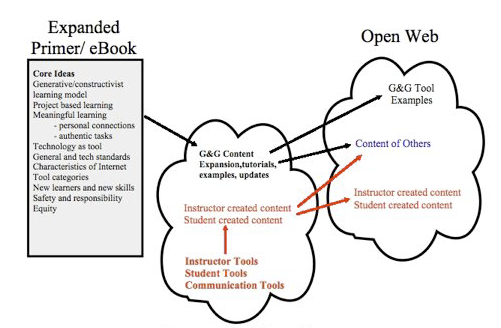
Four or so years ago we approached our publisher with a formal proposal for what we described as the $29 textbook project. I still have the proposal and the image that appears above was included in the proposal to identify some important components of the proposal. The core idea was to retain a traditional book (paper or online) in a significantly smaller and less expensive size and to offer more content online. This may sound unremarkable, but companies fail to follow through on such a model. The book is simply never downsized. Costs are never cut in a significant way.
The image identifies the three components – the Primer (book), closed web, and open web – we proposed to develop. At the time, the $29 model assumed students would pay for the Primer and the closed web content. The closed web implied the generation of resources that would be available online. The phrase “closed web” implied only that it would be necessary to operate a server to offer these resources. The open web implied the creation of examples available as “public” or “shared” content using services such as Flickr, YouTube, or Diigo. Instead of describing how such services could be useful, the intent was to demonstrate fully functional examples using the services of interest.
The one idea of general value from our plan may be that different delivery systems have unique advantages and disadvantages. While others may disagree with the issues I identify, I would argue that differentiating ways in which learning resources can be provided and considering which resources are best suited to which method of delivery would be a way for publishers to move beyond the traditional book.
Some ideas (from what I remember):
The book: The book should identify the content structure and the core concepts promoted by the author. These components are the message the author intends to promote. Your message should have some longevity over time so be willing to commit to core ideas for several years.
The closed web (The stuff available from the sponsored server. The phrase “closed web” probably made more sense when I was proposing that this be provided by the book company and available only to those who purchased the Primer.): The core message needs to be extended in multiple ways. First, what do key ideas look like in the present. If you have not written a large traditional book, you may not understand that the lag between some of the first things you write and when the finished product is available to a reader may be well over a year. We are discovering that the world moves too fast in many disciplines to offer a useful description in a product that takes a significant amount of time to develop and then is expected to remain static for an additional period of time. What research on important topics has become available in the past year? What tools might presently be available to implement classroom to classroom interaction? What are the present sources of inquity that frustrate the full potential applications of technology to learning? What legislation must be considered as students engage with technology?
Second, what experiences are best presented through multimedia. For example, tutorials for how to use specific tools make more sense as demonstrations than as text-based descriptions.
Finally, the closed web can offer resources to allow the instructor to customize the experience available to the students taking a particular course. Is the course a sophomore course provided to future teachers or a graduate course provided online to experienced teachers interested in new ideas for their classrooms? Is the course focused on teachers preparing to work in elementary or secondary classrooms? Does the instructor value a research perspective for the proposed activities or does the instructor believe the course should take a narrower focus? It is feels great to be able to develop a resource you realize will be highly valued by some but be irrelevant to others.
The open web: We will likely rely more and more on software as a service applications. Why not prepare and allow access to fully developed projects for students to explore? What does a Flickr site with several thousand photos look like? What does a social bookmarking site build to cover the topics explored in the Primer look like? What would a blog developed over 10 year years as a way to explore educational issues look like? Examples of projects offer a way to explore that support and extend general descriptions.
You might have noticed one other thing in the diagram. Some of the text and arrows appear in red. Once an author makes a real commitment to online resources, the online environment offers a very real opportunity to engage learners of all types in an interactive way. We can offer you a book, tutorials and summaries of relevant current issues. You can likely offer me and others creative ways to teach the content of a course that might use this book. Your students might generate interesting projects as a consequence of such courses. I have been enamored of the idea of the participatory web for years and believe that the potential is there for good ideas to flow from many different individuals. I see our responsibility as creating a structure within which this is possible.
Some might suggest that new ebooks allow the incorporation of multimedia and can be updated by the author as necessary. I know that. However, the multimedia infused book still has the problem of trying to be everything to everyone. As an alternative, I have been playing with the idea of an instructor “loaded” interactive syllabus. This is the idea that an instructor could select a set of resources from a collection within a self-defined structure embellished with instructor created resources. Maybe I can explore this idea in a future post.
What goes where? This is my way of imagining the role of a textbook in the educational process and of reimagining the “textbook” within a collection of resources an “author” can offer the instructor and students. This post is one in a series based on our personal experiences creating a textbook and related resources and mostly attempting to describe the logic and process of our “project”. (see initial post in this series)
Our Kindle book was created out of the frustration of getting our previous publisher to allow us to move from a large and expensive product to a different and less expensive collection of resources. This proposed collection retained a book in a format we described as a Primer. Do not continue reading if you expect me to argue there is no longer great value in some form of a textbook. We tried for several years to make a transition because the textbook industry seemed befuddled by the obvious backlash against the cost and limitations of textbooks in the present form and because we thought we had an idea that happened to be centered in a content area (the course intending to prepare preservice and in-service teachers to make better use of technology) that would be as good as any for trying something different. Advocates for technology in learning should be interacting with learners in ways that incorporate learning with technology. Anyway, given the scale of the general problem of changing an industry, some experimentation is necessary if these companies hope to survive. Given the amount of money involved in the entire commercial textbook enterprise, some R&D seemed a wise investment even if some ventures did not generate a substantial return on investment.
From the beginning, I had no intention of ridding the world of textbooks. Some probably think this position is taken as a concession to the desire of most to comprimise rather than revolt and that the real visionaries would offer something completely different. Being different just to be different seems pointless. First, you would have to prove to me that a book was an unproductive way to learn.
My general premis was that one should consider the tasks a textbook might be expected to accomplish and accept that the textbook as commonly designed is not appropriate to all tasks. The static, large, text-heavy book is not appropriate to all tasks. However, some form of a textbook is ideal for some tasks.
Why a book (digital or not)?
This is a question that is core and I think educators need to consider it seriously. Some have already reached the conclusion that a book is no longer nececessary and they can simply direct their students to various web resources – free and selected to meet the priorities of the class and the teacher. I read books, assign books, and write books and do not agree with a complete abandonment of the textbook.
The most important expertise of an educational author is the ability to externalize in a tangible and explorable format, a coherent model of a domain of study. This may sound abstract so allow a different explanation. Think of a book as an outline with context explaining how key ideas fit together. You have access to this explorable resource in a convenient form. Getting this outline out of the head of someone else is a complex process. This is what should be regarded as complex and abstract. Learning is clearly not transmission. Teachers do a different set of things associated with the same goal of assisting students in developing their own models of a domain of study. Providing experiences that are motivating and that illustrate important principles is a different goal. Getting up and talking with students day after day about a topic to encourage their building of a personal model is a different skill. However, organizing knowledge in a tangible form is a very different contribution. What are the key ideas and how do these ideas relate to each other? The tangible attribute is important. The book is the trangible product. The tanglible product takes a great deal of time to create and more time than people typically understand to imagine and research.
Authors and teachers assist learners in building their own models of the world. Whether we do our jobs well or poorly or understand what we do in this way, this is really what it all amounts to in the end. Some educators like to throw the term “constructivism” around, but I think it is commonly misrepresented. Understanding that learning is the building of personal models of the world is what constructivism assumes. It is not the experiences or resources provided, but the mental behaviors of the learner involved in processing these experiences that construct understanding. This is how some seem confused by the process. It is not necessarily constructivism if the learner gets his hands wet or dirty or cuts something with a scissors or a scalpel. The thing constructed is not the dissected frog or the log fort, it is the abstract mental representation of circulation or frontier life.
Some students will constract a great model out of any experience – great minds have obviously been present in all historical periods often relying on listening and reading. These learners constructed their models using these inputs because the sources resulted in thinking. The personal motivation and the form of the inputs were sufficient. It seems simplistic to take a position that a given resource (e.g., a book) or experience (e.g., reading, listening) cannot result in meaningful learning. It makes more sense to examine multiple resources and experiences to evaluate potential strengths and weaknesses and to offer options.
We see learning from a book one of the more learner-centered and efficient ways to offer a conceptual model to others. We read far faster than we are allowed to listen or view. We control a book in ways we have no hope of applying to a presenter, video, or life experience. We can review a book to remediate without bogging down a group experience and do so by simply redirecting our eyes to the paragraph we could not understand. No need to waste time on the parts of the experience we understand. If we happen to be bored at the moment, the experience will still be at our disposal in a few minutes or tomorrow when we may feel more like attending. A book offered by someone from a given perspective is far easier and less expensive to replace with an alternative than is an assigned mentor. It is fun to think deeply about any resource – you discover that assumed strengths and weakness are quite debatable. I obviously struggle with what seem simplistic positions to me. This is a constuctivist problem – we see the world from our personal model of how things work. However, understanding we construct understanding is a great starting point because it encourages the comparison of models allowing possible advancement in our own. This is pretty much what Piaget claimed. Challenge me with your model. I can use it to contrast with my own.
My conclusion is that a book is perfectly useful as a learning resource. Rethinking the book is not about whether I can learn from one, but whether the resource I am provided is optimal in terms of recency (probably implying accuracy), cost, ease of conceptualizing, fit with other available resources, personalization, and probably a host of other variables I have not considered. I have given some thought to some of these things and with my coauthor attempted to generate a suite of resources given these considerations. This is not a mental exercise – the suite of resources has been generated (note – recency has been considered so the suite by definition is never in final form). I will admit to another announce – those who offer advice or insight and cannot offer a product as an example. You learn a great deal trying to act on your advice. What I intend to outline in a few blog posts to follow is our thinking about what these resources should consist of and what we have found practical to offer.
– – –
Here is an example of how others feel limited by a textbook. I obviously see the instructor as operating somewhat independently and welcome a related perspective offered by a different individual. Our perspective also is intended to counter the static (for a 3 year period) resource by offering different resources in different ways.
Cindy and I have just released the 6th edition of our book (Integrating Technology for Meaningful Learning) as a Kindle Book. The Kindle Book is available for $9 (Amazon Prime members can get it at no cost for the next 90 days if I understand the terms). This book was developed as a Primer (about half of the length of our earlier editions). We did this purposefully in order to move resources online. The online resources are available to educators (preservice and inservice) at no cost.
The Back Story
This may seem like self-promotion. I suppose it is. However, the backstory may put our project in perspective and be of interest to others whether or not they are interested in the product. By the way, the 5th edition is also still available from Amazon ($107). The price difference is part of the story.
Cindy and I began developing a textbook for preservice teachers in 1994. We published with Houghton-Mifflin in 1995 with a 1996 copyright (Note: The college division of HMCO has been sold and resold a couple of times since then. This is also another part of the story of the book business). We were the first, we think, to use the phrase “integrating technology” and “meaningful” in a book title (we think). If you are curious, check how many current books incorporate these words. I can’t claim the idea of technology integration as now understood was ours. I took the concept from a book called “Mindtools” authored by David Jonassen. I thought his ideas about the use of productivity software in educational settings made a lot of sense and my contribution was to “interpret” and provide classroom examples for educators. Many of the examples came from Cindy’s work as a technology facilitator.
The textbook business is struggling. Some of these problems have been self inflicted. Some are the result of public misunderstanding of what it takes to create a quality product. Sometimes you get what you deserve. Sometimes you find yourself dealing with circumstances and perceptions that you cannot control. We have obviously broken our association with a major publisher to go it on our own. Still, do not get me wrong – I am sympathetic and have friends in the business. The “textbook crisis” is not ALL the fault of the big companies (see Beer Money Ploy).
Anyway, we wanted to transition a book that was a commercial success through 5 editions to a different format. We believed it was the appropriate thing to do given the field we focus on (educational use of technology). If you truly believe that technology can play a meaningful role in learning, it seems disingenuous to make your point using only a book. Our proposal (once blocked after we had secured a commitment from a second publisher because it seemed we were duplicating our content in a way that would amount to competing with ourselves) was to create a Primer and online resources. The idea, which we labelled the $29 textbook, was intended to offer a hybrid product that allowed each components to do what each was best suited to do. We intend a Primer to organize the basic arguments – the more stable elements that benefit from a solid structure and elaboration. The online world is suited to the recent, the speculative, the examples, and the tutorials. It made no sense to incorporate all of these elements in a book. A single, static product did not allow learners to experience demonstrations as they should be experienced. It did not allow them to participate. It did not allow updates until three-years later when the company asked you if you wanted to do a new edition. It is a little more complicated than what I have described here, but I hope the general idea of the benefits of a hybrid approach is clear.
We finally decided enough was enough. We thought we had an agreement to do it our way, but the profit margin on a $29 book and concerns for permissions related to the content we wanted to offer online could not be overcome (lawyer costs must be included in the cost of a textbook). I do not blame the company for their decision. I blame them for the delay in making it. Many instructors looked for our content three years ago. We will have to see if they can find it now.
I just purchased a Google Nexus 7. I bought the 8 gig version because my prepurchase investigations had convinced me that it would be all I would require for my personal needs and because I have multiple devices in the same “space”. The following image displays several of my options (iPad, Nexus 7, Galaxy Nexus). I do not really need all of these devices. Perhaps owning all of this stuff is a bad thing, but I write about the applications of technology and I prefer to really use the devices and services I write about rather than parrot what others say. I have been an Apple advocate since the beginning. However I also believe healthy competition is key to innovation and fair treatment of consumers. I wanted to understand for myself if a $200 device can get the job done even if I can afford the iPad. I need to spend more time and I realize it depends on what “the job” is, but so far the Nexus 7 satisfies my needs for browsing, email, reading, etc. Early on the knock on the iPad was that it was a consumption device. This was a short sighted view, but if most of your activity is about consumption or if you have another device for production, my first reaction is that a $200 device works.
One of the activities I tried on the iPad, the Nexus 7 and the Galaxy Nexus was reading a Kindle book. Ironically given the focus of this post, the book was Age of the Platform. It is an interesting read examining company strategies (Amazon, Apple, Facebook and Google) to compete for our attention and dollars. My take on the book (after a couple of chapters) is that it explores the distinctions between and interdependencies among hardware, platform, and content. Perhaps it might be claimed that Apple has created a great platform to sell hardware. Google has explored hardware to encourage various companies to develop similar hardware products and encourage access to the Google platform. Amazon offers content, needs a platform to do so, and puts just enough into hardware to keep customer options open. Facebook is pretty much all platform.
More and more as a content creator, I am a fan of companies that prioritize the platform without attempting to control it. I do not want a given company to control hardware, content, and platform. We are finishing a book (actually a book and other stuff) and while creating a content product for the Apple platform (an ibook) would have been a relatively easy translation of our content, such a product would leave out those with other hardware. This is why I am pleased to have had the experience with the Nexus 7 that I have had. I see tablets as a big deal in education, but I hope the Amazon/Google model of flexibility in the hardware that can be used to experience content (Kindle reader) will emerge as the hardware, platform, corporate strategy of choice.
A lengthy post just appeared on Jon Becker’s blog, addressing the issue of access to scholarly information focused most specifically on the format of the AERA annual meeting. I have excerpted a few comments to give you the flavor of the post (not including the author’s commitment not to attend further meetings unless some changes are made). I would encourage reading of the entire post.
I see no evidence of AERA’s commitment to the access principle, and that absence is more pronounced than ever in this era of advanced information and communications technology. AERA is not doing nearly enough to to advance and improve access to research and scholarship in education. Consider just the issues around publishing and annual meetings.
… so long as attendees expect to attend and hear 15-minute presentations about the paper, there’s not great incentive to read the papers ahead of time. What if you did away with presentations entirely and enforced the paper uploading expectations? What if you “flipped” the conference and had presenters create short video presentations to be uploaded and hosted by AERA in advance of the conference?
While I have attended this conference and purchased the AERA journals since 1975 or so, I have no specific reason to defend the approach taken by this or any other professional organization. It is expensive to attend conferences and belong to professional organizations. Yet AERA is far less expense than other organizations to which I have belonged (APA, ISTE). Professional organizations have some obligation to the public (I suppose), but the first responsibility of the organization is to members. Actually, I am guessing the first obligation is to self preservation. Hence, the organization must generate sufficient revenue to meet the needs of the organization. These needs may include bringing in costly speakers, “publishing” scholarly journals, maintaining a paid staff responsible for the day to day operations of the organization, hosting a national meeting, etc. Paying for information (at the conference and in your local library) generates revenue that helps meet the revenue needs of the organization. The organization generates revenue through dues, conference fees, journal subscriptions, and donations. You can guess where I am going with this – cut a few costs or increase some fees. Controlling access to information is one way to generate revenue. Perhaps the membership would be willing to double their dues or donate some money to the organization. Perhaps the invited speakers could be eliminated. Perhaps officers would be willing to serve at their own expense. Hmm….
Regarding access to convention content, here are my thoughts. I am not a fan of the concept of flipping. I want to listen to and review quality presentations. I have not found open discussions of much value and I do not value presenters who have too much time to work with and like to engage the audience in talking among themselves. I want to be in control of how I spend my time at a professional meeting. I value the opinion of individuals I have known over the years and we will have plenty of time to get together and discuss our projects outside of the formal sessions.
Not all presentations are of the “lecture type” so conference planning committees do offer posters and round tables as alternatives to encourage more give and take. Skip the 15 minute presentations if you prefer these other formats. Often the SIGs determine the format they prefer for the sessions they control. Contact your SIG officers to argue that SIG time be used in a different way. Working at the SIG level may be the most practical way to encourage that a different format be used more frequently.
I offered these comments just to make the point that not everyone thinks the flipped idea makes sense. However, I am guessing there are some more general issues that the author failed to consider.
Would people really attend the “expensive” meetings if they could review the formal presentations ahead of time? Would they attend the sessions even if they attended the meetings? It may be access to a carefully crafted presentation that is most helpful to other researchers.
Do presenters want to offer their presentations in a carefully crafted form? I find it very difficult to obtain “complete” versions of presentations now. Most are not available at all. PowerPoint slides do not and probably should not be detailed. I would prefer a well written document, but most presenters seem to reserve the effort required to generate such a document for “real publications”. Just how would the “you must submit a complete paper” actually be enforced? Perhaps the complete paper would have to be application to present. Any volunteers to review?
So, as is often the case, simple analyses miss many important factors. “The organization” was only the bad guy in the 60s.



You must be logged in to post a comment.