Here is another Google search feature that was new to me (credit to Daniel Russell for the tip). You can determine the latitude and longitude for a location of interest by search for locationname coordinates. I find the ability to geotag images of personal and educational benefit so this feature caught my attention. I have a very nice camera that takes great photos, but does not record coordinates. A cell phone will often collect such data and I commonly combine phone and camera photos for this reason.
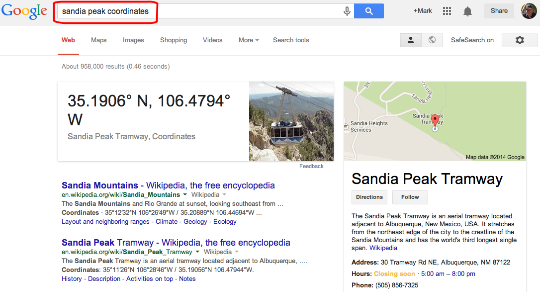
Here is a demonstration for the location Sandia Peak (the search would be Sandia Peak coordinates).
The search results:
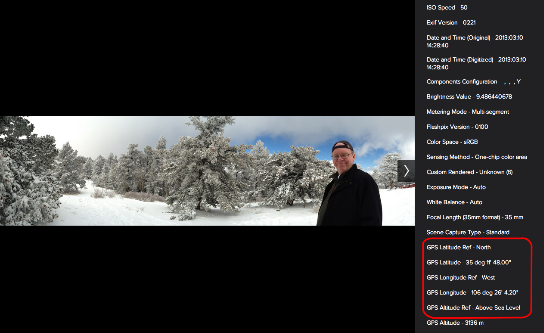
Here is a photo at the top of the peak captured with my phone (the exif data are provided). The data are difficult to read, but are very similar.
I see this is a post production tool useful in some situations for “mapping” digital camera photos.
Apple does not have a great reputation for cloud services, but it keeps trying. I discovered by accident today that Apple now offers browser-based apps for Numbers, Keynote, and Pages. Work that you have done on your iPad or your desktop can now also be modified using a web browser. I guess this is interesting, but it took me a while to see what advantages the web version might offer. Perhaps you do not want to pay for the desktop apps, but want to continue work you have started on your iPad (since the desktop apps cost $20 and the iOS versions are free this might be one use case). I do still like working on the desktop for bigger projects and the cross device capabilities with the iPad may be helpful.
The web version allows collaboration in real time. I admit I have never collaborated in real time when this was possible (Google), but it does sound interesting.
Google, Apple and Microsoft now have slight different versions of the same cross device / web model. Competition is good.
One of my motives in moving from a commercial textbook company to writing through Amazon was the desire to write on a continuous basis. My frustration with the commercial approach was that you ignored your work for three years and then worked feverishly for 3-5 months in order to generate the next edition. I saw there were two problems in this approach. First, hard copy textbooks are out of date when first published (at least when addressing technology) and it made sense to me to take an approach that would allow me to continue to offer new content (online) as soon as the content was relevant. Second, the hectic pace of meeting a deadline does not allow for the best analysis and writing. This was particularly the case for me as my academic job means I have the most open time in the summer and this was not the time frame during which the work had to be done. The commercial folks never disagreed with my analysis, they just did not want to pay any amount for a future edition and would not offer an advance.
You may or may not understand how textbooks are financed. After the first edition for which you should be able to secure an advance on sales, the company decides whether or not a future edition will be offered and does not offer an advance. Since you, as the author, do not own the copyright but share it with the company, you are not free to suggest that a different company might be more willing to support the authoring model you propose.
Anyway, we have now exclusively held our copyright for several years and I have been offering resources based on this approach. We have a web site offering “supplemental” content to our book since it was released and I plan to rework the core book based on this content this summer. Since, the release of the latest edition the topic of “computational thinking” (programming or coding to many) has kind of returned to favor among practicing educators. You may be aware of this trend or perhaps interest in the “maker movement” which often incorporates programming skills. I have prepared a chapter and supplemental resources for our the next revision of our book. Rather than wait until this summer to make the “chapter” available, I am offering the draft of this chapter on our web site. This content will be available from the site until the revision of the book is complete. If you are interested in computational thinking and would like to review my take on the topic, access to our web site is available at no cost.
The Google Doc adds-on offer some new capabilities and a great way of expanding the power of apps in general.
I am putting together content that will eventually be divided between a textbook and related online resources. My work flow results in one giant integrated file and I eventually decide what I will end up putting where.
In the image that appears above, you see the Table of Contents as a second window to the right of the open doc. The one technique I had to add to my normal approach is to identify my headings as headings (I usually just bold my headings). If you are familiar with HTML headings, you are ready to go.
I spent time driving by myself yesterday and enjoy the time to listen to podcasts and think. The audio consisted of a serious of education interviews with app/tool developers and authors. I guess these folks are now described as edupreneurs. All talked about the need to generate at least enough funds to sustain their visions. The discussions of business models got me thinking about what different folks think should be free and what is worth a payment.
The division that seems obvious to me is content vs. platform. As a writer (not an edupreneur at this point – I am employed), it seems the platform people assume the content people should donate their work. No doubt, platforms in the education sector or those available for any group require a considerable outlay of time and resources to create. However, without participants to offer content, the platforms serve no purpose. Of course, the opposite situation occurs for those hoping to make revenue from content. Getting material to consumers is far easier than was the case 10 years ago and to offer content requires a platform.
There are some barriers to what should be a collaborative effort. Some platforms do not allow ads and encourage “repurposing” as a form of authoring. I object to systems that strip ads or use content (with overlays or not) without serving from the original source. I understand the financial limitations of education as an educator, but the solution is not to take the work of others using lack of funds as a personal or public excuse. I also object to personal use of means to avoid ads. Paying for content is a way to avoid ads and avoiding ads through other means is selfish. Perhaps this is just me.
A recent article from Time presented several myths about online activity. I found the second myth of greatest interest.
The second myth is exposed by data that cross references social activity by the read time devoted to a primary information source. The data are expressed as a graph with hits organized in a 2 x 2 format. So you have articles with high and low read times by articles with high and low social activity. If one assumes that greater read time indicates greater personal interest, it is surprising that low interest articles generate the most social activity. Hence, you cannot assume that those suggestions you receive as tweets resulted from a thorough review by the tweeter. Perhaps the title alone was enough to encourage sharing.
Why? Not sure, but these data seem similar to a paper we just discussed in my grad class. The paper concerned a number of effective study techniques and then noted that college students seem not likely to use these techniques even though the strategies require no more time. One commonality of the methods is that they generated more errors and were likely perceived as more difficult. Perhaps, individuals are satisfied with a passive approach that offers the impression of doing something productive.
I wonder if a similar explanation fits here. Are many tweets that reference resources a way of feeling or offering the impression to others that something meaningful has been accomplished? I propose that tweets associated with blog entries are a better approach. Blog posts typically offer more personal commentary and I would think require a little more information from a primary source. If you cannot summarize what about a source was interesting or valuable, you likely did not get much from the resource yourself. Why offer the source to others?
Getty is a stock image provider. Typically, you pay for use of the images. Getty is now offering images to bloggers and web page authors at no cost – 35 million images are available.
It is important to understand the implications of image embeds. When you embed an image (see below), you are serving the image from the provider and not from the server you use to offer your blog or web page. The Getty approach does not offer you possession of the image.
What could be a limitation of this approach. I guess it depends on how paranoid you care to be. I heard one podcaster contend that the terms of service allow Getty to change its mind. For example, it could decide to terminate the service or possible monetize the service with ads. You can see that Getty identifies that it is the source of the image (see below). If you blog, the image would eventually disappear from your front page and might change without your awareness. I must say this would not concern me – few of those who visit my site use the search feature to locate old posts. Even if they did, what would be the harm in seeing an ad?


You must be logged in to post a comment.