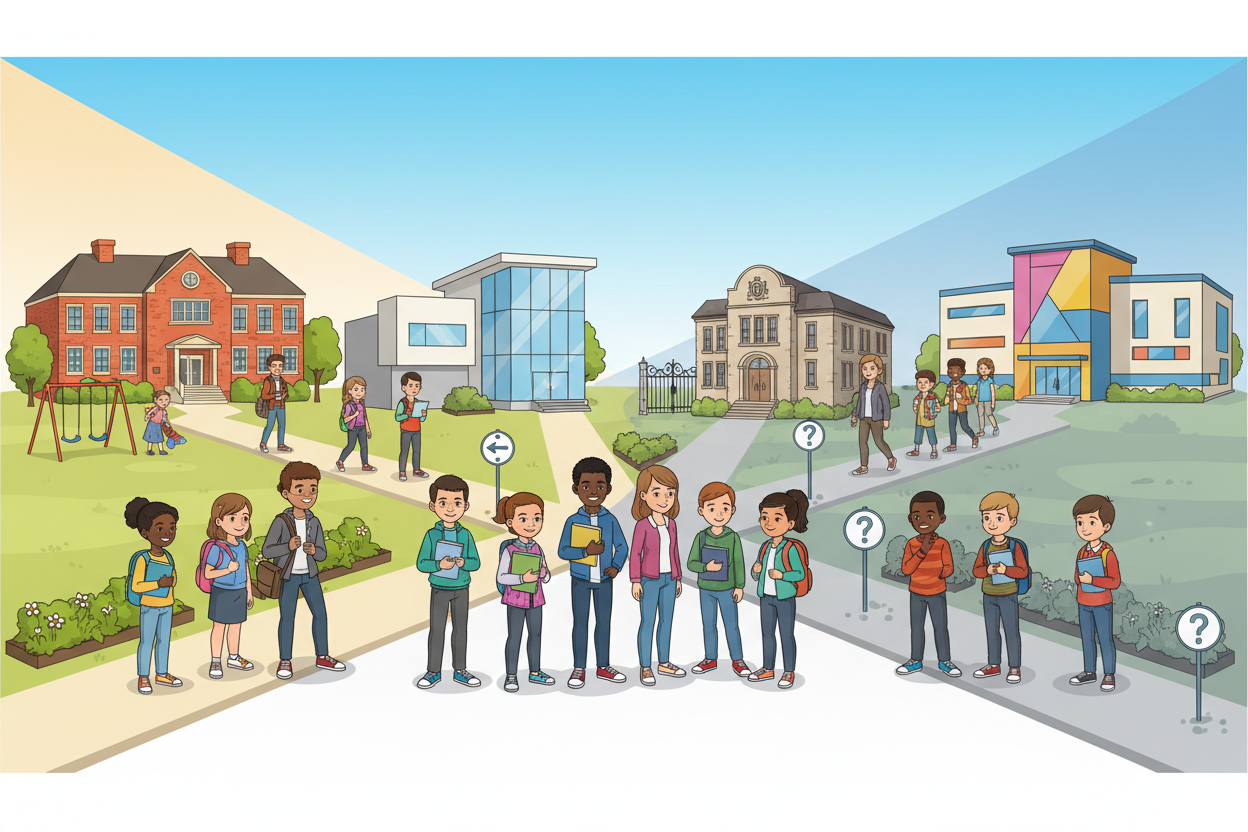
The education of learners in the K-12 range is undergoing a noticeable shift as the concept of “school choice” has become a political wedge issue, and state-level legislative policy decisions have given parents and their kids greater control over where and under what conditions students are educated. While often framed from a perspective of the individual family, I have always felt this perspective is too narrow and decisions made for the benefit of one benefit also impact the experiences of others. In various ways, we are all stakeholders, whether it be as citizens living in a society dependent on an educated population, financial contributors as state and local taxpayers, and students and their families involved in school experiences.
While I have followed the issue of school choice for years, this post was prompted by a recent EdWeek article – As School Choice Goes Universal, What New Research Is Showing. Before I comment on the article, here is some background on K12 School Choice.
School choice is the opportunity for parents to enroll their child in an elementary or secondary school other than the assigned school based on their home address. There are multiple variations. The optional school may be another public school in a different district or a public magnet or charter school. Funding for charter schools, which typically operate with a separate board from the public school district, may be public or private. Private schools can be further differentiated as parochial (religious emphasis) or independent.
My personal interest is mainly in the impact of tax-based funding as I see funding as a nearly zero-sum variable – schools compete for a fixed pot of money dependent on student enrollment. Private schools rely on tuition paid by families, contributions, and, increasingly, tax money collected and then distributed to the school in which the student is enrolled. When school choice sends tax money to a private school the approach may be as a voucher or a family-controlled educational savings account (ESA). A voucher might be thought of as the cut of tax money a school receives from the state – per pupil expenditure, but by my understanding typically not the local tax based on property taxes. An ESA provides funds parents can use for several forms of educational assistance – tutoring, textbooks, and private school tuition (source – Overview of Public and Private School Choice Options).
According to the EdWeek source I identified previously, 18 states now allow all students to use state funds to attend private schools, approximately 1.5 million students in the 30 states that allow at least some students access to similar programs. An example of the type of situation that accounts for the difference might be an allowance for students attending what are considered low-performing to use such resources.
My interest has been in the academic achievement of both students who leave their designated public school and a more nuanced issue of what happens to public schools when a sizeable number of students and the funds associated with these students leave. Despite all of the research on such topics, the EdWeek analysis notes that only one of the 18 states identified as providing all students access to state funds made use of the same standardized achievement test in both public and private schools. Obviously, having large numbers of participants from both public and private institutions taking the same tests would offer the cleanest and most powerful comparison of academic impact.
Proposed advantages and disadvantages of each approach to K12 education
At present, the political winds seem to be blowing toward greater parental choice. This is the case despite the lack of consistent findings on whether such choice is of greater benefit to student achievement. Depending on the sample of students used and the method used to quantify achievement, studies generate every possible outcome. The EdWeek attempt at a summary concludes that “Preliminary studies on earlier iterations of these programs have shown “neutral to negative” effects on state test scores, though some programs, like Ohio’s EdChoice, have demonstrated positive outcomes regarding graduation and college-going rates.”
What follows is my attempt to summarize the advantages and disadvantages based on two books by Diane Ravitch that I have read. Dr. Ravitch is a defender of public education as you can probably tell from the titles of her books, but pros and cons are more about the arguments and not the data. Ravitch’s work is heavily focused on research findings, but as I have already indicated, the subissues are so complex that it is very difficult to offer general conclusions. The issue that interests me – what happens to the public schools when students leave (the final con described below under the cons of Private schools) has not, to my knowledge, been a focus as an appropriate methodology would be very difficult to put together.
Pros of Public Schools:
- Universal Service and Stability: Public schools are charged with serving all children, providing not just education but also essential social services like nutritious meals, medical care, and mental health counseling.
- Accountability and Transparency: Public schools operate under strict state regulations and testing mandates, ensuring a level of transparency regarding student progress and the use of taxpayer funds that can be absent in the private sector.
- Professionalism: Public schools generally require higher standards for teacher certification and may provide due process (tenure) to protect academic freedom.
Cons of Public Schools:
- Impact of Poverty and Segregation: The biggest “con” of the public system is often beyond its direct control. Concentrated poverty and racial segregation significantly drive lower academic performance, and schools alone cannot solve these structural societal issues.
- Curriculum Narrowing: Due to high-stakes testing mandates, public schools may reduce time for the arts, history, and physical education to focus more on tested subjects like math and reading.
- Bureaucracy and Funding Disparities: Public schools are often burdened by intrusive regulations and suffer from persistent underfunding, particularly in districts with low property tax bases.
Pros of Private Schools:
- Autonomy and Flexibility: Private schools enjoy the freedom to design their own curricula and select their own testing methods, allowing them to cater to specific educational philosophies or religious values.
- Personalization and Choice: Families can select schools that align with their specific needs or interests, whether through small religious schools or specialized academies. This “market-driven” approach appeals to values of freedom and optimism.
Cons of Private Schools:
- Lack of Oversight: some private schools receiving public funds are not accredited and are exempt from state accountability systems. This makes it difficult for the public to evaluate if tax dollars are producing academic results.
- Selective Enrollment: Unlike public schools, private institutions can be selective. Critics argue this leads to greater segregation and less equity, as schools may shun students with the highest needs or those who are the “toughest challenge” to teach.
- Draining Public Resources: Every dollar diverted to a private school voucher is a dollar removed from the public school system, which still incurs fixed costs such as building maintenance and teacher salaries. This can lead to increased class sizes and program cuts in the remaining public schools.
Summary
Parents and their kids are being allowed greater control over where they attend school. School choice comes with multiple pros and cons, and these issues have been difficult to evaluate because public and private schools in most states are not required to use the same achievement tests. My personal interest is in what happens to the public schools that lose students to private schools when choice is allowed.
Sources for Pro and Con Section
Ravitch, D. (2014). Reign of error: The hoax of the privatization movement and the danger to America’s public schools. Vintage.
Ravitch, D. (2020). Slaying Goliath: The passionate resistance to privatization and the fight to save America’s public schools. Vintage.
