The concept of generative activities has consistently shaped my thinking and teaching on learning. I admit that such activities are not ultimately necessary. Still, they represent ways for learners and those who try to help them grow to understand and imagine how skills and knowledge might be applied. Focusing on generative activities was particularly useful in my interest in studying – the work an individual does to make experiences personally informative and useful.
Basic Definitions:
Studying – the mental and external activities a learner engages in after exposure to potentially useful experiences that are intended to store a representation of these and create meaning.
Generative activities – external tasks intended to encourage productive cognitive (mental) behaviors
Why is this perspective important at this time? My concern is that certain uses of AI are frequently being substituted for generative activities allowing individuals to accomplish tasks without achieving the cognitive benefits (i.e., retention, understanding) engagement with the generative tasks make more likely.
Why would learners substitute AI for generative activities? It seems likely they see AI as producing an equal or even superior product without the effort required to create such products on their own. This reflects both a focus on short-term benefits over long-term benefits and probably a lack of understanding of how personal knowledge and skills are developed, or perhaps even a disinterest in developing these personal attributes.
Some background:
When I explain the concept of generative activities I like to start with Rothkopf’s concept of a mathemagenic task because this researcher’s focus tends to make intuitive sense to most people. Rothkopf was interested in questions and variations in how questions might be associated with written material.
Questions presented before you read.
Questions presented after you read.
Inserted questions – questions added within text.
Different types of questions – application questions, factual questions.
Mathemagenic tasks
The made-up word mathemagenic translates roughly as giving birth to knowledge, implying that in attempting to answer questions, you might accomplish something else – a better likelihood of future retention, greater likelihood that you would recognize possible applications – that would not have occurred without exposure to the questions. My favorite example relates to the challenge educators often face in encouraging students to see the relevance of general concepts they have been taught. This translates as connecting new ideas with what you already know. The examples and the relevance are potentially there if you can make connections. So, what not ask students directly – provide an example of XXX? If personal examples exist, but learners have not made the effort to make the connections, perhaps the request will encourage that specific cognitive effort.
There is a huge body of research on all aspects of questioning. Questions are an everyday classroom activity, but the insight is just why do we spend the time, and could a more careful use of questions result in improved results? My favorite example here is what is called wait time – the average delay after asking a question (silence to allow thinking) is a little over a second. If we want students to think, typical behavior in classroom discussions is not particularly rationale. There is reason to examine and challenge typical behavior.
Anyway, questions are an external task that can be used to manipulate – change the odds of – productive cognitive behaviors. I suggest adding one important final point: a learner can ask herself questions, e.g., using flashcards. So various ways in which questions can be generated and used are an aspect of what those interested in study behavior investigate.
Generative Tasks
The concept of generative activities is simply an expansion of this same idea and asking questions would be one of many generative strategies. The idea of generative activities is not new (Wittrock, 1974, 2010) and to many educators may seem obvious and a reflection of common classroom practices. While true, researchers have attempted to understand the underlying mechanisms and to consider just how efficient different activities were especially in the comparison of one to others ( Fiorella & Mayer, 2016). A personal interest and one clearly relevant to the topic of how AI is applied in classrooms is writing to learn. I have always felt through self awareness that requires careful examination of existing ideas and integration of ideas from a variety of experiences to produce a product. There is a substantial body of research to support such perceptions (e.g., Graham et al., 2020). To be clear, researchers consider a variety of writing activities under the umbrella of writing to learn. The product need not be a massive, semester summarizing paper, but perhaps also notes and short, five-minute end of class descriptions related to the content just presented.
Caveat
One issue I think is important that may not be apparent in the notions that generative activities are intended to encourage productive cognitive skills is that such skills may occur without this external requirement and guidance and there is always the possibility that for some motivated and capable of thinking deeply, without such tasks, the task represents a form of “busy work”. In other words, the task adds little beyond annoyance. Of course, the reality is that educators in actual classrooms typically do not feel that they can arbitrarily assign tasks to some students and not others, so they must always deal with reactions to assignments, both legitimate and resulting from laziness.
AI and Generative Tasks
AI discussions related to education always seem to generate a good news / bad news situation. There seem to be several examples that apply to this general topic.
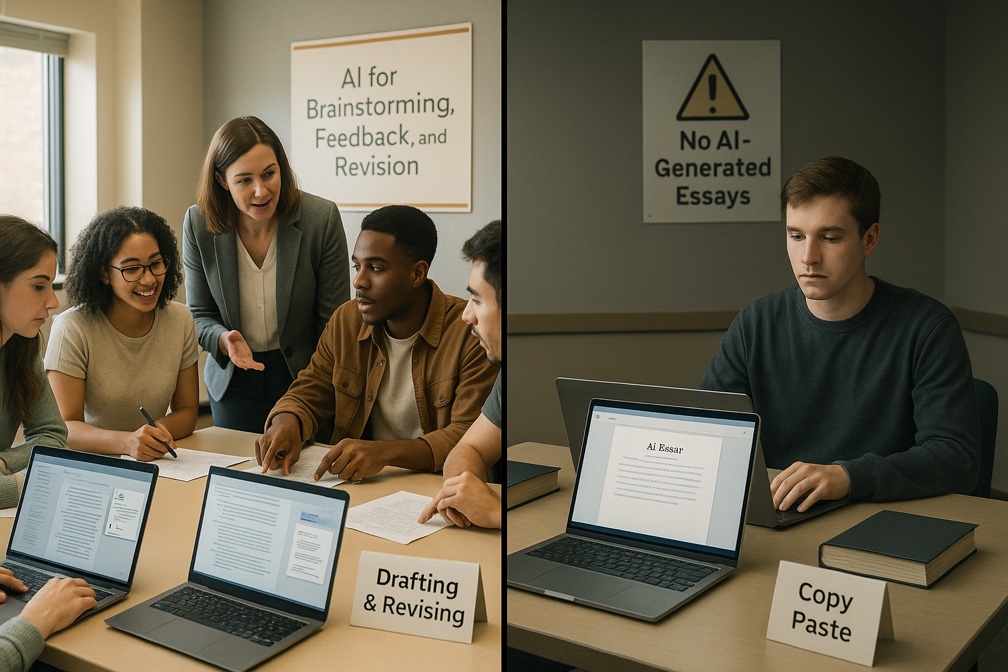
AI can be applied to render the potential benefits of a generative strategy useless. For example, if AI is used to respond wholly to a writing-to-learn assignment, the learner completes the assignment without engaging in much cognitive work. The educator is then in a position of assigning a task that takes valuable learning time and adds a commitment to the effort to provide feedback, but has little impact.
In contrast, AI can be used to formulate questions (both objective and open-ended) related to assigned material and to respond to a learner’s responses to such questions. Learners can even generate such activities on their own. It seems to me that the use of what might be described as short essay questions offer a unique advantage that would be difficult or at least very time consuming for the educator to administer. AI tools are very flexible and can ask and react to the answers for different types of questions. Short answer questions are a form of writing to learn and involve greater “retrieval practice” benefits than formats such as multiple choice that are useful, but less demanding of retrieval.
Summary
My effort here was intended as a way educations might frame their way of thinking about AI in classrooms using examples I assume are familiar. I hope this approach can be generalized. Of course, the challenge is in manipulating AI-based and any assigned activities so that productive thinking activities are encouraged and also that students gain insight into the importance of the mental work that is required of certain task. I understand this may seem obvious, but the work of adjusting to the advantages and disadvantages of AI tools will take some time and careful study. For example, I wonder if writing and organizing notes may accomplish much the same benefits as creating a writing to learn product. Learning to write is somewhat different than writing to learn although writing across the curriculum offers a secondary benefit of practicing writing skills. There are plenty of options to consider. We presently do little to teach advanced note making skills and note using skills even though these topics have received a great deal of attention as benefits to out of school functioning.
Citations
Fiorella, L., & Mayer, R. E. (2016). Eight ways to promote generative learning. Educational Psychology Review, 28(4), 717-741.
Graham, S., Kiuhara, S. A., & MacKay, M. (2020). The effects of writing on learning in science, social studies, and mathematics: A meta-analysis. Review of Educational Research, 90(2), 179-226.
Rothkopf, E. Z. (1970). The concept of mathemagenic activities. Review of educational research. 40(3), 325-336.
Wittrock, M. C. (1974). Learning as a generative process . Educational Psychologist, 11(2), 87–95. https://doi.org/10.1080/00461527409529129
Wittrock, M. C. (2010). Learning as a generative process. Educational Psychologist, 45(1), 40-45.
