In K-12 education, writing often takes a backseat to other academic priorities. Elementary education is dominated by math and reading, while secondary education spreads its focus across a wide range of subjects. Unfortunately, this distribution of attention has left the development of writing proficiency hindered by several factors.
Limited Time for Writing Practice
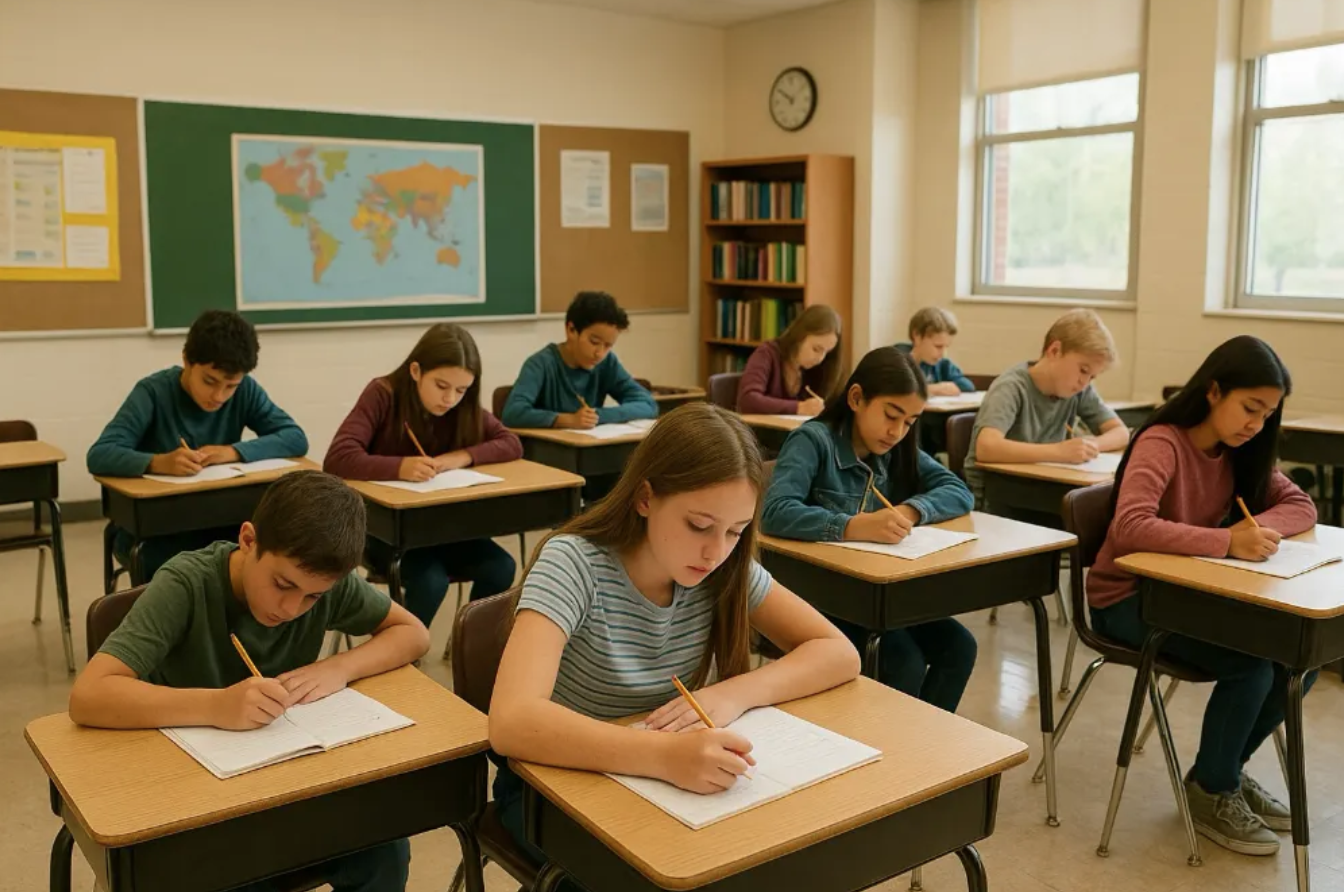
One significant issue is the limited time students spend on writing activities, both in and out of the classroom. Research shows that only about 25% of middle school students and 30% of high school students meet the recommended minimum of 30 minutes of daily writing practice. Writing assignments at these levels are often brief, typically a paragraph or a short essay, with few opportunities for more complex projects that require synthesizing ideas from multiple sources.
While initiatives like “writing across the curriculum” aim to increase writing opportunities and integrate writing into other subjects, many teachers outside of language arts lack the training to effectively incorporate writing into their instruction (Picou, 2020). This lack of preparation, combined with time constraints, contributes to disparities in writing proficiency, as reflected in differences in NAEP scores across schools (Mo & Troia, 2017).
The Broader Benefits of Writing
Writing is not just a skill—it is a multifaceted process that integrates numerous subskills and offers significant cognitive and academic benefits. However, these benefits are only fully realized when students receive meaningful feedback on their work. Unlike other disciplines, evaluating written work is particularly time-intensive for educators, which may discourage frequent and substantive writing assignments.
Beyond skill development, writing also serves as a powerful tool for learning. Often referred to as “writing to learn,” this process involves cognitive demands that enhance understanding and retention (previous post). Writing tasks act as generative activities, externalizing thought processes and encouraging deeper engagement with the material. For example, when students are asked to provide personal examples of a concept, they connect prior knowledge to new ideas, fostering meaningful learning.
Two types of writing tasks stand out in their educational value: writing to explain and writing to persuade.
Writing to Explain This task requires students to learn something and then articulate their understanding through writing. The act of externalizing knowledge serves as a form of self-assessment, revealing gaps in understanding and prompting further learning. This process, often linked to metacognition, helps students refine their knowledge as they work to organize and express their ideas. As educational psychologist Graham and colleagues (2020) note, writing to learn has consistently been shown to enhance academic outcomes.
Writing to Persuade Persuasive writing involves crafting a position, supporting it with evidence, and addressing counterarguments. Despite its importance in developing critical thinking and reasoning skills, persuasive writing accounts for only about 20% of writing-to-learn tasks. This is a missed opportunity, as persuasive writing offers concentrated practice in analysis and argumentation, much like debate, but in a more efficient format for classroom use.
The Impact of AI on Writing Development
While writing is already underutilized in education, the rise of AI tools presents a new challenge. Educators are grappling with how to integrate AI productively without further reducing the time students spend writing. If AI tools are used to complete writing tasks for students, the generative benefits of writing—such as critical thinking and cognitive engagement—may be lost.
As someone who uses AI tools daily, I recognize their potential to enhance productivity and creativity. However, I also understand the risks. For example, I use AI to interact with a personal corpus of notes, allowing me to explore ideas before writing. This approach complements my writing process rather than replacing it. Students, however, may lack the motivation or understanding to use AI in similarly constructive ways. Under time pressure, they may rely on AI to bypass the cognitive effort required for writing, undermining the development of essential skills.
Addressing the Challenges
One strategy that I think would address both writing challenges would require an increase in supervised classroom writing. Such tasks could be improved with collaborative writing activities that included peer editing and revision. The peer responsibilities would include attention to both writing quality and content accuracy when the task is a writing across the curriculum task.
Moving Forward
The challenges facing educators are undeniably complex, and the rise of AI adds another layer of difficulty. However, ignoring these realities will not improve the situation. Writing remains a critical skill, both as a standalone competency and as a tool for learning across disciplines. By increasing classroom writing opportunities and leveraging collaborative approaches, educators can help students develop the skills they need to succeed in an AI-driven world.
I welcome your thoughts on this analysis and any ideas you might have for addressing the interconnected issues of writing development, AI integration, and educational priorities.
Sources
Graham, S., Kiuhara, S. A., & MacKay, M. (2020). The effects of writing on learning in science, social studies, and mathematics: A meta-analysis. Review of Educational Research, 90(2), 179-226.
Mo, Y., & Troia, G. A. (2017). Predicting students’ writing performance on the NAEP from student- and state-level variables. Reading and Writing, 30(4), 739–770.
Picou, A. (2020). Are schools making writing a priority? New study shows students are not spending enough time. The Learning Agency Lab
Everyone needs to be aware of confirmation bias. This cognitive tendency is responsible for our focusing more on those ideas and facts that support our existing way of understanding the world. It applies to what information we select when given a choice and to the information that “sticks” when perceived. When I try to explain the second issue, I often describe what we already know as a model or perhaps an outline and new information that fits with this model or outline is easier to store and recall. This characteristic of human information processing is described as a bias because it argues that we find information that does not fit our existing way of seeing the world as less likely to influence us. We might argue we are open minded, but we still must work to identify and process challenges to existing ways of thinking.
Technology has long been argued to work in ways that support confirmation bias. Back in the early days of online search, there was a concern for what was called a filter bubble. This was the notion that search engines tracked our preferences and would bias hits appearing early in the list of possible sources based on our past choices as we responded to search results. Did we select results from the top of the response list or not? I read about this “problem” and struggled to find a way to test it. After reading accounts of the problem, I decided I could use my own online history as a test. I spent a lot of time searching and reading about technology and had made use of Apple equipment for years. It occurred to me that the word Apple was ambiguous — it could mean a computer company or a fruit. I reasoned that if I searched anonymously and when using a browser aware of my identity and searched for “apple” I should get different hits at the top of the search results. The results were fairly inconclusive and always favored computers. I may have been wrong about anonymous searchers, or perhaps just the notion that more people would want to know about apple the fruit.
AI and Confirmation Bias
I have tried to identify ways in which AI prompts might generated personally biased responses and started with some searches. The first warning I discovered argued that the prompts themselves could be an unrecognized problem. Psychology Today reported that Confirmation Bias could already exist at the stage of writing a prompt, so of course, the response from the AI tool would attempt to provide the information requested.
A recent announcement from ChatGPT led me to explore a different possibility. The new capability involved the opportunity to turn history on and off. I am still not certain of the intent of this control, but it got me thinking about the filter bubble issue I had tried to investigate in the early 2010s.
Before trying my original internet history strategy, I thought I would just ask ChatGPT about potential bias. If you just read the following, you may not note what I did, but it was clear that the AI tool knew quite a bit about me and used this information in responding.
Here is the reply to my prompt:
Great question, Mark.
When history is turned on, ChatGPT uses your prior conversations and context across sessions to tailor responses more personally. When history is off, each prompt is treated in isolation, with no memory of past conversations or preferences. Here’s how that difference plays out:
? With History ON
Personalization: ChatGPT may remember your preferences (e.g., your interest in educational psychology, your writing style, your teaching context) and adapt replies accordingly.
Continuity: It can refer to earlier parts of a conversation or even previous sessions if memory is active (e.g., remembering that you’re revising a specific slide deck).
Efficiency: You don’t have to reintroduce background details repeatedly; the system can “pick up where you left off.”
Persistent memory (if enabled): You can allow ChatGPT to remember things long-term, like your goals or recurring projects.
? With History OFF
No personalization: ChatGPT won’t recall your identity, preferences, or past queries.
Each prompt is standalone: Even within a single session, it treats each message without prior context unless you include it explicitly.
Privacy-first: The content of your chats won’t be stored or used to improve models.
More generic answers: Responses will tend to be more neutral or general-purpose since there’s no way to reference or build on prior knowledge.
? Same Prompt, Different Responses
Let’s say you prompt:
“Give me three ways to explain working memory to pre-service teachers.”
With history on, ChatGPT might recall that you’re preparing a university-level course for future educators and tailor examples accordingly (perhaps referencing your slide deck or prior discussions of models like Baddeley & Hitch).
With history off, it might assume a general audience and provide broader educational examples (e.g., working memory in classroom tasks like copying from the board or doing mental arithmetic).
Aside from the information itself, note several indicators it was tailoring the response to me. It identified my vocation as an educational psychologist. It used examples that would be helpful to someone who wanted to understand a general topic based on their background. So, it used educational examples.
Back to the “Apple” test.
I wanted to generate my own test of biased feedback and tried a version of the approach I had tried with search results. I tried to think of a topic I approach in a unique way and that might bias an AI response based on my personal history.
I am interested in the use of digital technology that seems different from more popular representation. For example, should class notes be taken by hand or on a laptop? Should people read from paper or a tablet screen? I think I can make a case for a digital approach because it is easier to store and utilize by-products of experiences over extended period of time. So digital notes and highlights can be exported and retained in ways that are easier to search, interrelate, update, etc.. Yet, this is not position taken in public sources offering advice to students, teachers, and decision makers.
My history of prompting AI to offer content are biased by my way of viewing such issues. For example, I might use the following prompts:
I am interested in comparing note-taking by hand and on a digital device. What are the advantages of digital notes when those notes are intended for use over an extended period of time
I am interested in comparing note-taking by hand and on a digital device. What are the advantages of digital notes when the goal is to discover connections among ideas recorded on different systems
Now for my test. What if I create a more neutral prompt and submit this prompt with my history turned on and off?
Summarize the research comparing note-taking by hand and on a laptop. What should a college instructor recommend?
With memory on
Research comparing handwritten and laptop notetaking focuses on how each method affects learning outcomes such as comprehension, retention, and conceptual understanding. Below is a summary of the key findings and instructional implications.
Key Research Findings
1. Encoding vs. External Storage
Notetaking supports learning through encoding (processing while writing) and external storage (referring back to notes).
The method of note-taking influences encoding quality more than external storage.
2. Handwriting Promotes Deeper Processing
Mueller & Oppenheimer (2014): Students taking notes by hand performed better on conceptual questions than those using laptops.
Explanation: Typing leads to verbatim transcription, while handwriting encourages summarizing and processing.
Follow-up studies confirmed that handwritten notes promote deeper understanding, especially for material requiring synthesis or inference.
3. Laptop Notetaking and Verbatim Transcription
Laptop users tend to transcribe lectures verbatim, which is a shallower form of processing.
Even when told to avoid verbatim notes, laptop users often struggle to summarize effectively.
4. Distraction and Multitasking
Laptops introduce distractions: Web browsing, messaging, and multitasking impair learning for both the note-taker and nearby students.
Sana, Weston, & Cepeda (2013): Nearby students also performed worse when seated near multitasking laptop users.
5. Volume vs. Depth
Laptops allow more content to be recorded, but more content doesn’t always equal better learning.
Handwritten notes tend to be shorter, more selective, and encourage rephrasing, which benefits comprehension.
6. Review and Revision
Laptop notes are easier to organize, search, and revise, which can aid long-term study.
Handwritten notes may encourage memory consolidation, especially when rewritten or summarized later.
Recommendations for College Instructors
1. Promote Purposeful Notetaking
Encourage students to summarize and paraphrase regardless of method.
Teach effective notetaking strategies such as the Cornell method or concept mapping.
2. Consider a Handwriting Default
Suggest handwriting for lectures emphasizing conceptual understanding or discussion.
Provide explicit rationale (e.g., “This will help you understand and remember better”).
3. Allow Laptops with Conditions
If laptops are allowed, encourage use of apps that limit distractions.
Consider designating laptop zones to reduce spillover distraction.
4. Support Note Review
Promote post-lecture activities: reviewing notes, rewriting, or using notes to answer practice questions.
Share outlines or slides to reduce pressure to capture everything.
5. Adapt to Context
For highly detailed or technical lectures (e.g., coding or statistics), typing may be more efficient.
Consider hybrid approaches (e.g., typed notes with handwritten annotations).
Final Takeaway
Recommendation: Encourage handwritten note-taking when feasible, especially for classes involving complex reasoning or discussion. If laptops are used, guide to avoid verbatim transcription and minimize distractions. Whatever the method, emphasize that note-taking is a learning activity — not just a record-keeping task.
Would you like citations or slides to support this summary in a teaching context?
— — — — — —
With memory off
Summarize the research comparing note-taking by hand and on a laptop. What should a college instructor recommend?
Sure! Here’s a concise summary of the research comparing hand note-taking and laptop note-taking, plus a recommendation for college instructors:
Research Summary:
Handwritten notes tend to enhance learning and retention better than typing notes on laptops.
Writing by hand encourages processing and summarizing information, leading to deeper understanding.
Laptop note-taking often leads to verbatim transcription, which can reduce comprehension and critical thinking.
Some studies find that laptop users are more easily distracted by unrelated activities (social media, browsing).
However, laptops allow for faster note-taking and easier organization or review, which can benefit some students, especially those with certain disabilities or faster speaking lectures.
Recommendation for College Instructors:
Encourage students to take handwritten notes, especially for conceptual understanding and long-term retention.
If laptops are allowed, instructors should coach students to avoid verbatim typing and focus on summarizing.
Consider a hybrid approach: use laptops for occasional digital resources, but emphasize active listening and synthesis in notes.
For accessibility, allow laptop use when needed but promote best practices to maximize learning.
Would you like me to draft a brief instructor note or syllabus statement based on this?
Comparison Summary
You can examine these two responses and reach your own conclusions. My interpretation is very possibly biased by my effort to demonstrate an impact of history. My analysis follows.
Without access to personal history, the prompt response is significantly shorter. This was predicted when I asked ChatGPT directly about what to expect with history on and off.
I would say the response with personal history on still favors nondigital notes, but there is more recognition of differences and some concessions to situations in which digital content may provide an advantage.
So what?
I think it possible to argue both approaches demonstrate a type of bias. Perhaps there is value in understanding this and recognizing that the individual prompting the AI must still be sensitive to personal bias. Simple prompts may also elicit simple responses, and more sophisticated issues end up being ignored.
I have been exploring and writing about AI now since the release of ChatGPT. I think about AI both as a user and as an educator and believe I have enough experience and a perspective from which to offer an overview. The tools have improved to a level at which I find them quite valuable as a research and writing assistant. My main approach is to use a tool that allows me to interact with my own digital notes collected over maybe a decade to assist in many of my writing projects. I count myself among those who advocate for the professional value of AI.
My thoughts on AI in education are more complex and it is this perspective I will try to share here. Let me start with what I think is an essential assumption and that is students will find ways to use AI. Whatever the perspective of individual educators is, I argue it is necessary to begin accepting this assumption. Trying to think across many different content areas and skills, it seems reasonable to stipulate that there are certain skills that must be practiced directly to develop (e.g., writing, reasoning, problem solving) and elements of information that may not be life changing whether retained in an individual’s memory or not, but that the general benefit of existing knowledge which is about stored information and the connections that exist within this information offer advantages in understanding and reasoning. Any given fact can certainly now be searched when needed, but this option does not account for the general benefits of what I would describe as general knowledge. We accumulate general knowledge by interacting with our world, but the purposeful accumulation of important information is more efficient through the process we commonly call education. Let me add one more assumption to this position statement. We cannot learn for others nor can we make them learn. We can at best provide access to information and provide external tasks that have the potential to influence the processes of learning. Ultimate responsibility must be placed on individual learners and this is often a requirement at a time when individual learners lack the background and perhaps cannot make decisions understanding how learning works and how skills and knowledge may influence their futures.
Here is my thinking about AI. Educators have a limited amount of time during which they can directly influence learners. They must depend on the cooperation of learners and perhaps their parents when attempting to influence learning during other times. I would describe this reality as important in making decisions about how this time of maximum influence will be spent. For example, I write a lot about study behavior. Educators and sometimes do use class time for studying. When they make this commitment, they are also reducing the time available for other experiences – presentation of information, experiences such as science labs, peer interactions such as guided discussions and debate. Some reactions to AI suggest that class time be used to some extent to control the use of AI. For example, writing a theme during class rather than at home or study hall or completing math problems during class rather than as homework. If the limitation of AI is determined to be significant enough, this can be done, but this will then replace other activities.
So, I believe that the development of some skills and a general knowledge base cannot be eliminated because of AI and this development can only be guaranteed during the time during which an entire class would have to be prevented from using AI. To be clear, I am not advocating for this option. I am trying to identify the benefits and costs of options which I believe cannot be individualized; e.g., educators cannot really differentiate what is required of different individuals in a classroom situation.
Much of what we are playing with involves decisions about when to attempt to exert control over personal goals and motivations. I was a university prof and there is a common approach at this level that differentiates the requirements for a major from general education requirements. We don’t allow students to decide if they want to develop basic writing skills because we require a couple of semesters of composition. We expect a basic level of function in mathematics, but allow individuals to make decisions as to whether the basic course will be what amounts to a high school level course in algebra or the Introduction to The Calculus.
How strongly do we as educators believe we should ignore personal goals and motivation? This is a question for us and for other stakeholders in the educational process. We certainly cannot control learners, but we can arrange evaluation processes to recognize when some mandatory proficiency has not been achieved. Politicians and the general public already tend to blame educators when basic proficiencies do not match those existing in other countries or when graduates seem unprepared for vocations or for civic responsibilities. What consequences do those who are critical suggest for educators or what are they willing to tolerate for the learners who are ultimately responsible?
When I write about this topic it becomes clear to me that the issues I address are very complex and perhaps that is a useful message for others who have simplistic positions on the process of education or the issues educators face. I am a big fan of research informing practice. One challenge with the type of issues described here is that most involve cumulative effects over an extended period of time. Longitudinal studies may eventually provide useful insights, but the downsides could impact an entire generation before the research makes this outcome clear.
Is a summary possible?
I am willing to say that AI offers great benefits to supplement human actions. We all should be prepared to take advantage and guided experience in developing AI-related knowledge and skills should now be a component of what we teach.
Reliance on AI in place of tasks that develop skills is detrimental. You cannot learn to write if AI replaces your attempts to write. You cannot develop critical thinking or reasoning skills if you do not struggle with tasks that require these skills. The issue then is whether the skills are important to the individual and when is the optimal time to make this decision. Perhaps even this is too narrow of a perspective. What are the commitments each of us owes to each other when it comes to basic knowledge and skills?
If forced to take a position, I would suggest that individuals be required to learn and be able to develop knowledge and skills AI-unaided and be able to demonstrate they can apply AI in ways appropriate to the tasks they presently must accomplish. The notion of tool or augmentation seems useful here and it would seem curriculum developers could differentiate cognitive skills from tool proficiency accordingly.
Note: I find that as I write about this topic I encounter the complexities that I think are important to consider. I certainly welcome comments that address these complexities and possibly provide me when ideas I can address in response.
Manage Consent
To provide the best experiences, we use technologies like cookies to store and/or access device information. Consenting to these technologies will allow us to process data such as browsing behavior or unique IDs on this site. Not consenting or withdrawing consent, may adversely affect certain features and functions.
Functional
Always active
The technical storage or access is strictly necessary for the legitimate purpose of enabling the use of a specific service explicitly requested by the subscriber or user, or for the sole purpose of carrying out the transmission of a communication over an electronic communications network.
Preferences
The technical storage or access is necessary for the legitimate purpose of storing preferences that are not requested by the subscriber or user.
Statistics
The technical storage or access that is used exclusively for statistical purposes.The technical storage or access that is used exclusively for anonymous statistical purposes. Without a subpoena, voluntary compliance on the part of your Internet Service Provider, or additional records from a third party, information stored or retrieved for this purpose alone cannot usually be used to identify you.
Marketing
The technical storage or access is required to create user profiles to send advertising, or to track the user on a website or across several websites for similar marketing purposes.


You must be logged in to post a comment.