Tactics - Podcast (Continued)
Introduction
One of the core themes of this site is that each of us can learn and discover a great deal in creating multimedia resources for others. I find that I continually have this revelation as I create content for you. Still, this perspective is probably best appreciated through personal experience and my job is to get you to have such experiences yourself so you will be willing to engage students in this process.
I have separated the content of this page from the main discussion because the message here is personal and embedded in a personal context. This is a personal story about my formative years, my father, and the place I came from. I do not have much in the way of images to offer you. Some of the images I would like to share are gone, and that, in part, is one of the thoughts I would like you take away from the section.
I have long been a Ken Burns fan. I own his "jazz" documentary series on DVD and watch the programs repeatedly. If you have not viewed Ken Burns work, he combines narration, music and a combination of still images and video to produce informative and engrossing documentaries. You may be familiar with the "Ken Burns" effect used in some of the Apple Computer software products (and probably in other software as well). This is a video effect created by zooming and panning using a still image as input.
The latest Burn's documentary, ''The War'', examines the WWII from the perspective of 4 communities and has been playing on PBS during the fall of 2007. (Burns and PBS offer some great resources related to the program - one component of this site offers resources for educators) The Burn's documentaries and recent books by Tom Brokaw (Boom! Voices of the sixties; The greatest generation speaks) brought back recollections of my father, created an awareness of the potential for documentaries in the history of our own families, and prompted my inclusion of this section.
My own brief story: This Old House
My father was stationed in the south pacific during the war as a radar operator. He sometimes described his duties as searching for Japanese fighters "coming down the slot". The only war story I can remember him telling was his one brush with combat - evidently a submarine surfaced to lob a few shells at their camp. He did not make it sound too scary. That was about it for comments on WWII.
When I was a kid, I found an old radio in the attic that could search the ham radio frequencies. I strung a wire from my bedroom window to a nearby tree to serve as an antenna. Dad knew Morse code from his military days and he would sit in the bedroom with me and decode the coded messages I would find. I was not particularly interested in the voice conversations among the hams, but the conservations in code intrigued me. I remember dad always printed in capital letters when he did this and this was not the way he normally wrote.
A big personal regret I have had in the last few years was that when I was an adolescent I ruined a large collection of photographic negatives my dad had brought back from the war. I became aware of the lost potential of these negatives when Cindy was working on her Teaching American History grant and the Burns material reminded me again.
My dad was an amateur photographer and also a bit of an entrepreneur. He had a 620 camera and took black and white pictures. A 620 negative is large - about 2.5 x 4.5 if I remember correctly. The advantage of the large size to my father while in the service and to me later was that prints could be created without an enlarger using three chemical solutions (developer, stop, fixer). The processing was called contact printing. You put the negative and a piece of contact print paper between two pieces of glass something like a sandwich and then turned on the light for a few seconds. I forget exactly how long we exposed the print, but I do remember we counted rather than used a fancy timer - thousand and one, thousand and two, thousand and three, etc. The print was then developed.
Dad took pictures with a "Kodak box camera" and sold small collections to his buddies so they could send pictures home. I found a shoe box full of these negatives in the attic when I was an adolescent. My dad helped me take and develop pictures and I also printed some of his pictures from the war. I was not particularly careful and he did not place a lot of personal value on the negatives. Over time the collection was damaged and somehow disappeared. What a resource the collection would be now!
My point is that I at one time had access to what might have become a valuable collection of primary source material - hundreds of image capturing the daily life of a small group of men serving on a small island in the South Pacific. I had access to someone who lived these pictures and might have been willing to offer me comments that I might have written down. I could have preserved this bit of history for my family and for anyone else with an interest in the "great generation".
I have one picture to offer. The following is a picture of my boyhood home the day it was bulldozed. You can't live on small Iowa farms anymore. We left to become college professors and engineers. The farmstead fell into disrepair and we had a problem with someone who set up a meth lab in the deserted location. At some point it become unreasonable to pay taxes on buildings that were no longer functional or repairable. The location is now just a flat spot with a few trees in a corn field. You can kind of see the attic where I used to explore and located the box of negatives and the radio. The left-most window on the second floor was the location the wire antenna entered my room and where we sat to decode the messages sent by the ham operators.
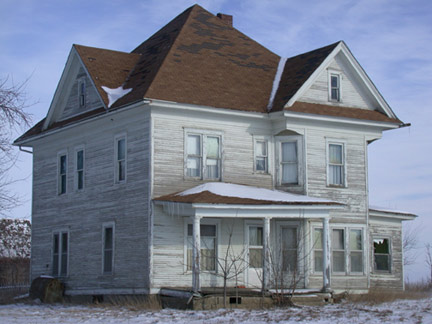
If I had a few more pictures, I might have turned these memories into a podcast. What I have is one picture and a few hundred words. At least these memories have been shared. You can probably tell that this is about far more than an academic exercise to me. This about authentic activities I think anyone can make a commitment to and the possibility that others may benefit as a by-product.
Resources
Brokaw, T. (2007). Boom! Voices of the sixties. New York: Random House.
Brokaw, T. (2001). The greatest generation speaks. New York: Random House